
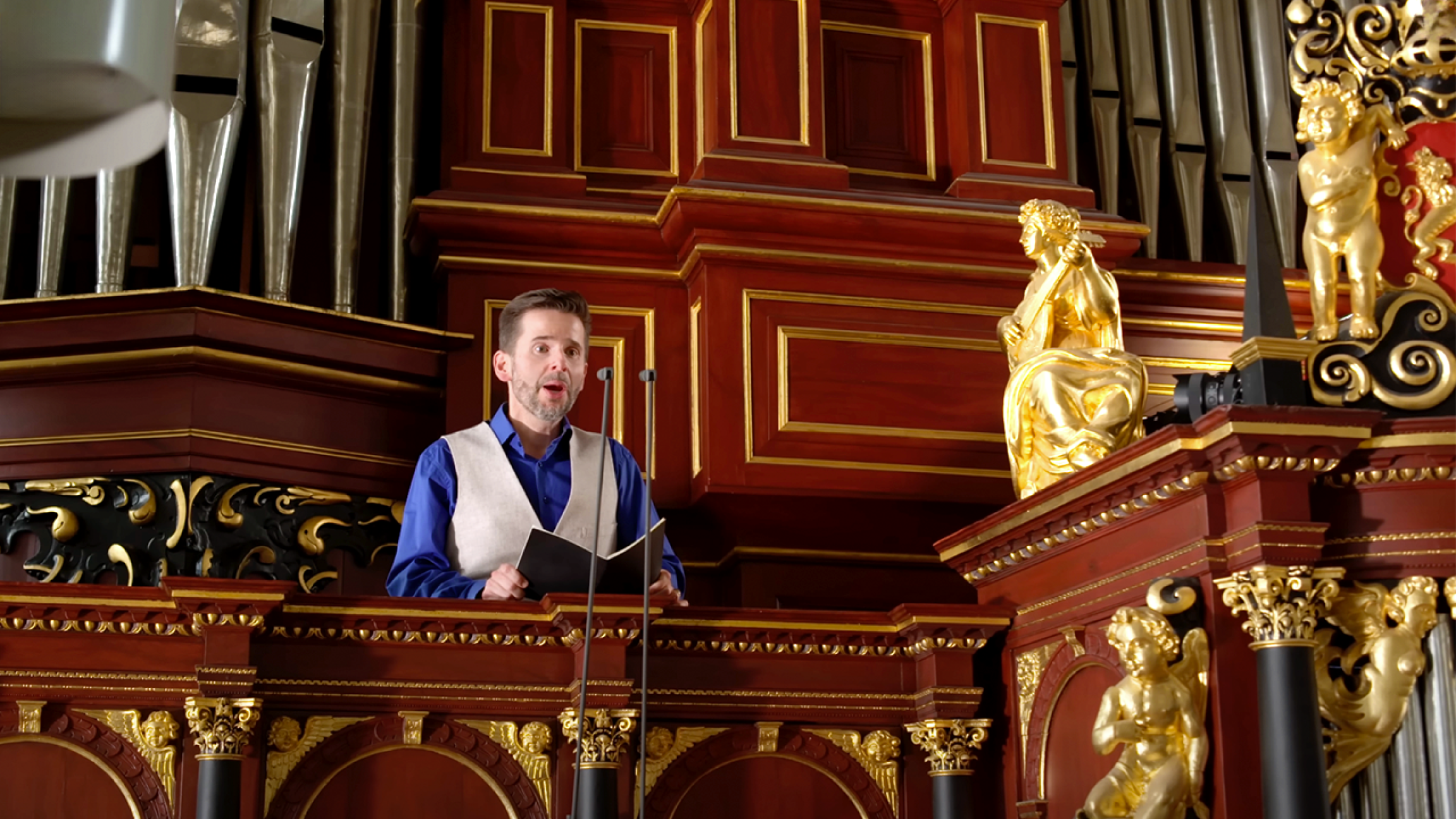
Gib dich zufrieden und sei stille
BWV 512 performed by Daniel Johannsen and Matthias Havinga
Walburgiskerk, Zutphen
Behind the music
Story
Story
Texts
Texts
Credits
Credits
Now be contented
Bach probably wrote this hymn as a source of private solace
Lutherans have no saints in the sense or function of the Roman Catholic Church. If nonetheless asked to single out unique heralds of faith and piety through the centuries, Paul Gerhardt would definitely be among them. Next to Martin Luther, no other religious poet has to this day remained as prominent in Protestant hymnals (and even in Catholic ones). If only because of the gem Befiehl du deine Wege.
Gib dich zufrieden may not be Gerhardt’s most famous hymn, yet all fifteen original verses from 1666 are still included in the current German Evangelisches Gesangbuch, to the melody by his contemporary Jakob Hintze. Bach used a modified version of this tune for BWV 460, but the text – clearly very dear to him – probably also inspired the master to compose his own melody of grave and solemn beauty, which he entered into the (second) Notenbüchlein für Anna Magdalena Bach.
Bach seems to have drawn particular solace from this strongly encouraging poem in his Hausandacht (his personal devotion). He may have considered it less suitable for liturgical use, since he never incorporated any of its verses into his cantatas. By 1725, when this melody seems to have been composed, Bach had already lost three children. Knowing that Gerhardt also had to bury four of his five children must have created a strong bond between the eighteenth-century choirmaster and the seventeenth-century pastor – a comforting connection across time and place.
The Notenbüchlein für Anna Magdalena Bach
Shortly after their arrival in Leipzig in 1723, Johann Sebastian and Anna Magdalena Bach revealed themselves as a cultural power couple. Although Anna Magdalena gave up her successful public singing career, she joined her husband in running a thriving music business, alongside looking after a large and growing family. We have at least two tangible traces of their married life in the form of two Notenbüchlein from 1722 and 1725.
Whereas the first Notenbüchlein was still a sort of notebook, containing things like early versions of five ‘French Suites’ (and who knows what else, as two-thirds of the pages are missing), the second one was definitely intended as a gift from Johann Sebastian to his wife. In fair copy, he notated two Partitas and all sorts of other music of Anna Magdalena’s own choosing, such as the aria from the Goldberg Variations and the song Dir, dir Jehova, as well as music by composers like Couperin and Anna Magdalena’s stepson Carl Philipp Emanuel. Together, the Notenbüchlein form a colourful mix of arias, chorales and suites.
Extra videos
Vocal texts
Original
1.
Gib dich zufrieden und sei stille
in dem Gotte deines Lebens,
in ihm ruht aller Freuden Fülle,
ohn ihn mühst du dich vergebens;
er ist dein Quell
und deine Sonne,
scheint täglich hell
zu deiner Wonne.
Gib dich zufrieden.
5.
Er hört die Seufzer deiner Seelen
und des Herzens stille Klagen,
und was du keinem darfst erzählen,
magst du Gott gar kühnlich sagen;
er ist nicht fern,
steht in der Mitten,
hört bald und gern
der Armen Bitten.
Gib dich zufrieden.
9.
Sprich nicht: Ich sehe keine Mittel,
wo ich such, ist nichts zum besten,
denn das ist Gottes Ehrentitel,
helfen, wenn* die Not am größten.
Wann ich und du
ihn nicht mehr spüren,
so schickt er zu,
uns wohl zu führen
Gib dich zufrieden.
14.
Es ist ein Ruhetag verhanden,
da uns unser Gott wird lösen,
er wird uns reißen aus den Banden
dieses Leibs und allem Bösen.
Es wird einmal
der Tod herspringen
und aus der Qual
uns sämtlich bringen
Gib dich zufrieden
Translation
1.
Now be contented and seek stillness
in God, who daily renews us.
In him we find our joy in fullness;
without him, all plans are useless.
He is your spring
and sun that’s shining,
daily he brings joy
to your living.
So be contented.
5.
He hears the soul when it is moaning
He hears the heart’s own silent cries,
and all the things you dare tell no-one
you can show boldly to God’s eyes;
He is not far,
He stands here, ready,
Is keen to hear
our prayers so needy.
So be contented.
9.
Don’t say: “I see no path to wander,
all ways I search seem misleading,”
for this is just where God is honored
to help in times of great needing.
When you and I
no longer sense him,
that’s just when he
best redirects us.
So be contented.
14.
A day of rest has been won for us,
God to us will be revealing,
for he will free us from all burdens
of this life and all its evils.
Once and for all
Death shall be conquered
and from all ills
bring us safe homeward.
So be contented.
translation © Ruth van Baak Griffioen, 2025
Credits
-
- Release date
- 25 September 2025
-
- Recording date
- 29 May 2024
-
- Location
- Walburgiskerk, Zutphen
-
- Tenor
- Daniel Johannsen
-
- Organ
- Matthias Havinga
-
- Instrument
- Henrick Bader, 1639/1643
-
- Director and editor
- Gijs Besseling
-
- Music recording
- Guido Tichelman, Pim van der Lee
-
- Music edit and mix
- Guido Tichelman
-
- Camera
- Danny Noordanus, Manon Hoskens, Remco van Leest
-
- Grip
- Wouter Visser
-
- Assistant music recording
- Marloes Biermans
-
- Producer
- Lisanne Marlou de Kok

Help us to complete All of Bach
There are still many recordings to be made before the whole of Bach’s oeuvre is online. And we can’t complete the task without the financial support of our patrons. Please help us to complete the musical heritage of Bach, by supporting us with a donation!