
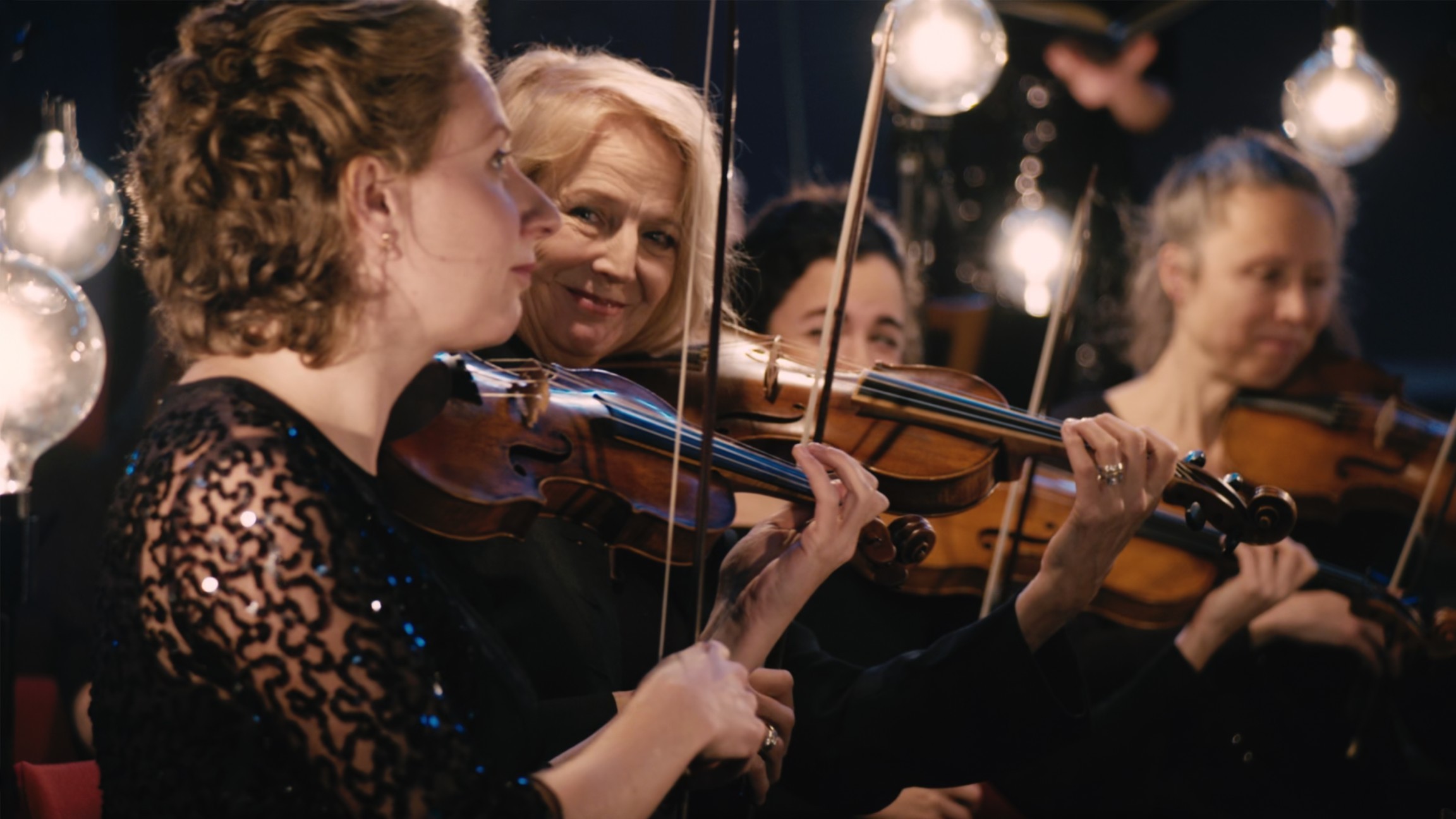
Ehre sei dir, Gott, gesungen from Christmas Oratorio
BWV 248/5 performed by the Netherlands Bach Society
conducted by Lars Ulrik Mortensen
Heuvellaan Hilversum, Hilversum
Behind the music
Story
Story
Extra videos
Extra videos
Texts
Texts
Credits
Credits
Illuminated by bright sunlight
The fifth cantata of the Christmas Oratorio brings summer to January
The fifth cantata of the Christmas Oratorio bears the closest resemblance to an ‘ordinary’ cantata: the instrumentation is modest – no trumpets, timpani, horns or even flutes. Maybe that is due to the liturgical ‘position’ of the cantata. Bach wrote the piece for the first Sunday after New Year; a day that came in between the bigger feasts of Jesus’s circumcision and Epiphany. And maybe on dramaturgical grounds, Bach also opted for a relatively simple form for this cantata, thus creating maximum contrast with the finale of the Christmas Oratorio on the feast of Epiphany.
The opening chorus is so sunny that it almost seems to be summertime – light, dancy and smooth, like gymnastics for the chorus. Yet Bach incorporates a detailed fugue into it, following which the tenor takes the floor. He keeps returning throughout the cantata to tell the story of the three wise men from the Orient and Herod, the king of Judea, whose reactions to Christ’s birth are diametrically opposed.
The three wise men saw Jesus’s star and immediately set off to pay tribute to Jesus. They arrived excitedly in Jerusalem and asked Herod, ‘where is the newborn King of the Jews?’ The narrative is interrupted by the alto, who answers on behalf of the faithful: Jesus is in your heart. Then the chorus enters again, representing the three wise men and singing, ‘We have seen his star in the East and are come to worship him’. Filled with passion, the alto sings of the happiness of the three wise men, because they may personally behold Jesus’s light, both literally and figuratively. The message is then generalised in a chorale: ‘Lead us in your ways, so that we...may see your glorious light forever!’
The light of Jesus’s coming is once again the subject of an aria for bass, with oboe d’amore. Bach adapted this aria from a secular soprano aria he wrote for the occasion of a visit from the Elector of Saxony, Augustus III. The new setting for a low voice fits with the new text, and the ‘sombre thoughts’ are clearly audible in the dark timbre of the bass.
The tenor begins his narration again: Herod is horrified when he hears of the birth of Jesus – surely he, as the ruler of Judea, is the only king of the Jews? He cannot afford a competitor. The alto returns with a pious recitative: how can such a joyful message horrify anybody? The tenor finishes his story. Herod calls together all the high priests, who must tell him where he can find Jesus. They cite a prophecy, which Bach underlines with a running bass: Bethlehem, because that is where the scriptures say the Messiah will be born.
The sequel to this, which Bach does not set to music, is the most gruesome passage in the Christmas story – Herod has all the newborn boys in Bethlehem slaughtered. The congregation would, however, have filled in this part of the story for themselves. In the trio that follows, an interesting dialogue takes place between the soprano and tenor, who wonder when Jesus will return to earth – while the alto knows that he is already here. The alto recapitulates everything in a concise, triumphant recitative. Jesus will live forever in the faithful heart of the believer. The cantata closes with a chorale: as soon as the rays of God’s mercy shine, so also will the ‘dark pit’ of mankind’s heart be filled with sunlight.
Extra videos
Vocal texts
Original
1. Chor
Ehre sei dir, Gott, gesungen,
Dir sei Lob und Dank bereit.
Dich erhebet alle Welt,
Weil dir unser Wohl gefällt,
Weil anheut
Unser aller Wunsch gelungen,
Weil uns dein Segen
so herrlich erfreut.
2. Rezitativ (Tenor)
Da Jesus geboren war zu Bethlehem
im jüdischen Lande zur Zeit des Königes Herodis,
siehe, da kamen die Weisen
vom Morgenlande gen Jerusalem und sprachen
3. Chor, Rezitativ (Alt)
Wo ist der neugeborne König der Jüden?
Sucht ihn in meiner Brust,
hier wohnt er, mir und ihm zur Lust!
Wir haben seinen Stern gesehen im Morgenlande
und sind kommen, ihn anzubeten.
Wohl euch,
die ihr dies Licht gesehen,
es ist zu eurem Heil
geschehen!
Mein Heiland, du, du bist das Licht,
das auch den Heiden scheinen sollen,
und sie, sie kennen dich noch nicht,
als sie dich schon
verehren wollen.
Wie hell, wie klar
muß nicht dein Schein,
geliebter Jesu, sein!
4. Choral
Dein Glanz all Finsternis verzehrt,
die trübe Nacht in Licht verkehrt.
Leit uns auf deinen Wegen,
daß dein Gesicht
und herrlichs Licht
wir ewig schauen mögen!
5. Aria (Bass)
Erleucht auch meine finstre Sinnen,
erleuchte mein Herze
durch der Strahlen klaren Schein!
Dein Wort soll mir die hellste Kerze
in allen meinen Werken sein;
dies lässet die Seele nichts Böses beginnen.
6. Rezitativ (Tenor)
Da das der König Herodes hörte,
erschrak er
und mit ihm
das ganze Jerusalem.
7. Rezitativ (Alt)
Warum wollt ihr erschrecken?
Kann meines Jesu Gegenwart
euch solche Furcht erwecken?
O! solltet ihr euch nicht
vielmehr darüber freuen,
weil er dadurch verspricht,
der Menschen Wohlfahrt zu verneuen.
8. Rezitativ (Tenor)
Und ließ versammlen alle Hohepriester
und Schriftgelehrten unter dem Volk
und erforschete von ihnen,
wo Christus sollte geboren werden.
Und sie sagten ihm:
Zu Bethlehem im jüdischen Lande;
denn also stehet geschrieben durch den Propheten:
Und du Bethlehem
im jüdischen Lande,
bist mitnichten die kleinest
unter den Fürsten Juda;
denn aus dir soll mir kommen der Herzog,
der über mein Volk Israel ein Herr sei.
9. Aria / Terzet (Sopran, Alt, Tenor)
(S/T) Ach, wenn wird
die Zeit erscheinen?
(T/S) Ach, wenn kömmt der Trost
der Seinen?
(A) Schweigt, er ist schon würklich hier!
(S/T) Jesu, ach so komm zu mir!
10. Rezitativ (Alt)
Mein Liebster
herrschet schon.
Ein Herz,
das seine Herrschaft liebet
und sich ihm ganz zu eigen gibet,
ist meines Jesu Thron.
11. Choral
Zwar ist solche Herzensstube
wohl kein schöner Fürstensaal,
sondern eine finstre Grube;
doch, sobald dein Gnadenstrahl
in denselben nur wird blinken,
wird es voller Sonnen dünken.
Translation
1. Chorus
May honor, God, be sung unto you,
May laud and thanks be given to you.
All the world exalts you,
Because our well-being pleases you,
Because this day
The wish of us all has come true,
Because your blessing [of salvation]
gladdens us so gloriously.
2. Recitative (tenor)
When Jesus was born at Bethlehem
in the Jewish region at the time of King Herod,
look, then the wisemen from the Orient
came to Jerusalem, declaring:
3. Chorus, Recitative (Alt)
Where is the newborn King of the Jews?
Seek him in my breast;
He dwells here, to my and his delight!
We have seen his star in the Orient, and are come to worship him.
Well for you, you [foreigners]
who have seen this light;
It is [also] for your salvation
[that this light has] come about!
You, my savior, you are the light
That shall shine also to the gentiles,
And they [the gentiles], they do not know you yet,
[At a time] when they [nevertheless]
already want to revere you.
How bright, [then,] how clear
must not your luminosity be,
Beloved Jesus!
4. Choral
Your radiance consumes all darkness,
Turns the murky night into light.
Lead us along your pathways,
That we may behold your visage
And glorious light
Eternally.
5. Aria (bass)
Light up, too, my dark inclinations,
Light up my heart
By the clear luminosity of [your] streams [of light]!
Your word shall be the brightest candle to me
In all my [good] works;
This will not let the soul embark upon anything evil.
6. Recitative (tenor)
When Herod the King heard this
[that a king of the Jews was portended],
he was alarmed,
and with him the whole [population of] Jerusalem.
7. Recitative (alto)
Why would you [Herod and Jerusalem] be alarmed?
Can the presence of my Jesus
Arouse such fear in you?
Oh! Should you not,
To the contrary, be glad about that,
Because he promises [with his presence] thereby
To renew the welfare of humankind.
8. Recitative (tenor)
And [Herod] had all the chief priests
and scholars of scripture [from] among the people
gather and inquired of them,
where Christ was expected to be born.
And they told him:
“At Bethlehem in the Jewish region;
for so it is written by the prophet,
‘[Thus declares the Lord:] And you Bethlehem
in the Jewish region
are by no means the least significant [city]
among the princes of Judah;
for out of you shall come unto me the leader who
would be a [divine] lord over my people Israel.’”
9. Aria / trio (soprano, alto, tenor)
(S/T) Ah, when will the time
[of the kingdom of God] appear?
(T/S) Ah, when is [God’s messiah,] the consolation of
Those who [shall] belong to him, coming?
(A) Be silent!—he is actually already here!
(S/T) Jesus, ah, then come to me.
10. Recitative (alto)
My most beloved already
[in infancy] rules [as messiah].
A heart [of mine]
that loves his [the messiah’s] dominion,
And wholly gives itself to him to possess,
Is the throne of my Jesus.
11. Chorale
True, such a heart’s chamber is
Certainly no beautiful princely hall,
[But] rather a dark [sin-filled] pit;
Yet, [Jesus,] as soon as your stream of grace
Will merely flicker within this same [heart],
It [the heart] will seem full of sun.
transl. © Daniel R. Melamed and Michael Marissen
For the annotated version of the text and translation, see here.
Credits
-
- Release date
- 25 December 2025
-
- Recording date
- 3 January 2025
-
- Location
- Heuvellaan Hilversum, Hilversum
-
- Organ and direction
- Lars Ulrik Mortensen
-
- Soprano
- Carine Tinney
-
- Alto
- Alex Potter
-
- Tenor
- Daniel Johannsen
-
- Bass
- Tomáš Král
-
- Ripieno soprano
- Marta Paklar, Amelia Berridge
-
- Ripieno alto
- Michaela Riener, Sofia Gvirts
-
- Ripieno tenor
- João Moreira, Adriaan de Koster
-
- Ripieno bass
- Matthew Baker, Donald Bentvelsen
-
- Violin 1
- Cecilia Bernardini, Annelies van der Vegt, Ivan Iliev
-
- Violin 2
- Lucia Giraudo, Anneke van Haaften, Kirsti Apajalahti
-
- Viola
- Femke Huizinga, Ivan Jorge Saez Schwartz
-
- Cello
- Ira Givol, Luka Stefanovic
-
- Double bass
- Robert Franenberg
-
- Oboe & oboe d'amore
- Rodrigo López Paz
-
- Oboe
- Katharina Verhaar
-
- Bassoon
- Benny Aghassi
-
- Harpsichord
- Siebe Henstra
-
- Director and editor
- Onno van Ameijde
-
- Music recording
- Guido Tichelman, Lilita Dunska, Pim van der Lee
-
- Music edit and mix
- Guido Tichelman
-
- Camera
- Rieks Soepenberg, Jorne Tielemans, Jasper Verkaart, Caroline Nutbey, Merijn Stojansek
-
- Lights
- Ernst-Jan Thieme, Martijn Schoeber, Jordi Kooij, Patrick Galvin
-
- Assistant director
- Marieke Donker Kaat
-
- Data handling
- Stefan Ebels
-
- Assistant music recording
- Marloes Biermans
-
- Documentary
- Marloes Biermans, Gijs Besseling
-
- Producer concert
- Stephan Esmeijer
-
- Producer film
- Lisanne Marlou de Kok
Christmas Oratorio
The Christmas Oratorio is one of Bach’s most famous works. It consists of six cantatas, covering all the days from Christmas Day to the Feast of the Epiphany on 6 January.
-
Jauchzet, frohlocket! from Christmas Oratorio
cantatas, BWV 248/1
-
Und es waren Hirten from Christmas Oratorio
cantatas, BWV 248/2
-
Herrscher des Himmels from Christmas Oratorio
cantatas, BWV 248/3
-
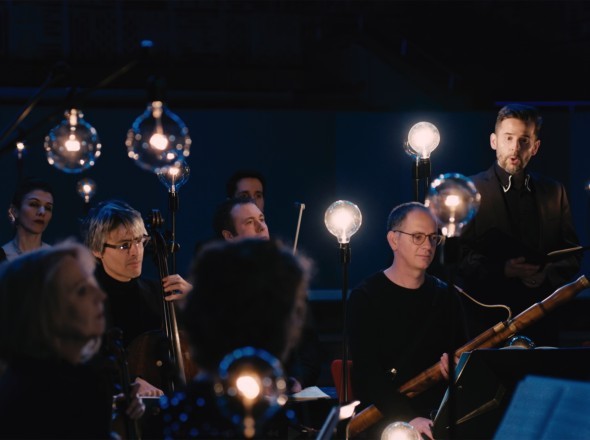
Fallt mit Danken, fallt mit Loben from Christmas Oratorio
cantatas, BWV 248/4
-
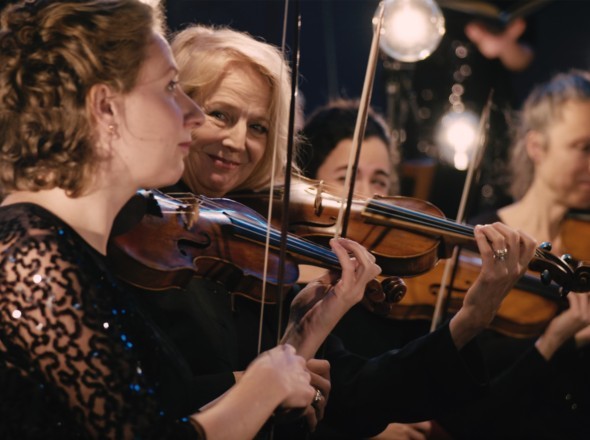
Ehre sei dir, Gott, gesungen from Christmas Oratorio
cantatas, BWV 248/5

Help us to complete All of Bach
There are still many recordings to be made before the whole of Bach’s oeuvre is online. And we can’t complete the task without the financial support of our patrons. Please help us to complete the musical heritage of Bach, by supporting us with a donation!