
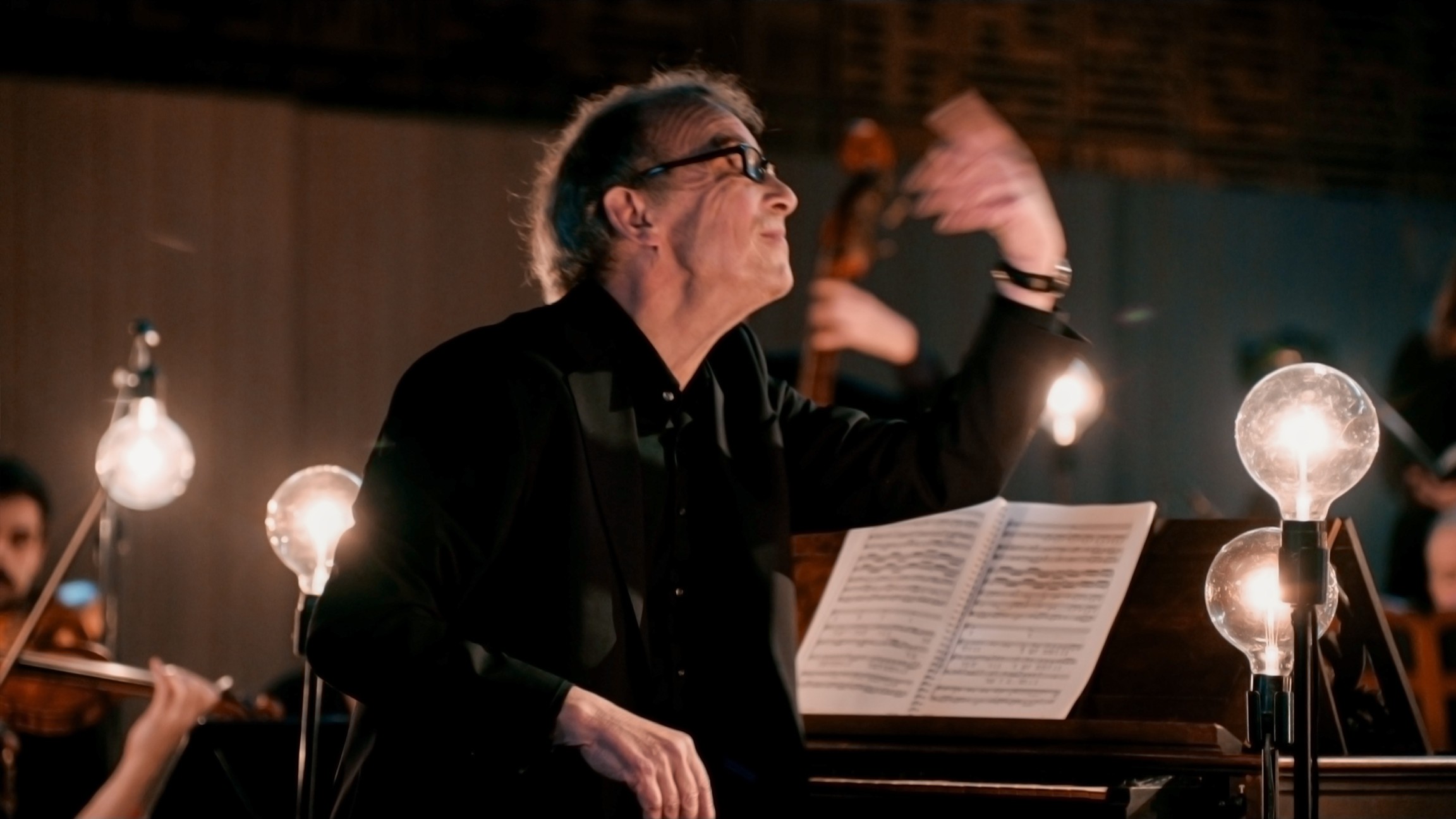
Wie schön leuchtet der Morgenstern
BWV 1 performed by the Netherlands Bach Society
conducted by Lars Ulrik Mortensen
Heuvellaan Hilversum, Hilversum
Behind the music
Story
Story
Extra videos
Extra videos
Texts
Texts
Credits
Credits
The resonance of sweet ‘Musika’
A radiant light in the quiet days of Lent
Whereas the calendar date of Easter changes with the lunar cycle, the date of Christmas is fixed. So it is logical that Annunciation Day, when the angel Gabriel announced the birth of Jesus, is precisely nine months earlier. However, this date sometimes falls right in the middle of Lent, forming a strangely festive clash with that period of penitence. And that is how, in 1725, Bach came to write the cantata Wie schön leuchtet der Morgenstern in honour of Annunciation Day for 25 March 1725, which also happened to be Palm Sunday.
In 1725, Bach’s second year in Leipzig, he completed his annual cycle of chorale cantatas: cantatas based on existing chorale melodies and texts. He often quoted these texts literally in the opening and closing choruses of a cantata, as here in BWV 1, where they are taken from a well-known hymn by Philipp Nicolai from 1599. For their part, the arias and recitatives are more of a paraphrase of the chorale poetry of Nicolai – sometimes expressly in line with the reading of the day, in this case from the gospel of St Luke. In this way, Bach’s anonymous lyricist still manages to turn a feast day for Mary into one for Jesus, suited to the day of Jesus’s entry into Jerusalem.
In Bach’s atmospheric opening chorus, the ‘bright morning star’, as Christ referred to himself in Revelations 22:16, is lent extra radiance by two solo violins in a swaying 12/8 time. The instrumentation is anyhow colourful, with two horns and two oboes da caccia. In her aria, the soprano is accompanied by one of these dark oboes, in order to express the divine flames. The violin duo returns when the tenor sings about the power of music; a reference to the ‘süße Musika’ that has a ‘freudenreich’ resonance, according to verse 6 of Nicolai’s chorale. Finally, listen out for the second horn, which shines out in the final chorale with a virtuoso countermelody.
And why was the number BWV 1 assigned to this particular cantata? The explanation goes further than mere coincidence, but has a practical element as well. From 1950, Wolfgang Schmieder numbered the Bach works that were known at the time, adopting the already established order in the Bach-Gesellschaft Ausgabe (1851-1900). Wie schön leuchtet der Morgenstern was the first work in that publication because, according to musicologist Ulrich Leisinger, a hundred years after Bach’s death the cantata was regarded as an exceptionally representative work, with respect to both music and text, and was thus a fitting opener for Bach’s monumental oeuvre.
With support from
Rev Nancy and Dr William Raabe
Extra videos
Daniel Johannsen on singing recitatives
"The recitativo is about storytelling. The main principle of the recitativo is to deliver the words once, in contrast to the da capo aria."
Vocal texts
Original
1. Chor
Wie schön leuchtet der Morgenstern
voll Gnad und Wahrheit von dem Herrn,
die süße Wurzel Jesse!
Du Sohn David aus Jakobs Stamm,
mein König und mein Bräutigam,
hast mir mein Herz besessen,
lieblich, freundlich,
schön und herrlich, groß und ehrlich,
reich von Gaben,
hoch und sehr prächtig erhaben.
2. Rezitativ (Tenor)
Du wahrer Gottes und Marien Sohn,
du König derer Auserwählten,
wie süß ist uns
dies Lebenswort,
nach dem die ersten Väter schon
so Jahr' als Tage zählten,
das Gabriel
mit Freuden dort
in Bethlehem verheißen;
o Süßigkeit,
o Himmelbrot,
das weder Grab,
Gefahr noch Tod
aus unserm Herzen reißen.
3. Arie (Sopran)
Erfüllet, ihr himmlischen göttlichen Flammen,
die nach euch verlangende gläubige Brust!
Die Seelen empfinden die kräftigsten Triebe
der brünstigsten Liebe
und schmecken auf Erden die himmlische Lust.
4. Rezitativ (Bass)
Ein irdscher Glanz, ein leiblich Licht
rührt meine Seele nicht;
ein Freudenschein ist mir von Gott entstanden,
denn ein vollkommnes Gut,
des Heilands Leib und Blut,
ist zur Erquickung da.
So muß uns ja
der überreiche Segen,
der uns von Ewigkeit bestimmt
und unser Glaube zu sich nimmt,
zum Dank und Preis bewegen.
5. Arie (Tenor)
Unser Mund und Ton der Saiten
sollen dir
für und für
Dank und Opfer zubereiten.
Herz und Sinnen sind erhoben,
lebenslang
mit Gesang,
großer König, dich zu loben.
6. Choral
Wie bin ich doch so herzlich froh,
daß mein Schatz ist das A und O,
der Anfang und das Ende;
er wird mich doch zu seinem Preis
aufnehmen in das Paradeis,
des klopf ich in die Hände.
Amen! Amen!
Komm,
du schöne Freudenkrone,
bleib nicht lange,
deiner wart ich mit Verlangen.
Translation
1. Chorus
How beautifully the morning star [Jesus] shines,
Full of grace and truth from the Lord,
The sweet root of Jesse!
[Jesus,] you son of David from Jacob’s line,
My king and my bridegroom,
Have taken possession of my heart;
Lovely, friendly,
Beautiful and glorious, great and honorable,
rich in gifts,
Highly and very magnificently exalted.
2. Recitative (Tenor)
You true son of God and of Mary,
You king of the ones chosen [for salvation],
How sweet to us is
this [promised] word of [eternal] life,
According to which already
the earliest [biblical] patriarchs
Reckoned [their] years [of waiting]
as [if they were] days,
[This word] that [the angel] Gabriel, with joy,
[Had also] promised there
[to the shepherds] in Bethlehem!
O sweetness; o [eucharistic] bread of heaven
That neither grave, danger, nor death
[Can] pluck from our hearts!
3. Aria (Soprano)
Fulfill, you heavenly divine flames [of love],
The believing breast longing for you.
The souls [of believers] feel the strongest impulses
Of most ardent love [from Jesus],
And taste [in the eucharist] heavenly delight on earth.
4. Recitative (Bass)
An earthly radiance, a physical light
Does not bestir my soul;
A halo of joy has arisen unto me from God,
Because [by God’s luminous grace] a perfect good
Is here for restoring [us],
The savior’s [sacramental] body and blood.
Thus, yes,
The abundant blessing [of the sacrament],
Which [was] intended for us from eternity
And [which] our faith partakes of,
Must move us to thanks and praise.
5. Aria (Tenor)
Our mouth and [the] sound of strings
Shall,
Ever and ever,
Prepare thanks and offerings to you [Jesus].
Hearts and minds are lifted up,
Lifelong
With singing,
To praise you, great king.
6. Chorale
How so heartily glad I am indeed
That my darling/treasure [Jesus] is the alpha and omega,
The beginning and the end;
He will indeed take me up into paradise
For his [eternal] praise;
At this I clap my hands.
Amen! Amen!
Come, you beautiful crown of joy, tarry not long;
[Exceedingly fair bridegroom, Jesus,] I wait for you with longing.
transl. © Daniel R. Melamed and Michael Marissen
For the annotated version of the text and translation, see here.
last update: November 2026
Credits
-
- Release date
- 26 November 2026
-
- Recording date
- 5 January 2025
-
- Location
- Heuvellaan Hilversum, Hilversum
-
- Organ and direction
- Lars Ulrik Mortensen
-
- Soprano
- Carine Tinney
-
- Tenor
- Daniel Johannsen
-
- Bass
- Tomáš Král
-
- Ripieno soprano
- Marta Paklar, Amelia Berridge
-
- Ripieno alto
- Michaela Riener, Sofia Gvirts, Tim Braithwaite
-
- Ripieno tenor
- João Moreira, Adriaan de Koster
-
- Ripieno bass
- Matthew Baker, Donald Bentvelsen
-
- Violin 1
- Cecilia Bernardini, Annelies van der Vegt, Ivan Iliev
-
- Violin 2
- Lucia Giraudo, Anneke van Haaften, Kirsti Apajalahti
-
- Viola
- Femke Huizinga, Ivan Jorge Saez Schwartz
-
- Cello
- Ira Givol, Luka Stefanovic
-
- Double bass
- Robert Franenberg
-
- Oboe
- Rodrigo López Paz, Katharina Verhaar
-
- Bassoon
- Benny Aghassi
-
- Horn
- Bart Aerbeydt, Milo Maestri
-
- Harpsichord
- Siebe Henstra
-
- Director and editor
- Onno van Ameijde
-
- Music recording
- Guido Tichelman, Lilita Dunska, Pim van der Lee
-
- Music edit and mix
- Guido Tichelman
-
- Camera
- Rieks Soepenberg, Jorne Tielemans, Jasper Verkaart, Caroline Nutbey, Merijn Stojansek
-
- Lights
- Ernst-Jan Thieme, Martijn Schoeber, Jordi Kooij, Patrick Galvin
-
- Assistant director
- Marieke Donker Kaat
-
- Data handling
- Stefan Ebels
-
- Assistant music recording
- Marloes Biermans
-
- Documentary
- Marloes Biermans, Gijs Besseling
-
- Producer concert
- Stephan Esmeijer
-
- Producer film
- Lisanne Marlou de Kok
-
- With support from
- Dr. William A. and Rev Nancy M. Raabe, to celebrate 35 years of marriage. The cantata was played at the couple’s wedding liturgy, featuring Stephen Rohde, organ, and the Master Singers of Milwaukee.

Help us to complete All of Bach
There are still many recordings to be made before the whole of Bach’s oeuvre is online. And we can’t complete the task without the financial support of our patrons. Please help us to complete the musical heritage of Bach, by supporting us with a donation!