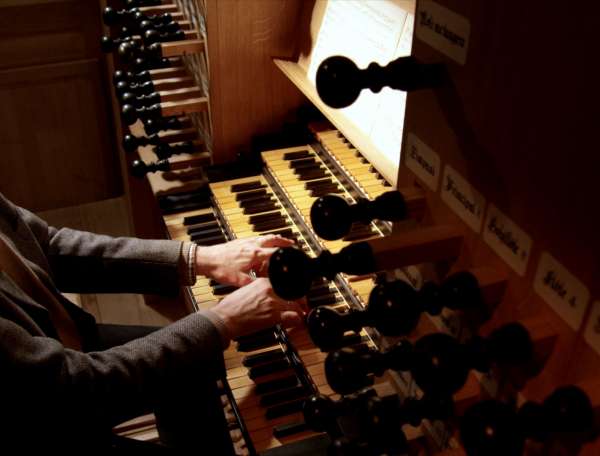

Du wahrer Gott und Davids Sohn
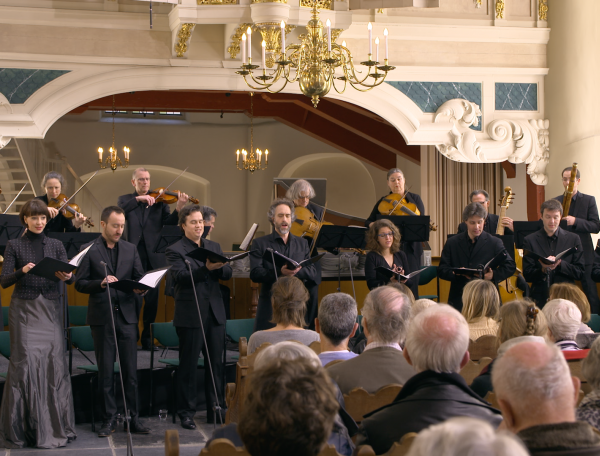
BWV 23 performed by the Netherlands Bach Society
conducted by Sigiswald Kuijken
Walloon Church, Amsterdam
Behind the music
Story
Story
Extra videos
Extra videos
Texts
Texts
Credits
Credits
Audition notes
Bach played this music to convince the Leipzig council of his qualities
With no introduction, you dive straight into the story, which is about the healing of a blind man that Jesus met on the road to Jericho. The blind man asked Jesus for help and he healed him. The blind man sees his true nature, while the sighted bystanders are blinded. In the bass, you can hear the road to Jericho, above which is an oboe duet and a duet for soprano and alto – so twice two-part texture. The oboe parts and those of the singers imitate one another. They are the same and yet not the same. This may refer to Jesus’ duality as god and as mortal (‘wahrer Gott und Davids Sohn’).
This cantata first consisted of only three movements. The original ending was the positive ‘Aller Augen warten, Herr’, in which you hear the optimism and faith of the blind man. The final movement that was added later (the monumental chorale arrangement ‘Christe du Lamm Gottes’) was based on a Passion hymn that was familiar to everyone in Bach’s day. Bach was thus referring to the weeks ahead, as Quinquagesima is the last Sunday before Lent, and Lent is followed by the Passion.
Incidentally, the fact that Bach only added ‘Christe du Lamm Gottes’ later, does not mean that it was just tacked on. You can already hear the melody of the hymn in the oboe in the tenor’s recitative. But whereas the tenor calls attention to his suffering, like the blind man from the parable, the oboe already refers to the suffering of Jesus himself. By adding a complete chorale arrangement to the same hymn at the end, Bach pursues the comparison.
Actually, this cantata must be viewed in conjunction with Jesus nahm zu sich di Zwölfe, BWV 22. Bach performed Du wahrer Gott und Davids Sohn along with BWV 22 on 5 February 1723, at a service in Leipzig. The two works were written on commission from the city council as audition pieces, to be played as part of Bach’s job application procedure in Leipzig. His music pleased the council and he was eventually appointed cantor there. The newspaper wrote: “Am verwichenen Sonntage Vormittage machte der Hochfürstl. Capellmeister zu Cöthen, Mr. Bach, all hier in der Kirchen zu Thomä wegen der bisher noch immer vacant stehenden Cantor-Stelle seine Probe, und ist desselben damahlige Music von allen, welche der gleichen ästimeren, sehr gelobet worden...”.
Extra videos
Vocal texts
Original
1. Arie (Sopran, Alt)
Du wahrer Gott und Davids Sohn,
der du von Ewigkeit in der Entfernung schon
mein Herzeleid und meine Leibespein
umständlich angesehn,
erbarm dich mein!
Und lass durch deine Wunderhand,
die so viel Böses abgewandt,
mir gleichfalls Hilf und Trost geschehen.
2. Rezitativ (Tenor)
Ach! gehe nicht vorüber;
du, aller Menschen Heil,
bist ja erschienen,
die Kranken und
nicht die Gesunden zu bedienen.
Drum nehm ich ebenfalls an
deiner Allmacht teil;
ich sehe dich auf diesen Wegen,
worauf man mich hat wollen legen,
auch in der Blindheit an.
Ich fasse mich und lasse dich
nicht ohne deinen Segen.
3. Chor
Aller Augen warten, Herr,
du allmächtger Gott, auf dich,
und die meinen sonderlich.
Gib denselben Kraft und Licht,
lass sie nicht
immerdar in Finsternissen!
Künftig soll dein Wink
allein der geliebte Mittelpunkt
aller ihrer Werke sein,
bis du sie einst durch den Tod
wiederum gedenkst zu schliessen.
4. Choral
Christe, du Lamm Gottes,
der du trägst die Sünd der Welt,
erbarm dich unser!
Christe, du Lamm Gottes,
der du trägst die Sünd der Welt,
erbarm dich unser!
Christe, du Lamm Gottes,
der du trägst die Sünd der Welt,
gib uns dein 'Frieden. Amen.
Translation
1. Aria (Soprano, Alto)
[Jesus,] you true God and son of David,
You who in the distance, from eternity,
Already closely looked upon my heartache
And my bodily pain,
have mercy on me.
And through your miracle-working hand,
Which has averted so much evil,
Let help/salvation and consolation befall me likewise.
2. Recitative (Tenor)
Ah, do not pass by;
You, the salvation of all humankind,
Have appeared, yes,
To minister to the sick and not the healthy.
Thus I, likewise, partake of your omnipotence;
I look upon you in these paths
Where people
Wished to let me lie,
Also in blindness.
I compose myself
And will not let you go
Without [receiving] your blessing.
3. Chorus
The eyes of all wait, Lord,
You omnipotent God, for you,
And mine especially.
Give them strength and light;
Do not leave them
Forever in darknesses.
Your signal alone
Shall come to be the beloved center
Of all their works,
Until you some day, through death,
Have a mind to close them again.
4. Chorale
Christ, you lamb of God,
You who bear the sin of the world,
Have mercy on us.
Christ, you lamb of God,
You who bear the sin of the world,
Have mercy on us.
Christ, you lamb of God,
You who bear the sin of the world,
Give us your peace. Amen.
transl. © Daniel R. Melamed and Michael Marissen
For the annotated version of the text and translation, see here.
Last update: July 2026
Credits
-
- Release date
- 11 November 2016
-
- Recording date
- 23 April 2016
-
- Location
- Walloon Church, Amsterdam
-
- Violoncello da spalla and direction
- Sigiswald Kuijken
-
- Soprano
- Miriam Feuersinger
-
- Alto
- Damien Guillon
-
- Tenor
- Wolfram Lattke
-
- Bass
- Christian Immler
-
- Ripieno soprano
- Griet de Geyter
-
- Ripieno alto
- Barnabás Hegyi
-
- Ripieno tenor
- Kevin Skelton
-
- Ripieno bass
- Sebastian Myrus
-
- Violin 1
- Shunske Sato, Pieter Affourtit
-
- Violin 2
- Sayuri Yamagata, Anneke van Haaften
-
- Viola
- Staas Swierstra
-
- Violoncello da spalla
- Lucia Swarts
-
- Violone
- Robert Franenberg
-
- Oboe
- Martin Stadler, Peter Frankenberg
-
- Bassoon
- Benny Aghassi
-
- Trumpet
- Robert Vanryne
-
- Organ
- Leo van Doeselaar
-
- Harpsichord
- Siebe Henstra
-
- Director and editor
- Bas Wielenga
-
- Music recording
- Guido Tichelman, Bastiaan Kuijt, Pim van der Lee
-
- Music edit and mix
- Guido Tichelman
-
- Camera
- Jochem Timmermans, Merijn Vrieling, Chris Reichgelt
-
- Lights
- Zen Bloot, Gijs 't Hoen
-
- Assistant director
- Ferenc Soetman
-
- Video engineers
- Vincent Nugteren, Justin Mutsaers
-
- Camera assistants
- Robert Wijermans, Leon Mignon
-
- Set technicians
- Justin Mutsaers, Chris Reichgelt
-
- Data handling
- Jesper Blok
-
- Projectmanager NEP
- Peter Ribbens
-
- Interview
- Onno van Ameijde
-
- Producer
- Marco Meijdam, Imke Deters, Jessie Verbrugh
-
- Acknowledgements
- Nienke Meuleman
Help us to complete All of Bach
There are still many recordings to be made before the whole of Bach’s oeuvre is online. And we can’t complete the task without the financial support of our patrons. Please help us to complete the musical heritage of Bach, by supporting us with a donation!