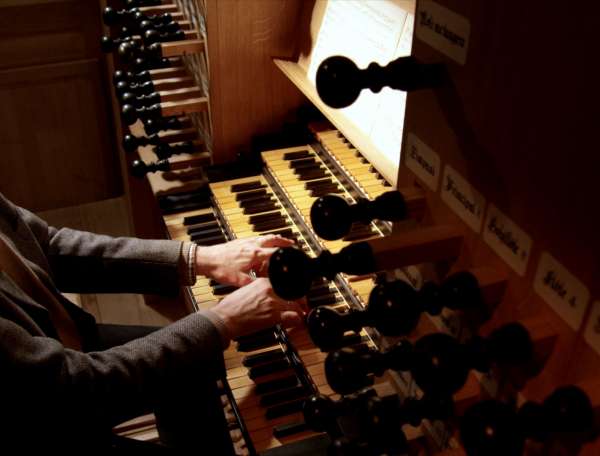
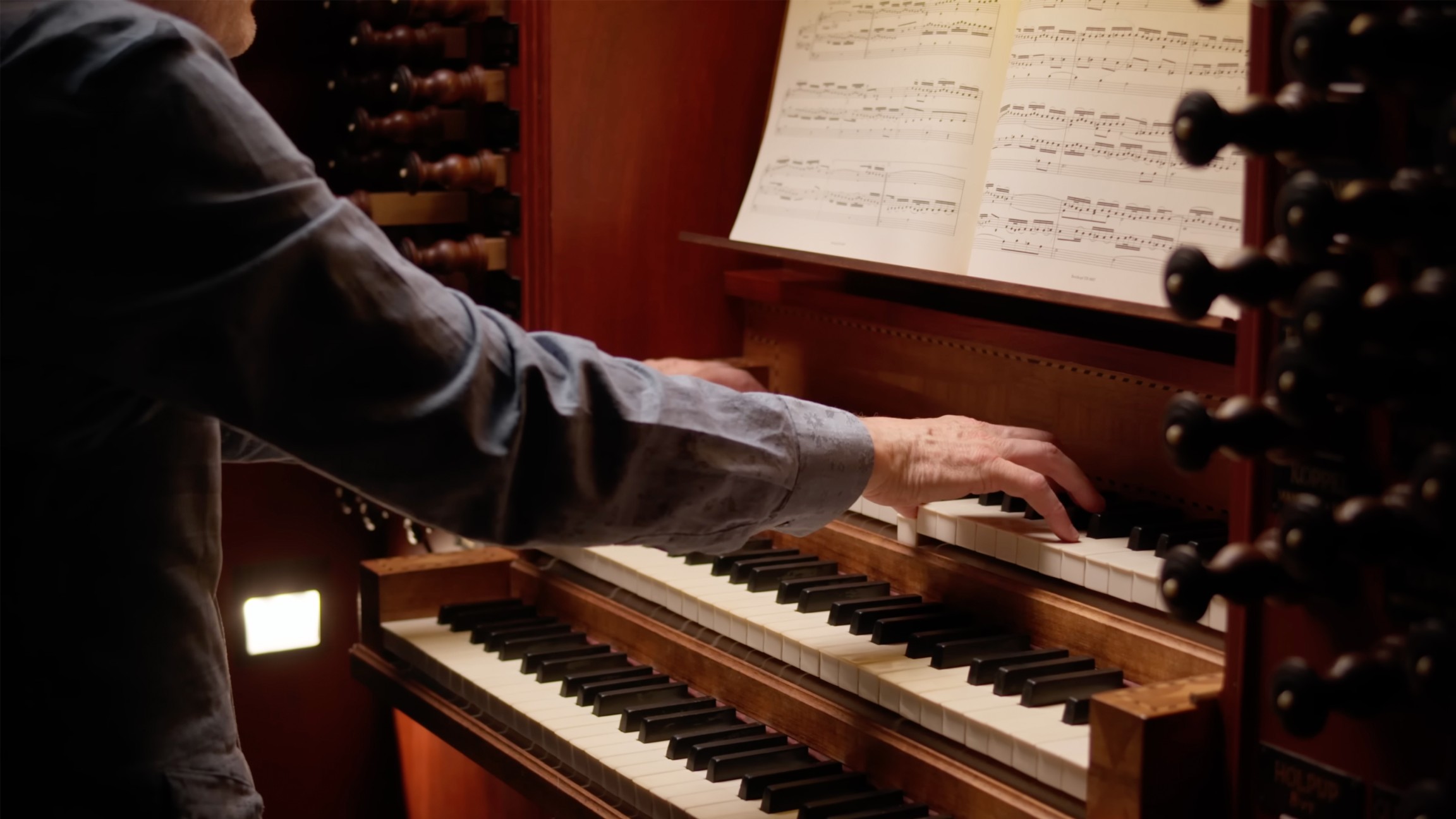
O Lamm Gottes, unschuldig
BWV 618 performed by Leo van Doeselaar
Walburgiskerk, Zutphen
Behind the music
Story
Story
Extra videos
Extra videos
Credits
Credits
Prayer in canon
Bach introduces a new technique in a well-known Easter chorale
In his Orgelbüchlein, Bach deftly combined two of his many hats: those of composer and teacher. The Orgelbüchlein gives a reflection of his incredible path as a composer, whilst also forming a sort of study guide for beginner improvisers on the organ. With the ‘organ booklet’ to hand, organists learn to develop their abilities, piece by piece.
In O Lamm Gottes, unschuldig – one of the compositions that ended up in the Orgelbüchlein – canon technique gets an exciting upgrade. Canons are often sung in unison, like Brother John for instance. And that applies to all the canons in the Büchlein that come before O Lamm Gottes, unschuldig, with each voice entering neatly in succession, at the same pitch. In BWV 618, Bach goes one step further with a canon ‘alla quinta’, in which two or more voices enter with the same melody at different times, but – unlike in a canon in unison – at a different pitch, i.e. a fifth apart.
After a few bars of the prelude, first the tenor speaks, and then five tones higher (and two beats later) the alto. The rules of the canon are clear: the melody remains constant, even if that produces sharp dissonants or ‘forbidden’ twists. Such a distance between the voices therefore often leads to harmonic tension, and even more so if a melody has not been specially designed for a canon, as in the case of a chorale.
Bach’s genius is apparent in the way that he succeeds in presenting the unrelenting interplay between the voices of the canon. There is a technical side, where the light-hearted soprano and bass can soften the strictness of the canon at times. But symbolically, too, the accompanying voices play their role, for example with the ever-audible sighing motif that might stand for carrying the cross, or for bearing our sins. Or then with the extra chromaticism (chromaticism is where a melody or chord includes notes that do not belong in the key used – ed.) on the word ‘verzagen’ in the penultimate line. Such a brilliant example enabled beginner church musicians to significantly expand their repertoire.
Orgelbüchlein, BWV 599-644
During his time as court organist at Weimar (1708-1714), Bach already started compiling his first collection of chorale arrangements and chorale preludes (compositions based on Lutheran hymns). They were intended to be used in church services, and the preludes were an introduction to congregational singing. According to the list of contents in Bach’s manuscript, it was supposed to have been a collection of 164 compositions, but in the end it did not exceed 46 (BWV 599-644). The order, combined with the limited length of the pieces, indicates that Bach was planning to compile a complete cycle of chorale arrangements. Later, in his period at Köthen, he gave the collection a title page, which reads: ‘Orgel-Büchlein, Worinne einem anfahenden Organisten Anleitung gegeben wird, auff allerhand Arth einen Choral durchzuführen…’ (‘Little organ book, in which a beginner organist is taught to arrange a chorale in all sorts of ways...’). So at the time, he intended the collection just as a teaching manual, maybe to present on his application in 1722 for the post of cantor at the Thomasschule in Leipzig, which was an important teaching position. The pupils must have had a hard time of it, as the preludes contain the complete range of baroque keyboard techniques in a nutshell.
Extra videos
Vocal texts
Original
Translation
Credits
-
- Release date
- 19 March 2026
-
- Recording date
- 27 May 2024
-
- Location
- Walburgiskerk, Zutphen
-
- Organ
- Leo van Doeselaar
-
- Instrument
- Henrick Bader, 1639/1643
-
- Director and editor
- Gijs Besseling
-
- Music recording
- Guido Tichelman, Pim van der Lee
-
- Music edit and mix
- Guido Tichelman
-
- Camera
- Danny Noordanus, Manon Hoskens, Remco van Leest
-
- Grip
- Wouter Visser
-
- Assistant music recording
- Marloes Biermans
-
- Producer
- Lisanne Marlou de Kok
Help us to complete All of Bach
There are still many recordings to be made before the whole of Bach’s oeuvre is online. And we can’t complete the task without the financial support of our patrons. Please help us to complete the musical heritage of Bach, by supporting us with a donation!