

Halt im Gedächtnis Jesum Christ
BWV 67 performed by the Netherlands Bach Society
conducted by Jos van Veldhoven
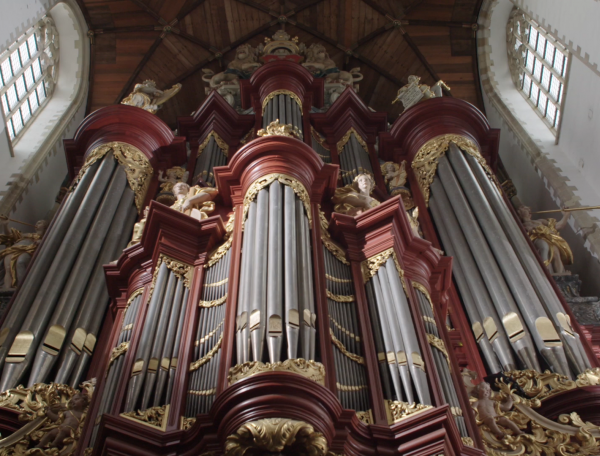
Grote Kerk, Naarden
Behind the music
Story
Story
Extra videos
Extra videos
Texts
Texts
Credits
Credits
A cantata filled with jubilant optimism
Nine days after his first Passion, Bach was already in full swing again
Bach must have had a difficult time in his first year as cantor in Leipzig. Not only did he want to compose a complete series of new cantatas, but he also wanted to set his hand to a Passion straight away. It is understandable that after the presentation of his St John Passion on Good Friday 1724, there was not much energy left for more tours de force. For his cantatas in the following Easter days, he resorted to making a few changes to existing work. But by Quasimodogeniti, seven days after Easter, Bach was back in full swing again. His cantata ‘Halt im Gedächtnis Jesum Christ’ is a completely new work with a wonderfully optimistic undertone. The work is in seven movements, yet is far from long-winded, and is full of variety, both with regard to vocal and instrumental combinations and to the range of moods. It was also the first time that Bach made use (albeit modestly) of the transverse flute. Along with the two oboes d’amore, the instrument adds colour to the sensitive moments, while the slide trumpet emphasises the festivity in the chorale melodies.
The reading for the first Sunday after Easter is about doubting Thomas. The words of the cantata talk about divine mercy: all those who struggle, yet see the error of their ways, will be shown forgiveness. The large-scale chorus at the beginning celebrates the resurrection of Christ. But then the tenor shows signs of Thomas-like doubt, which run smoothly on into those of the alto. However strongly the central chorale goes on to argue that the redeemer has crushed our enemies, the alto does not admit defeat easily. It is only in the fervent bass aria with chorus, rich in contrast, that a turning point is reached. Jesus himself comes to the aid of the faithful in their clearly audible struggle, with the repeated soothing words ‘Peace be with you’. And in the simple final chorale, peace does indeed return to the hearts of the faithful.
Extra videos
Conductor Jos van Veldhoven
"Jos van Veldhoven explains why this cantata was already fairly popular in the early 19th century."
Vocal texts
Original
1. Chor
Halt im Gedächtnis Jesum Christ,
der auferstanden ist von den Toten.
2. Arie (Tenor)
Mein Jesus ist erstanden,
allein, was schreckt mich noch?
Mein Glaube kennt des Heilands Sieg,
doch fühlt mein Herze Streit und Krieg,
mein Heil, erscheine doch!
3. Rezitativ (Alt)
Mein Jesu, heissest du des Todes Gift
und eine Pestilenz der Hölle:
ach, dass mich noch
Gefahr und Schrecken trifft!
Du legtest selbst auf unsre Zungen
ein Loblied, welches wir gesungen:
4. Choral
Erschienen ist der herrlich Tag,
dran sich niemand gnug freuen mag:
Christ, unser Herr, heut triumphiert,
all sein Feind er gefangen führt.
Alleluja!
5. Rezitativ (Alt)
Doch scheinet fast,
dass mich der Feinde Rest,
den ich zu gross und allzu schrecklich finde,
nicht ruhig bleiben lässt.
Doch, wenn du mir den Sieg erworben hast,
so streite selbst mit mir, mit deinem Kinde.
Ja, ja, wir spüren schon im Glauben,
dass du, o Friedefürst,
dein Wort und Werk an uns erfüllen wirst.
6. Arie (Bass, Chor)
Friede sei mit euch!
Wohl uns! Jesus hilft uns kämpfen
und die Wut der Feinde dämpfen,
Hölle, Satan, weich!
Friede sei mit euch!
Jesus holet uns zum Frieden
und erquicket in uns Müden
Geist und Leib zugleich.
Friede sei mit euch!
O Herr, hilf und lass gelingen,
durch den Tod hindurchzudringen
in dein Ehrenreich!
Friede sei mit euch!
7. Choral
Du Friedefürst, Herr Jesu Christ,
wahr' Mensch und wahrer Gott,
ein starker Nothelfer du bist
im Leben und im Tod:
drum wir allein
im Namen dein
zu deinem Vater schreien.
Translation
1. Chorus
Keep Jesus Christ in mind,
who is arisen from the dead.
2. Aria T
My Jesus is arisen,
but what still frightens me?
My faith knows the victory of the Savior,
yet my heart is filled with strife and battle,
my Savior, only appear!
3. Recitative A
My Jesus, you are known as the bane of death
and a pestilence to Hell:
alas, that danger
and terror still surround me!
You yourself lay upon our tongues
a song of praise, which we sing:
4. Chorale
The glorious day has appeared,
over which no one can rejoice enough:
Christ, our Lord, triumphs today,
he leads all his enemies captive.
Alleluia!
5. Recitative A
Yet it almost seems
that the remnants of my enemies,
which I find to be too great and all too frightening,
will not remain quiet.
Yet, since you have won the battle for me,
then struggle even with me, with your child.
Yes, yes, we sense already in faith
that you, O Prince of Peace,
will fulfill your word and work in us.
6. Aria B and Chorus
Peace be with you!
Happy us! Jesus helps us fight
and dampens the rage of the enemy,
Hell, Satan, back!
Peace be with you!
Jesus brings us to peace
and refreshes in us weary ones
spirit and body together.
Peace be with you!
O Lord, help and let it be accomplished,
through death to be brought
to your glorious kingdom!
Peace be with you!
7. Chorale
O Prince of peace, Lord Jesus Christ,
true human and true God,
you are a strong helper in need
in life and in death:
therefore only
in your name
do we cry to your Father.
Translation © Pamela Dellal
Last update: August 2026
Credits
-
- Release date
- 23 January 2015
-
- Recording date
- 11 October 2014
-
- Location
- Grote Kerk, Naarden
-
- Conductor
- Jos van Veldhoven
-
- Alto
- Alex Potter
-
- Tenor
- Thomas Hobbs
-
- Bass
- Peter Kooij
-
- Ripieno soprano
- Lauren Armishaw, Marjon Strijk (solo), Kristen Witmer
-
- Ripieno alto
- Marleene Goldstein, Barnabás Hegyi
-
- Ripieno tenor
- João Moreira, Kevin Skelton
-
- Ripieno bass
- Matthew Baker, Jelle Draijer
-
- Violin 1
- Shunske Sato, Anneke van Haaften, Annelies van der Vegt
-
- Violin 2
- Sayuri Yamagata, Pieter Affourtit, Paulien Kostense
-
- Viola
- Staas Swierstra, Jan Willem Vis
-
- Cello
- Lucia Swarts, Richte van der Meer
-
- Double bass
- Robert Franenberg
-
- Traverso
- Marten Root
-
- Oboe
- Martin Stadler, Peter Frankenberg
-
- Bassoon
- Benny Aghassi
-
- Trumpet
- Robert Vanryne
-
- Harpsichord
- Siebe Henstra
-
- Positive organ
- Leo van Doeselaar
-
- Concert production
- Imke Deters, Erik van Lith, Marco Meijdam
-
- Producers
- Zoë de Wilde, Frank van der Weij
-
- Film director
- Lucas van Woerkum
-
- Director of photography
- Sal Kroonenberg
-
- Camera
- Sal Kroonenberg, Robert Berger, Ruben van den Broeke, Benjamin Sparschuh
-
- Film editors
- Lucas van Woerkum, Frank van der Weij
-
- Music recording producer
- Leo de Klerk
-
- Gaffer
- Zen Bloot
-
- Best boys
- Roeland van Bemmel, Patrick Galvin
-
- Score reader
- MaNOj Kamps
-
- Music recording assistants
- Jaap Firet, Gilius Kreiken, Jaap van Stenis, Bobby Verbakel
-
- Camera assistants
- Izak de Dreu, Zino Rosmolen
-
- Music edit and mix
- Leo de Klerk, Frank van der Weij
-
- Music edit assistant
- Martijn Snoeren
-
- Acknowledgements
- Angela Mast, Marlo Reeders
Help us to complete All of Bach
There are still many recordings to be made before the whole of Bach’s oeuvre is online. And we can’t complete the task without the financial support of our patrons. Please help us to complete the musical heritage of Bach, by supporting us with a donation!