Prelude in F major
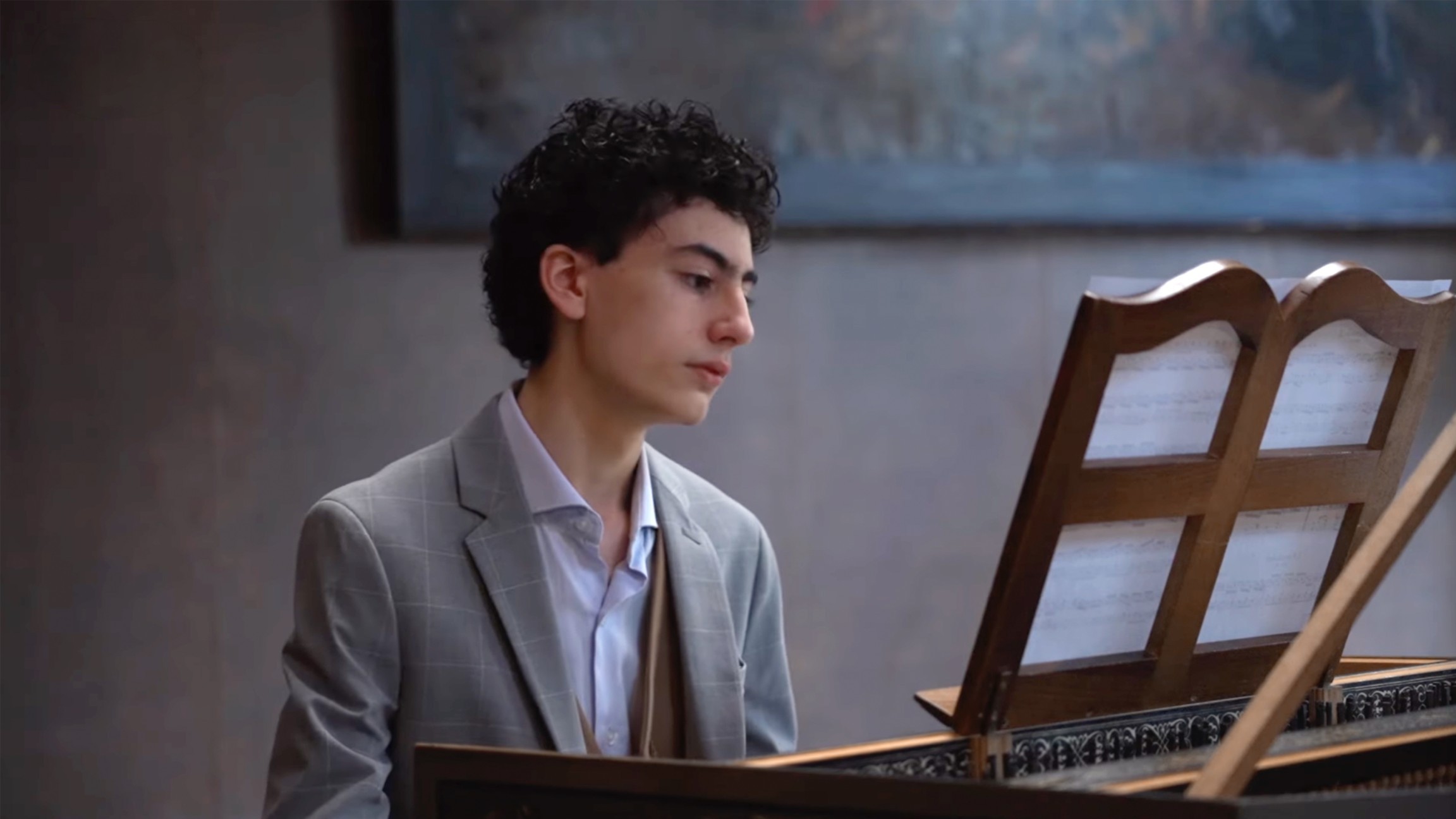
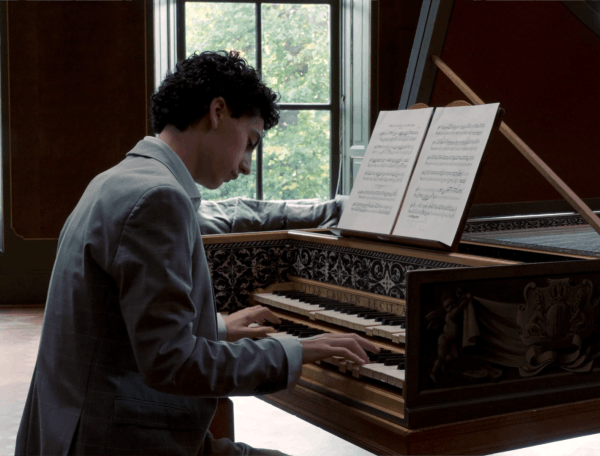
BWV 927 performed by Adriel González
Maltezerhuis, Utrecht
Behind the music
Story
Story
Extra videos
Extra videos
Credits
Credits
Broken simplicity
Nimble-fingered chords feature in a little work handed down anonymously
During his years in Köthen (1717-23), Bach almost became a different composer – temporarily, that is. The court of Leopold of Anhalt-Köthen was Calvinist, which meant that church music remained firmly in the background. So Bach had time for other work, such as refining the ‘Brandenburg’ concertos, or his big works for solo violin. And besides composing secular court music, Bach started to write down his own keyboard method, largely with his growing family in mind.
In Köthen, this led to the creation of the Inventions and the three-part Sinfonias, as well as the first part of the Wohltemperirte Clavier. And also to two keyboard notebooks! The Notenbüchlein for Anna Magdalena Bach is a varied collection of pieces for a clearly proficient player, including the first version of the 'French' Suites. The notebook for Wilhelm Friedemann, started in 1720, is very systematic in its arrangement. Each little work provides an exercise in a particular technique or form, which is testimony to father Bach’s experience as a teacher – also seen in the Orgelbüchlein he compiled earlier in Weimar.
This short prelude is the eighth work in Friedemann’s book – added in his own hand in 1722 – but it also appears in a sort of appendix to the manuscript of the Wohltemperirte Clavier I, in a hand that is not Bach’s. All the focus is on the lively broken chords, but at the same time it is striking that the piece never departs from the key of F major – an absolute rarity in the case of Bach.
Young talent
Once every two or three years, the Netherlands Bach Society organises a talent development project for gifted young musicians under the age of 18. The projects, which focus on the performance practice of Bach’s music, allows us to bring talented youngsters into contact with historical performance practice and give them deeper insight into Bach’s music. In this project, we worked with keyboardists of the future. Seven very talented international youngsters between twelve and eighteen years old were selected from auditions to take two masterclasses about Bach, the harpsichord and baroque playing techniques and styles, given by Siebe Henstra. Each keyboardist rehearsed movements from the Klavierbüchlein für Wilhelm Friedemann Bach, including the Nine Little Preludes, BWV 924-932, which Bach wrote to use in lessons with his son Wilhelm Friedemann. The rehearsed works were recorded for All of Bach in October 2024, at the Maltezerhuis in Utrecht.
Extra videos
Vocal texts
Original
Translation
Credits
-
- Release date
- 5 maart 2026
-
- Recording date
- 16 October 2024
-
- Location
- Maltezerhuis, Utrecht
-
- Harpsichord
- Adriel González
-
- Instrument
- Titus Crijnen, 1992 after Johannes Ruckers, 1638
-
- Director and camera
- Robin van Erven Dorens
-
- Music recording
- Guido Tichelman, Pim van der Lee
-
- Music recording, edit and mix
- Guido Tichelman
-
- Camera
- Martijn van Beenen
-
- Lights
- Ernst-Jan Thieme
-
- Data handling
- Brechtje van Riel
-
- Assistant music recording
- Marloes Biermans
-
- Producer
- Lisanne Marlou de Kok

Help us to complete All of Bach
There are still many recordings to be made before the whole of Bach’s oeuvre is online. And we can’t complete the task without the financial support of our patrons. Please help us to complete the musical heritage of Bach, by supporting us with a donation!