

Was Gott tut, das ist wohlgetan
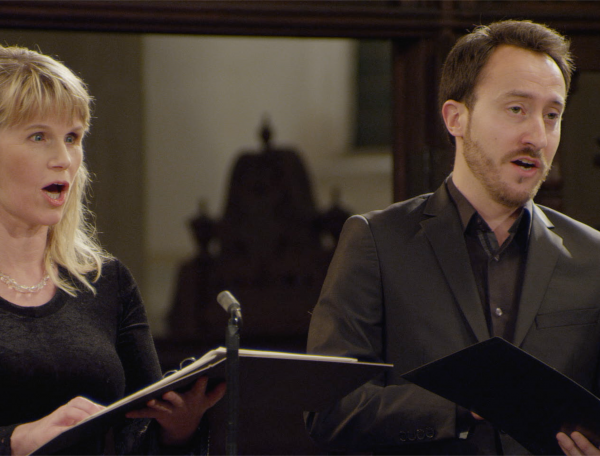
BWV 100 performed by the Netherlands Bach Society
conducted by Jos van Veldhoven
Grote Kerk, Naarden
Behind the music
Story
Story
Extra videos
Extra videos
Texts
Texts
Credits
Credits
Optimism without contemplation
Bach offers comfort for any day of the year
When Bach used the chorale text 'Was Gott tut, das ist wohlgetan’ for the second time, sometime after 1732, he took a completely different approach to his cantata of the same name from ten years earlier (BWV 99). He lent extra festivity to the instrumentation of that version (flute, oboe d’amore, horn, strings and basso continuo) by adding a second horn and timpani. The text gave every reason for doing so, as not only are the opening and closing choruses derived from the chorale, but the four in-between movements are as well. Because of the unisonous opening line of the successive verses, these movements are all called ‘Was Gott tut, das ist wohlgetan’, like the cantata itself. There is no contemplation in the form of recitatives. Four arias, one of which is a duet for alto and tenor, celebrate the grace of God without interruption or any hint of reserve.
It seems as though Bach, just like the lyricist Samuel Rodigast in 1675, felt a strong need to place the emphasis on his steadfast faith in God’s grace, rather than on the pain of suffering. Rodigast originally wrote the hymn to hearten the sick cantor Severus Gastorius. And it worked, as the cantor recovered and even composed a melody to it, which stood the test of time.
As this cantata was not connected to one specific Sunday, the hymn of praise could be performed at any time. It offered comfort on any day of the year, which must have been very important to Bach’s own family, who had lost three children between 31 August 1732 and 6 November 1733.
Extra videos
Conductor Jos van Veldhoven
"Bach more or less copied the opening chorus of BWV 99 in this cantata but he added two horns and timpani. Why?"
Vocal texts
Original
1. Chor
Was Gott tut, das ist wohlgetan,
es bleibt gerecht sein Wille;
wie er fängt meine Sachen an,
will ich ihm halten stille.
Er ist mein Gott,
der in der Not
mich wohl weiss zu erhalten;
drum lass ich ihn nur walten.
2. Duett (Alt, Tenor)
Was Gott tut, das ist wohlgetan,
er wird mich nicht betrügen;
er führet mich auf rechter Bahn,
so lass ich mich begnügen
an seiner Huld
und hab Geduld,
er wird mein Unglück wenden,
es steht in seinen Händen.
3. Arie (Sopran)
Was Gott tut, das ist wohlgetan,
er wird mich wohl bedenken;
er, als mein Arzt und Wundermann,
wird mir nicht Gift einschenken
vor Arzenei.
Gott ist getreu,
drum will ich auf ihn bauen
und seiner Gnade trauen.
4. Arie (Bass)
Was Gott tut, das ist wohlgetan,
er ist mein Licht, mein Leben,
der mir nichts Böses gönnen kann,
ich will mich ihm ergeben
in Freud und Leid!
Es kommt die Zeit,
da öffentlich erscheinet,
wie treulich er es meinet.
5. Arie (Alt)
Was Gott tut, das ist wohlgetan,
muss ich den Kelch gleich schmecken,
der bitter ist nach meinem Wahn,
lass ich mich doch nicht schrecken,
weil doch zuletzt
ich werd ergötzt
mit süssem Trost im Herzen;
da weichen alle Schmerzen.
6. Choral
Was Gott tut, das ist wohlgetan,
darbei will ich verbleiben.
Es mag mich auf die rauhe Bahn
Not, Tod und Elend treiben,
so wird Gott mich
ganz väterlich
in seinen Armen halten;
drum lass ich ihn nur walten.
Translation
1. Chorus
What God does is done well;
His will remains righteous.
However he dispatches my affairs,
I will keep still before him.
He is my God,
Who in [times of] distress
Knows well how to preserve me;
That is why I just let him rule.
2. Duet (Alto, Tenor)
What God does is done well;
He will not deceive me;
He guides me on the right course [of life];
Thus I will be content
With his favor
And have patience;
He will turn my misfortune around;
It is in his hands.
3. Aria (Soprano)
What God does is done well;
He will well take me into consideration;
He, as my physician and man of miracles,
Will not pour me poison
As medicine.
God is faithful;
That is why I will rely on him
And trust his mercy.
4. Aria (Bass)
What God does is done well;
He is my light, my life,
Who can wish me nothing evil;
I will give myself over to him
In joy and sorrow.
The time is coming
When [at the last] it will be openly manifest
How he faithfully means it [to uphold his lack of ill will].
5. Aria (Alto)
What God does is done well;
If right now I must taste the cup [of suffering]
That is bitter according to my way of thinking,
I do not let myself yet be afraid,
Because yet at the last
I will be cheered
With sweet comfort in my heart;
There [at the last] all sorrows give way.
6. Chorale
What God does is done well—
I will abide by this.
If distress, death, and affliction may
Drive me on the rough course [of life],
Then God will,
Most paternally,
Hold me in his arms;
That is why I just let him rule.
transl. © Daniel R. Melamed and Michael Marissen
For the annotated version of the text and translation, see here.
Sourced: August 2026
Credits
-
- Release date
- 8 January 2016
-
- Recording date
- 7 February 2015
-
- Location
- Grote Kerk, Naarden
-
- Conductor
- Jos van Veldhoven
-
- Soprano
- Gerlinde Sämann
-
- Alto
- Damien Guillon
-
- Tenor
- Charles Daniels
-
- Bass
- Peter Kooij
-
- Ripieno soprano
- Marjon Strijk, Hilde Van Ruymbeke
-
- Ripieno alto
- Elsbeth Gerritsen, Barnabás Hegyi
-
- Ripieno tenor
- Kevin Skelton, Endrik Üksvärav
-
- Ripieno bass
- Michiel Meijer, Drew Santini
-
- Violin 1
- Sayuri Yamagata, Pieter Affourtit, Hanneke Wierenga
-
- Violin 2
- Anneke van Haaften, Paulien Kostense, Lidewij van der Voort
-
- Viola
- Staas Swierstra, Jan Willem Vis
-
- Cello
- Lucia Swarts, Richte van der Meer
-
- Double bass
- Maggie Urquhart
-
- Traverso
- Marten Root
-
- Oboe
- Martin Stadler
-
- Bassoon
- Yukiko Murakami
-
- Horn
- Erwin Wieringa, Alexandre Zanetta
-
- Timpani
- Peppie Wiersma
-
- Harpsichord
- Siebe Henstra
-
- Positive organ
- Leo van Doeselaar
-
- Film director and editor
- Lucas van Woerkum
-
- Music recording producers
- Guido Tichelman, Bastiaan Kuijt, Micha de Kanter
-
- Music editor
- Guido Tichelman
-
- Camera
- Jorrit Garretsen, Ruben van den Broeke, Diderik Evers, Maarten van Rossem
-
- Gaffer
- Zen Bloot, Harm Bredero, Marcel Brugman
-
- Score reader
- Stijn Berkouwer
-
- Data handler
- Wesley Westerhuis
-
- Interview
- Onno van Ameijde
-
- Producer concert
- Marco Meijdam, Erik van Lith
-
- Producer film
- JeanMarc van Sambeek, Jessie Verbrugh
-
- Acknowledgements
- Angela Mast, Marlo Reeders

Help us to complete All of Bach
There are still many recordings to be made before the whole of Bach’s oeuvre is online. And we can’t complete the task without the financial support of our patrons. Please help us to complete the musical heritage of Bach, by supporting us with a donation!