
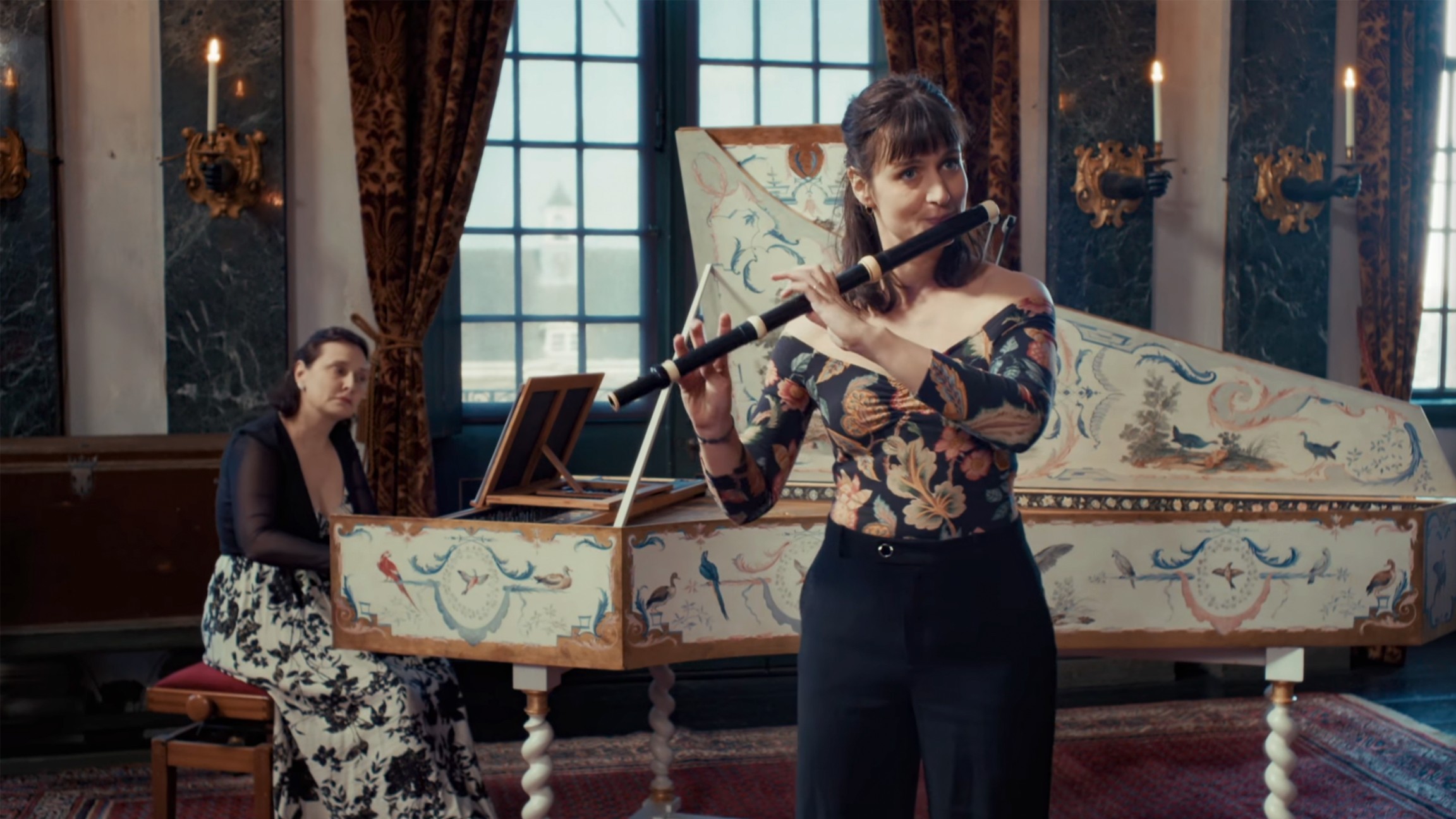
Flute sonata in C major
BWV 1033 performed by Anna Besson and Beatrice Martin
Kasteel Amerongen, Amerongen
Behind the music
Story
Story
Extra videos
Extra videos
Credits
Credits
Love letter and postcard
This flute sonata is no less beautiful for the controversy surrounding it
However beautiful this Flute Sonata in C may be, researchers are puzzled by it. Is the piece actually by Bach? On the one hand, there is that typically elegant flute part, which first curls like cigarette smoke and then whispers like a spring breeze. And on the other hand, there is that bass line. It is uncharacteristically basic and simple for Bach; so basic in fact that at times it even sounds crude. There is practically no doubt that Bach wrote the flute part, but who is responsible for that bass line?
Musicologist Robert Marshall came up with the most interesting theory. The manuscript is in the hand of Carl Philipp Emmanuel, one of Bach’s sons, and he has written neatly above it that the piece is by his father. Could it be that he added the bass line later, maybe under the watchful eye of his father, as a pedagogic exercise? It is not inconceivable that this part of his musical education took place in the Bach family home. But on the other hand, Carl Philipp Emmanuel was around seventeen when he wrote the manuscript. At the age of ten, Bach’s eldest son, Wilhelm Friedemann, wrote a whole fugue that could hold its own with his father’s simpler work with regard to quality. Could the almost adult CPE Bach really still be making such a hash of it?
In the end, these discussions are inherently pedantic: what does it matter who wrote the sonata if it is so beautiful? A lilting Andante switches to a reciting Presto, which is followed by a chirpy Allegro. The undisputed highlight is the poetically plaintive Adagio, which contrasts with the closing two minuets, in the way that a love letter contrasts with a postcard. Bach, whether father or son, is a master of musical timbres: against the elegant blue skies of the surrounding movements, the dark Adagio stands out with even more depth and sensitivity. And in the rear mirror, that basic bass line now looks very different as well – as if it lets go for a moment, so that the flute part can take off. Sometimes, you just have to know when to let go.
Extra videos
Vocal texts
Original
Translation
Credits
-
- Release date
- 19 February 2026
-
- Recording date
- 1 April 2025
-
- Location
- Kasteel Amerongen, Amerongen
-
- Traverso
- Anna Besson
-
- Harpsichord
- Beatrice Martin
-
- Director and camera
- Onno van Ameijde
-
- Music recording
- Guido Tichelman, Pim van der Lee
-
- Music edit and mix
- Guido Tichelman
-
- Camera
- Onno van Ameijde, Rieks Soepenberg, Joost Kuiper
-
- Lights
- Patrick Galvin
-
- Data handling
- Stefan Ebels
-
- Assistant music recording
- Marloes Biermans
-
- Producer
- Lisanne Marlou de Kok

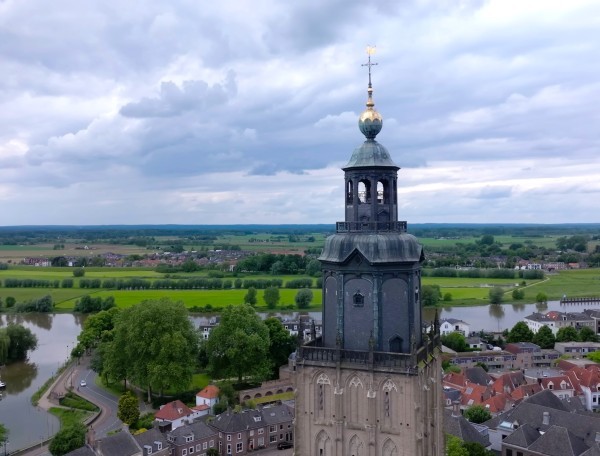
Help us to complete All of Bach
There are still many recordings to be made before the whole of Bach’s oeuvre is online. And we can’t complete the task without the financial support of our patrons. Please help us to complete the musical heritage of Bach, by supporting us with a donation!