Sinfonia in D major
BWV 1045 performed by the Netherlands Bach Society
conducted by Shunske Sato
Waalse Kerk, Amsterdam
Behind the music
Story
Story
Extra videos
Extra videos
Credits
Credits
Painting while playing the violin
This long-drawn-out movement almost resembles minimal music
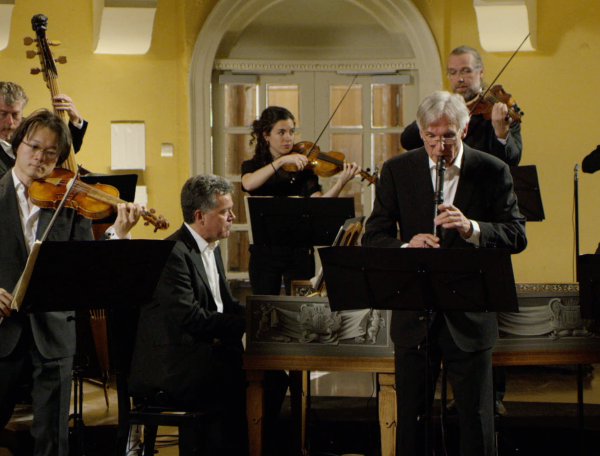
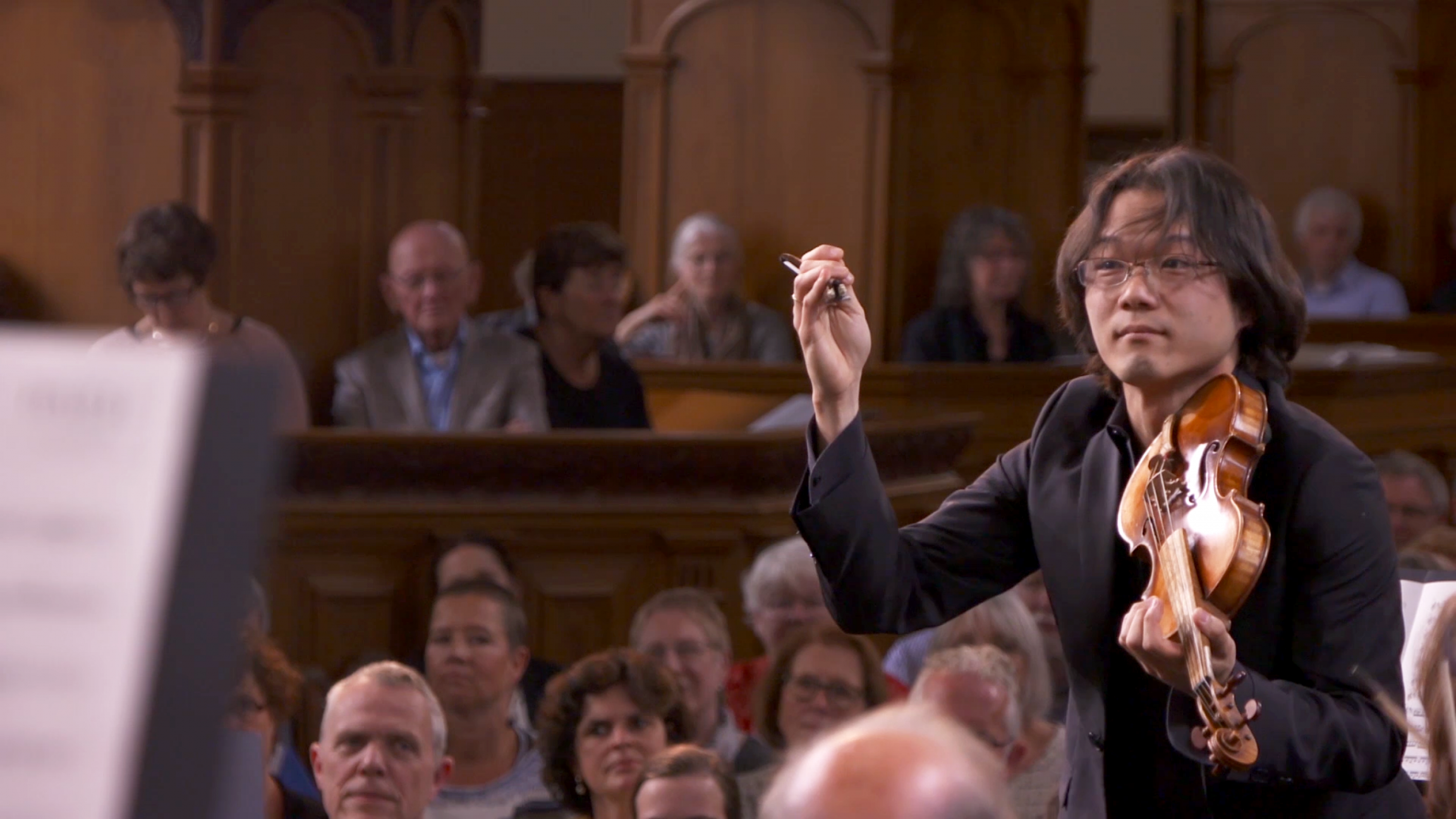
This sinfonia is possibly one of Bach’s most surprising compositions. According to the manuscript, it is an ‘Intrada’, an instrumental introduction to what was probably a festive cantata. However, there is no trace whatsoever of the vocal parts. This Sinfonia in D major is therefore doomed to remain an independent instrumental movement. The work’s exuberant instrumentation includes three trumpets and timpani, as well as a special part for a solo violin. The continual figurations in the lively violin part lend the music an almost hypnotic character. You could maybe even class it as an early forerunner of minimal music. Bach regularly brings the harmonic progression to a halt. Violinist Shunske Sato even calls it “shameless virtuosity”. The way in which Bach notated the violin part with arpeggios – chords that are not written out in full – offers great scope for freedom. “It’s as if you’re painting while playing the violin”, says Shunske Sato.
Extra videos
Vocal texts
Original
Translation
Credits
-
- Release date
- 9 March 2018
-
- Recording date
- 13 May 2017
-
- Location
- Walloon Church, Amsterdam
-
- Violin and direction
- Shunske Sato
-
- Violin 1
- Anneke van Haaften, Annelies van der Vegt
-
- Violin 2
- Sayuri Yamagata, Pieter Affourtit, Paulien Kostense
-
- Viola
- Staas Swierstra, Jan Willem Vis
-
- Cello
- Lucia Swarts, Richte van der Meer
-
- Double bass
- Hen Goldsobel
-
- Oboe
- Martin Stadler, Peter Frankenberg
-
- Bassoon
- Benny Aghassi
-
- Trumpet
- Robert Vanryne, Fruzsina Hara, Mark Geelen
-
- Timpani
- Robert Kendell
-
- Organ
- Leo van Doeselaar
-
- Harpsichord
- Siebe Henstra
-
- Director
- Bas Wielenga
-
- Music recording
- Guido Tichelman, Bastiaan Kuijt, Pim van der Lee
-
- Music edit and mix
- Guido Tichelman
-
- Camera
- Jochem Timmerman, Thijs Struick, Martin Struijf
-
- Lights
- Zen Bloot, Henry Rodgers, Patrick Galvin
-
- Assistant director
- Ferenc Soeteman
-
- Video engineer
- Robert-Jan Neijland
-
- Set technique
- Justin Mutsaers
-
- Data handling
- Jesper Blok
-
- Project manager nep
- Peter Ribbens
-
- Interview
- Onno van Ameijde, Marloes Biermans
-
- Producer concert
- Marco Meijdam, Imke Deters
-
- Producer film
- Jessie Verbrugh
Help us to complete All of Bach
There are still many recordings to be made before the whole of Bach’s oeuvre is online. And we can’t complete the task without the financial support of our patrons. Please help us to complete the musical heritage of Bach, by supporting us with a donation!