Lobet Gott in seinen Reichen
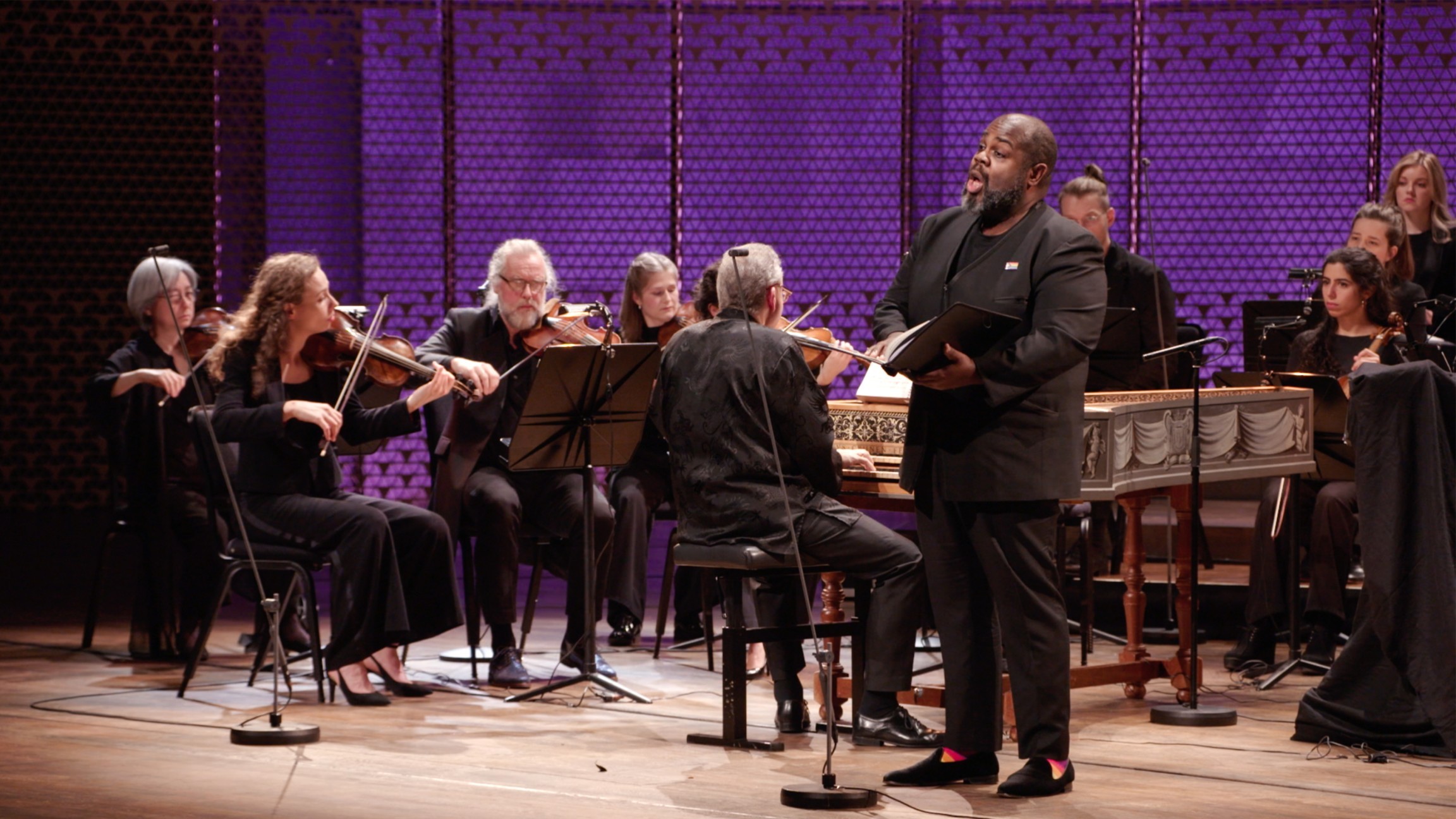
BWV 11 performed by the Netherlands Bach Society
conducted by Richard Egarr
Amare, The Hague
Behind the music
Story
Story
Texts
Texts
Credits
Credits
From now to eternity
Bach’s third oratorio pulls out all the stops
Ascension Day forms the hinge between the earthly life of Jesus and his divine rule at God’s right hand. The biblical message keeps it brief: Jesus blessed his followers, rose to heaven and the disciples saw it happen. After a reassuring intervention by two angels, the disciples returned home.
Yet the theological implications are far-reaching. Christ’s body may have left the world, but according to Luther and others he remains among us, just as God does not restrict himself to heaven. So where this Ascension Oratorio refers to God’s ‘Reich’, it means both heaven and earth and Jesus’s physical absence does not mean he has disappeared. Rather he will show himself from now on in different ways, including through his Church – see Whitsuntide. In this way, a new era of hope and expectation dawns for the faithful.
Shortly after the premiere of the sumptuous Christmas Oratorio, Bach once again pulled out all the stops for Ascension Day 1735, in radiant D major, with flutes, oboes, timpani, trumpets and some deft recycling. For instance, he borrowed the opening chorus from Froher Tag, verlangte Stunden (BWV Anh. I/18, 1732), which was performed at the inauguration of the renovated Thomasschule. Two moving arias (by the alto and the soprano) were taken from the wedding serenade Auf! Süß entzückende Gewalt (1725): the alto mourns the departure of Jesus and the soprano looks forward to his joyful return.
While the tenor tells the story, the other singers interrupt with personal views, as in the alto aria. Many listeners will recognise this as a (somewhat more embellished) version of the ‘Agnus Dei’ from the Mass in B minor. The soprano aria radiates an unearthly hope, which Bach emphasises by accompanying the high flutes, oboe and soprano with a ‘bassetto’; a remarkably high bass line played by the violins and violas. The original wedding text ‘Unschuld, Kleinod reiner Seelen’ shines through beautifully.
Then come another two ariosi or accompanying recitatives with colourful wind instruments. In ‘Ach ja! so komme bald zurück’ there is a very poignant moment, where a slowly descending bass line produces some sharp dissonants, expressing the listener’s emotional response to the departure of Jesus.
Whilst churchgoers almost certainly did not sing along with Bach’s cantata chorales, they would definitely have recognised the melody. Bach used the hymn ‘Von Gott will ich nicht lassen’ twice. First with clear symbolism, in a simple chorale in an extra low setting: Jesus is now in heaven, high above creation. Then the exuberant closing chorus mirrors the grandeur and rhythmic energy of the opening. And just listen to how cleverly Bach fits a minor melody into the ever so major trumpets’ key of D major.
Extra videos
Vocal texts
Original
1. Chor
Lobet Gott in seinen Reichen,
preiset ihn in seinen Ehren,
rühmet ihn in seiner Pracht!
Sucht sein Lob recht zu vergleichen,
wenn ihr mit gesamten Chören
ihm ein Lied zu Ehren macht!
2. Rezitativ (T)
Der Herr Jesus hub seine Hände auf
und segnete seine Jünger,
und es geschah, da er sie segnete,
schied er von ihnen.
3. Rezitativ (B)
Ach, Jesu, ist dein Abschied schon so nah?
Ach, ist denn schon die Stunde da,
da wir dich von uns lassen sollen?
Ach, siehe, wie die heißen Tränen
von unsern blassen Wangen rollen,
wie wir uns nach dir sehnen,
wie uns fast aller Trost gebricht.
ach, weiche doch noch nicht!
4. Arie (A)
Ach, bleibe doch, mein liebstes Leben,
ach, fliehe nicht so bald von mir!
Dein Abschied und dein frühes Scheiden
bringt mir das allergrößte Leiden,
ach ja, so bleibe doch noch hier;
sonst werd ich ganz von Schmerz umgeben.
5. Rezitativ (T)
Und ward aufgehaben zusehends
und fuhr auf gen Himmel,
eine Wolke nahm ihn
weg vor ihren Augen,
und er sitzet zur rechten Hand Gottes.
6. Choral
Nun lieget alles unter dir,
dich selbst nur ausgenommen;
die Engel müssen für und für
dir aufzuwarten kommen.
Die Fürsten stehn auch auf der Bahn
und sind dir willig untertan;
Luft, Wasser, Feuer, Erden
muß dir zu Dienste werden.
7a. Rezitativ (T & B)
Und da sie ihm nachsahen
gen Himmel fahren,
siehe, da stunden bei ihnen
zwei Männer in weißen Kleidern, welche auch sagten:
Ihr Männer von Galiläa,
was stehet ihr und sehet gen Himmel?
Dieser Jesus, welcher von euch ist aufgenommen
gen Himmel, wird kommen,
wie ihr ihn gesehen habt gen Himmel fahren.
7b. Rezitativ (A)
Ach ja! so komme bald zurück:
tilg einst mein trauriges Gebärden,
sonst wird mir jeder Augenblick
verhaßt und Jahren ähnlich werden.
7c. Rezitativ (T)
Sie aber beteten ihn an,
wandten um gen Jerusalem von dem Berge,
der da heißet der Ölberg,
welcher ist nahe bei Jerusalem
und liegt einen Sabbater-Weg davon,
und sie kehreten wieder gen Jerusalem
mit großer Freude.
8. Arie (S)
Jesu, deine Gnadenblicke
kann ich doch beständig sehn.
Deine Liebe bleibt zurücke,
daß ich mich hier in der Zeit
an der künftgen Herrlichkeit
schon voraus im Geist erquicke,
wenn wir einst dort vor dir stehn.
9. Chor
Wenn soll es doch geschehen,
wenn kömmt die liebe Zeit,
daß ich ihn werde sehen
in seiner Herrlichkeit?
Du Tag, wenn wirst du sein,
daß wir den Heiland grüßen,
daß wir den Heiland küssen?
Komm, stelle dich doch ein!
Libretto: unbekannt
Translation
1. Chorus
Praise God in his realms;
Extol him in his glories;
Vaunt him in his splendor;
Seek to rightly give his due praise
When, with full choirs,
You render a hymn of glory to him.
2. Recitative (T)
The Lord Jesus raised his hands up
and blessed his disciples;
and it came to pass [that]
as he blessed them he parted from them.
3. Recitative (B)
Ah, Jesus, is your departure already so near?
Ah, is then the hour already here
When we should let you [go] from us?
Ah, see how hot tears
Roll from our pale cheeks,
How we long for you,
How we lack almost all comfort.
Ah, indeed, do not leave yet.
4. Aria (A)
Ah, do remain, my dearest life;
Ah, do not flee so soon from me.
Your departure and your early parting
Brings me the greatest suffering of all;
Ah, yes, so do remain yet here;
Otherwise I will be completely beset with agony.
5. Recitative (T)
And [Jesus] was visibly raised up,
and [he] ascended to heaven;
a cloud took him away before their [the apostles’] eyes,
and he sits at the right hand of God.
6. Chorale
Now everything has its place under you [Jesus],
Except only you [God the father] yourself;
The angels must forever
Come to attend you.
The [celestial] princes also stand along the way
And are willingly subject to you;
Air, water, fire, earth
Must come to be in service to you.
7a. Recitative (T & B)
And as they watched him
go to heaven,
see, two men in white robes stood next to them,
who also said:
You men of Galilee,
why are you standing and looking to heaven?
This Jesus, who has been taken from you
up to heaven, will come [back]
as you have seen him go to heaven.
7b. Recitative (A)
Ah, yes, so come back soon.
Blot out my sorrowful bearing one day;
Otherwise every moment will become
Hateful to me and become like years.
7c. Recitative (T)
But they [the apostles] worshipped him,
went back to Jerusalem from the mountain
called the Mount of Olives,
which is nearby Jerusalem
and lies a sabbath’s journey away,
and they returned to Jerusalem
with great joy.
8. Aria (S)
Jesus, your glances of mercy/grace
I can indeed constantly see.
Your love remains behind,
That here [on earth] in temporality
I may refresh myself in spirit beforehand
On the future glory [from eternity],
When one day we stand there [in heaven] before you.
9. Chor
When shall it indeed come to pass;
When will the dear time come,
That I will see him
In his glory?
You day, when will you be,
That we may greet the savior,
That we may kiss the savior?
Indeed, come, [you day,] appear!
transl. © Daniel R. Melamed and Michael Marissen
For the annotated version of the text and translation, see here.
Last updated May 2026
Credits
-
- Release date
- 14 May 2026
-
- Recording date
- 28 February 2025
-
- Location
- Amare, The Hague
-
- Organ and direction
- Richard Egarr
-
- Soprano
- Rowan Pierce
-
- Alto
- Reginald Mobley
-
- Tenor
- Guy Cutting
-
- Bass
- Matthew Brook
-
- Ripieno soprano
- Amelia Berridge, Lauren Armishaw, Valérie Stammet
-
- Ripieno alto
- Sofia Gvirts, Bernadett Nagy, Edurne Ruiz Garcia
-
- Ripieno tenor
- Adriaan De Koster, João Moreira, Jasper Dijkstra
-
- Ripieno bass
- Matthew Baker, Hidde Kleikamp, Vincent Berger
-
- Violin 1
- Eva Saladin, Sayuri Yamagata, Anneke van Haaften, Pieter Affourtit
-
- Violin 2
- Lucia Giraudo, Annelies van der Vegt, Natascha Pichler
-
- Viola
- Femke Huizinga, Esther van der Eijk, María García Sánchez
-
- Cello
- Ira Givol, Barbara Kernig
-
- Double bass
- Robert Franenberg
-
- Traverso
- Johanna Bartz, David Westcombe
-
- Oboe
- Rodrigo López Paz, Katharina Verhaar
-
- Bassoon
- Javier Sánchez Castillo
-
- Trumpet
- Robert Vanryne, Amir Rabinovitz, Christopher Price
-
- Organ
- Daniel Seeger
-
- Timpani
- Robert Kendell
-
- Director and editor
- Bas Wielenga
-
- Music recording
- Guido Tichelman, Lilita Dunsk, Pim van der Lee
-
- Music edit and mix
- Guido Tichelman
-
- Camera
- Martin Struijf, Chiel Hooijman, Bjorn Tiebout, Jesper Blok, Wouter Revier, Yannick Gijssel
-
- Lights
- Zen Bloot
-
- Technical setup
- Casper Heer, Chinouk van Doorn
-
- Director assistent
- Ferenc Soeteman
-
- Datahandling
- Ruben Kuyl
-
- Assistant music recording
- Marloes Biermans
-
- Producer concert
- Stephan Esmeijer
-
- Producer film
- Lisanne Marlou de Kok

Help us to complete All of Bach
There are still many recordings to be made before the whole of Bach’s oeuvre is online. And we can’t complete the task without the financial support of our patrons. Please help us to complete the musical heritage of Bach, by supporting us with a donation!