
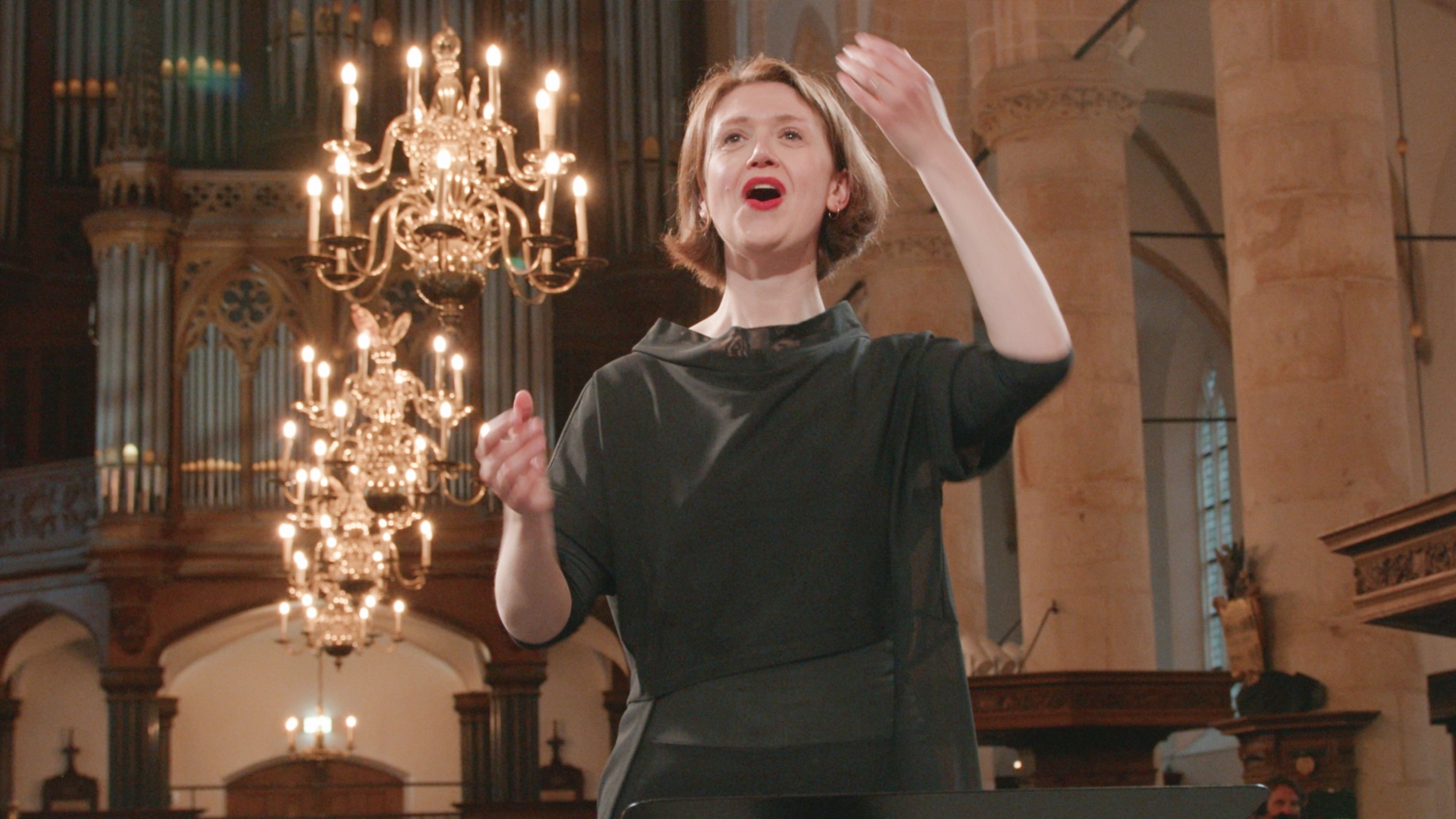
Wer Dank opfert, der preiset mich
BWV 17 performed by the Netherlands Bach Society
conducted by Johanna Soller
Grote Kerk, Naarden
Behind the music
Story
Story
Extra videos
Extra videos
Texts
Texts
Credits
Credits
A surprising lack of variety
Bach intentionally wrote a ‘monotonous’ cantata to emphasise the biblical message
Just like today’s listeners, the church-goers in Leipzig were probably accustomed to variation after a couple of years of Bach’s music. Particularly in his cantatas, Bach seems to be continually searching for a new angle, varied instrumentation or an unexpected timbre.
Cantata Wer Dank opfert, der preiset mich, on the other hand, is surprisingly unvaried, in the main. Firstly, there is no dramatic contrast, such as between suffering and joy, or between fear and redemption, and the glorification and praise of God’s greatness resounds throughout the cantata. But musically speaking, too, the surprise lies mainly in the lack of variation. After hearing two oboes in the opening chorus, we expect them to return in one of the arias, as usual in Bach’s cantatas. But no – after the soprano aria with strings, the tenor aria does not differ greatly in character and instrumentation. Once again, it is an exuberant song of praise for voice and strings alone.
However, this ‘monotony’ may have been precisely the intention. The soprano aria already states the rhetorical question: how can you do anything but continually praise God’s goodness? And the tenor, too, can do nothing but sing the praises of God. This idea comes from the Bible reading for the day on which BWV 17 was first performed, which is about Jesus healing ten sick men. When they left, only one of them turned around, and “when he saw he was cured, he turned back and praised God in a loud voice”. This biblical quote literally forms the central idea in BWV 17, as it is the text of the tenor recitative that comes exactly in the middle of the cantata.
Praising God ‘in a loud voice’ also seems to be the inspiration for the theme of the singing voices in the opening chorus. The melody rises rapidly, covering one and a half octaves within three bars already. Although the first recitative begins with nature as a silent witness to God’s greatness, it ends with the tongue of mankind that is moved to praise Him. A small difference with the printed source from which Bach derived the text for BWV 17 suggests that this idea was in Bach’s mind. Whereas the bass recitative originally included the words ‘with cheerful heart', Bach changed them to ‘with joyous mouth’.
Finally, in the closing chorus, after all that glorification, we do get a sudden surprise after all: an undertone of the awareness of mortality and death.
Vocal texts
Original
1. Chor
Wer Dank opfert, der preiset mich,
und das ist der Weg,
daß ich ihm zeige das Heil Gottes.
2. Rezitativ (A)
Es muß die ganze Welt
ein stummer Zeuge werden
von Gottes hoher Majestät,
Luft, Wasser, Firmament und Erden,
wenn ihre Ordnung als in Schnuren geht;
ihn preiset die Natur mit ungezählten Gaben,
die er ihr in den Schoß gelegt,
und was den Odem hegt,
will noch mehr Anteil an ihm haben,
wenn es zu seinem Ruhm
so Zung als Fittich regt.
3. Aria (S)
Herr, deine Güte reicht,
so weit der Himmel ist,
und deine Wahrheit langt,
so weit die Wolken gehen.
Wüßt ich gleich sonsten nicht,
wie herrlich groß du bist,
so könnt ich es gar leicht
aus deinen Werken sehen.
Wie sollt man dich mit Dank
davor nicht stetig preisen?
da du uns willst
den Weg des Heils
hingegen weisen.
4. Rezitativ (T)
Einer aber unter ihnen,
da er sahe, daß er gesund worden war,
kehrete um und preisete Gott
mit lauter Stimme
und fiel auf sein Angesicht zu seinen Füßen
und dankte ihm,
und das war ein Samariter.
5. Aria (T)
Welch Übermaß der Güte
schenkst du mir!
Doch was gibt mein Gemüte dir dafür?
Herr, ich weiß sonst nichts zu bringen,
als dir Dank und Lob zu singen.
6. Rezitativ (B)
Sieh meinen Willen an,
ich kenne, was ich bin:
Leib, Leben und Verstand,
Gesundheit, Kraft und Sinn,
der du mich läßt
mit frohem Mund genießen,
sind Ströme deiner Gnad,
die du auf mich läßt fließen.
Lieb, Fried, Gerechtigkeit
und Freud in deinem Geist
sind Schätz, dadurch du mir
schon hier ein Vorbild weist,
was Gutes du gedenkst
mir dorten zuzuteilen
und mich an Leib und Seel
vollkommentlich zu heilen.
7. Choral
Wie sich ein Vatr erbarmet
übr seine junge Kindlein klein:
so tut der Herr
uns Armen,
so wir ihn kindlich fürchten rein.
Er kennt das arme Gemächte,
Gott weiß, wir sind nur Staub.
Gleich wie das Gras vom Rechen,
ein Blum und fallendes Laub,
der Wind nur drüber wehet,
so ist es nimmer da:
also der Mensch vergehet,
sein End, das ist ihm nah.
Translation
1. Chorus
Whoever offers thanks, he praises me [God];
and this is the way that I [Jesus]
show him the salvation of God.
2. Recitative (A)
The entire world [of nature]
must become a mute witness
To God’s high majesty:
Air, water, firmament, and earth,
As if their arrangement moves by puppet-string.
Nature praises him by countless gifts
That he has placed in its bosom;
And that which enjoys breath
Desires to have still more portion in him,
If [human] tongue as well as [bird] wing
bestirs to his glory.
3. Aria (S)
Lord, your goodness reaches
as far as the sky is,
And your truth extends
as far as the clouds go.
If I did not yet know otherwise
how gloriously great you are,
I could so easily see it
from your works [of Creation].
How shall one not, in return,
constantly praise you with thanks?
There [in your works],
on the other hand [alongside your Word],
you desire to show us the way of salvation.
4. Recitative (T)
But one among them [the lepers Jesus healed],
when he saw that he had become well,
turned back [toward Jesus] and praised God
with a loud voice
and fell upon his face
at his [Jesus’s] feet and thanked him—
and this was a Samaritan.
5. Aria (T)
What overmeasure of goodness
You bestow on me!
But what does my spirit give you in return?
Lord, I know nothing else to bring
But to sing you thanks and praise.
6. Recitative (B)
Look upon my will;
I know what I am:
Body, life, and understanding;
health, strength, and mind;
[All] of which you let me savor
with enraptured mouth,
Are streams of your grace
that you let flow upon me.
Love, peace, righteousness,
and joy in your [Holy] Spirit
Are treasures through which you show me
now here [on earth] as a prefigurement
Of good things you have in mind
to apportion me there [in heaven],
So as to heal/save me perfectly
in body and soul.
7. Chorale
Like a father has mercy
On his little young children:
The Lord acts in the same way
toward us wretched ones
If we fear him innocently, childlike.
He knows the wretched creature;
We are, Lord knows, but dust.
Just like grass to the rake,
Like a flower and falling foliage,
The wind merely wafts over it,
And it is there no more:
In the same way, the human being passes;
His end, it is near.
transl. © Daniel R. Melamed and Michael Marissen
For the annotated version of the text and translation, see here.
Last update: August 2026
Credits
-
- Release date
- 10 September 2026
-
- Recording date
- 15 May 2026
-
- Location
- Grote Kerk Naarden
-
- Conductor
- Johanna Soller
-
- Soprano
- Carine Tinney
-
- Alto
- Alex Potter
-
- Tenor
- Daniel Johannsen
-
- Bass
- Matthias Winckhler
-
- Ripieno soprano
- Marta Paklar, Valérie Stammet
-
- Ripieno alto
- Sofia Gvirts, Bernadett Nagy
-
- Ripieno tenor
- João Moreira, Emilio Aguilar
-
- Ripieno bass
- Matthew Baker, Vincent Berger
-
- Violin 1
- Evgeny Sviridov, Kirsti Apajalahti, Ruiqi Ren
-
- Violin 2
- Lucia Giraudo, Anneke van Haaften, Annelies van der Vegt
-
- Viola 1
- Deirdre Dowling, Femke Huizinga
-
- Cello
- Albert Brüggen, Luka Stefanovic
-
- Double bass
- Robert Franenberg
-
- Oboe
- Rodrigo López Paz, Katharina Verhaar
-
- Bassoon
- Javier Sánchez Castillo
-
- Organ
- Haru Kitamika
-
- Harpsichord
- Emmanuel Frankenberg
-
- Director and editor
- Bas Wielenga
-
- Music recording
- Guido Tichelman, Lilita Dunska, Pim van der Lee
-
- Music edit and mix
- Guido Tichelman
-
- Dop & datahandling
- Onno van Ameijde
-
- Camera
- Onno van Ameijde, Rieks Soepenberg, Caroline Nutby, Jorne Tielemans
-
- Lights
- Ernst-Jan Thieme, Patrick Galvin, Jochem Vagevuur, Martijn Schoeber
-
- Music reader
- Ferenc Soeteman
-
- Set technique
- Gert-Jan Wieman, Sander Moll
-
- Assistant music recording
- Marloes Biermans
-
- Producer concert
- Stephan Esmeijer
-
- Producer film
- Erik Laarman

Help us to complete All of Bach
There are still many recordings to be made before the whole of Bach’s oeuvre is online. And we can’t complete the task without the financial support of our patrons. Please help us to complete the musical heritage of Bach, by supporting us with a donation!