Auf, auf, mein Herz, mit Freuden
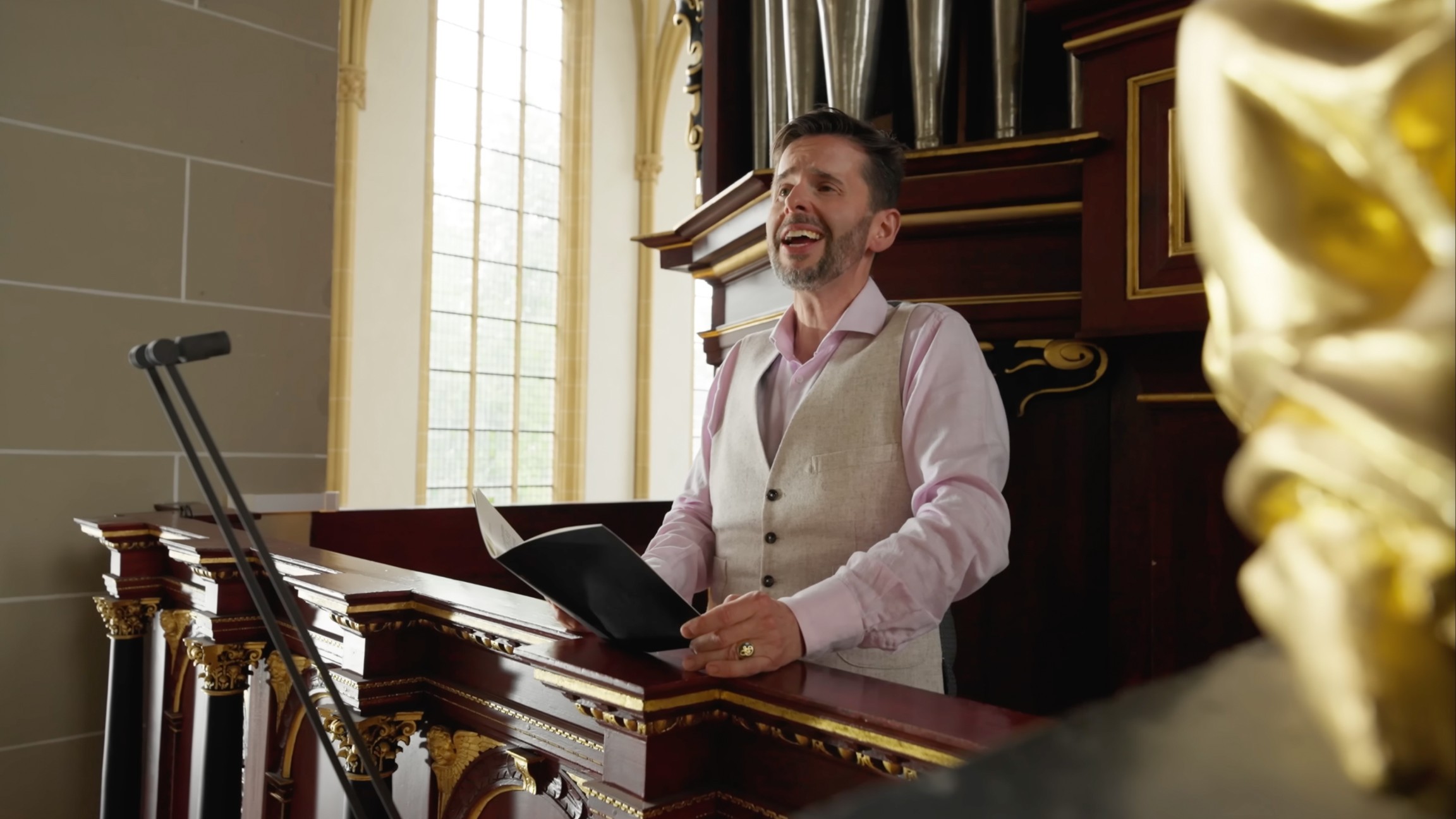
BWV 441 performed by Daniel Johannsen and Leo van Doeselaar
Walburgiskerk, Zutphen
Behind the music
Story
Story
Extra videos
Extra videos
Texts
Texts
Credits
Credits
Joyful ecstasy
A radiant Schemelli song about Christ’s triumph over death
Paul Gerhardt (1607–1676), often referred to as the ‘Lutheran King David’, was a unique poet-theologian who fully deserves to be remembered. He left more than 150 poems in German and Latin, most of which were already set to music by contemporary composers. The most important among them was undoubtedly Johann Crüger (1598–1662), a church composer of remarkable creativity. He also wrote the melody presented here, and like all his settings of Gerhardt, it is a splendid musical arrangement, enriched with instrumental upper Voices.
Bach adopted this beautiful tune almost unchanged in both harmony and melody, smoothing only a few dotted rhythms, as if to portray the joyful ecstasy of Christ’s resurrection in a more composed and reflective way. Still, the lively triple meter (a flowing three-quarter time) loses little of its radiance in the Schemelli version.
Gerhardt’s words speak with a boldness born of faith: theological truths are indeed proclaimed, yet the believing, singing soul repeatedly bursts into jubilation, for absolutely nothing can diminish Christ’s triumph over death and hell. And what always touches the heart so deeply in Gerhardt’s work: Jesus takes who trust in Him by the hand and leading him as His companion (‘Gesell’) across mountains and valleys. Wonderful is the image of the golden inscription above Heaven’s gate, which reads: ‘Wer dort wird mit verhöhnt, wird hier auch mit gekrönt’ )Whoever there (on earth) is often scorned, will be crowned here (in paradise) all the more). A powerful message, which Bach expresses beautifully through music.
Musicalisches Gesang-Buch G.C. Schemelli
In the eighteenth century, sacred songbooks for private use were an important aid in simple, domestic devotion. For example, no fewer than 17 editions of Johann Freylinghausen’s Geistreiches Gesangbuch were published between 1704 and 1734. Two years later, pietist Georg Christian Schemmel, alias Schemelli, launched his own songbook, containing no fewer than 954 songs, 69 of which included melody, text incipit and figured bass. In order to outdo the competition, he involved probably the most famous music consultant of all time, who happened to be his son’s music teacher: Bach. Following intensive research, only three of the 21 original melodies in the collection (BWV 439-509) can be attributed with certainty to the cantor at the Thomasschule: BWV 452, 478 and 505. The others are accompaniments, revisions and improvements. Bach’s precise role in Schemelli’s Gesangbuch will probably always remain a mystery.
Extra videos
Daniel Johannsen about freedom in baroque
"In this baroque music, you can take your freedom, especially in the recits"
Vocal texts
Original
Auf! mein Herz, mit Freuden, nimm wahr,
was heut geschicht,
wie kommt nach großen Leiden
nun ein so großes Licht!
Mein Heiland ward gelegt,
da, wo man uns hinträgt,
wenn von uns unser Geist
gen Himmel ist gereist.
Er war ins Grab gesenket,
der Feind trieb groß Geschrei,
eh ers vermeint und denket,
ist Christus wieder frei
und ruft Viktoria,
schwingt fröhlich hie und da
sein Fähnlein als ein Held,
der Feld und Mut behält.
Ich hang und bleib auch hangen
an Christo als ein Glied,
wo mein Haupt durchgegangen,
da nimmt es mich auch mit.
Er reiset durch den Tod,
durch Welt, durch Sünd und Not,
er reiset durch die Höll,
ich bin stets sein Gesell.
Er bringt uns an die Pforten,
die in den Himmel führt,
daran mit güldnen Worten
der Reim gelesen wird:
Wer dort wird mit verhöhnt
wird hier auch mit gekrönt,
wer dort mit Sterben geht,
wird hier auch mit erhöht.
Translation
Awake, my heart, with gladness,
See what today is done;
Now, after gloom and sadness,
Comes forth the glorious Sun.
My Savior there was laid
Where our bed must be made
When to the realms of light
Our spirit wings its flight.
The foe in triumph shouted
When Christ lay in the tomb;
But, lo, he now is routed,
His boast is turned to gloom.
For Christ again is free;
In glorious victory
He Who is strong to save
Has triumphed o’er the grave.
Now I will cling forever
To Christ, my Savior true;
My Lord will leave me never,
Whate’er He passeth through.
He rends Death’s iron chain,
He breaks through sin and pain,
He shatters hell’s dark thrall,
I follow Him through all.
That leads to bliss untold,
Whereon this rhyme immortal
Is found in script of gold:
“Who there My cross hath shared
Finds here a crown prepared;
Who there with Me hath died
Shall here be glorified.”
Vertaling: John Kelly
Credits
-
- Release date
- 16 April 2026
-
- Recording date
- 28 May 2024
-
- Location
- Walburgiskerk, Zutphen
-
- Tenor
- Daniel Johannsen
-
- Organ
- Leo van Doeselaar
-
- Instrument
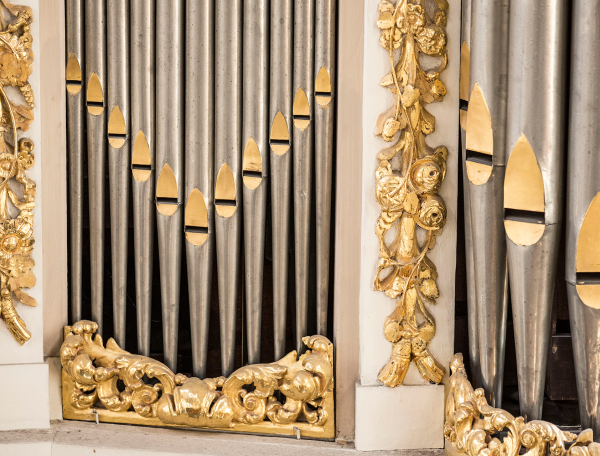
- Henrick Bader, 1639/1643
-
- Director and editor
- Gijs Besseling
-
- Music recording
- Guido Tichelman, Pim van der Lee
-
- Music edit and mix
- Guido Tichelman
-
- Camera
- Danny Noordanus, Manon Hoskens, Remco van Leest
-
- Grip
- Wouter Visser
-
- Assistant music recording
- Marloes Biermans
-
- Producer
- Lisanne Marlou de Kok

Help us to complete All of Bach
There are still many recordings to be made before the whole of Bach’s oeuvre is online. And we can’t complete the task without the financial support of our patrons. Please help us to complete the musical heritage of Bach, by supporting us with a donation!