Brich entzwei, mein armes Herze
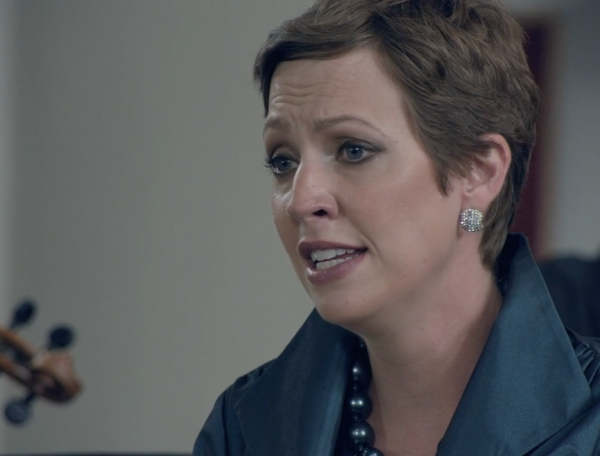
BWV 444 performed by Michaela Riener and Menno van Delft
Kasteel Amerongen, Amerongen
Behind the music
Story
Story
Extra videos
Extra videos
Texts
Texts
Credits
Credits
Accessible simplicity
This poignantly sincere song revolves around emotions
Brich entzwei, mein armes Herze, BWV 444, is an atypical composition for Bach. The sacred song sounds very simple. In contrast to most of Bach’s virtuoso vocal works, sacred songs were intended to be sung in the home. The melody is clear and pure: even those with a limited range could sing along easily. The accompaniment is equally accessible, with chords briefly indicated above a straightforward bass line, rather like the way pop musicians notate their music. So with a bit of practice, this song could be performed by anyone with a little musical training. All that was needed was a voice and a low instrument of your own choosing.
The song comes from a book of 954 sacred songs published by Bach’s fellow composer Georg Christian Schemelli. Schemelli’s son had probably taken lessons from Bach at the Thomasschool, where Bach taught. It has been established that Bach wrote three of these songs, and BWV 444 is one of the dubious cases. It is very likely that Bach only put the finishing touches to it. It hardly mattered to Bach, as he never signed his own compositions with his name, always concluding with the letters ‘SDG’, an abbreviation of the Latin phrase ‘Soli Deo Gloria’ meaning ‘glory to God alone’.
The poignantly sincere text is easy to understand. It is a lament that sounds like a hymn of praise. Although the subject is the death of Jesus, you hear the sunbeams of his resurrection in the harmonies. The personal tone is fitting for a theological movement that was gaining ground in Bach’s day: Pietism, which revolved around the emotions of the faithful and around living a pious life.
Musicalisches Gesang-Buch G.C. Schemelli
In the eighteenth century, sacred songbooks for private use were an important aid in simple, domestic devotion. For example, no fewer than 17 editions of Johann Freylinghausen’s Geistreiches Gesangbuch were published between 1704 and 1734. Two years later, pietist Georg Christian Schemmel, alias Schemelli, launched his own songbook, containing no fewer than 954 songs, 69 of which included melody, text incipit and figured bass. In order to outdo the competition, he involved probably the most famous music consultant of all time, who happened to be his son’s music teacher: Bach. Following intensive research, only three of the 21 original melodies in the collection (BWV 439-509) can be attributed with certainty to the cantor at the Thomasschule: BWV 452, 478 and 505. The others are accompaniments, revisions and improvements. Bach’s precise role in Schemelli’s Gesangbuch will probably always remain a mystery.
Extra videos
Vocal texts
Original
1.
Brich entzwei, mein armes Herze,
mein armes Herze, brich entzwei
ach mein Schmerz! der große Schmerze
der ist so viel und mancherlei
der Himmel zittert,
die Erde schüttert.
Ach Not! Ach Not! Ach Not!
Jesulein, mein Schatz, ist tot,
mein Schatz ist tot!
6.
Lasse, Welt, itzt Lust und Trinken,
ach! weinet vielmehr, die ihr lebt,
itzund muss der König sinken,
der über alles lebt und schwebt,
die toten Frommen,
die müssen kommen.
Ach Not! Ach Not! Ach Not!
Jesulein, mein Schatz, ist tot,
mein Schatz ist tot!
7.
Jesulein, mein Schatz und Leben,
hier bring ich mein Herz, nimm es an,
das soll sich der Welt begeben,
soll weinen, heulen was es kann,
so lang sichs reget
und sich beweget.
Ach Not! Ach Not! Ach Not!
Jesulein, mein Schatz, ist tot,
mein Schatz ist tot!
8.
Jesulein, mein Schatz, ist blieben,
ach! jämmerlich an einem Pfahl.
Ach, mein Schatz! den ich muss lieben
in Ewigkeit und überall,
den ich muss missen
und nicht mehr küssen.
Ach Not! Ach Not! Ach Not
Jesulein, mein Schatz, ist tot,
mein Schatz ist tot!
Translation
1.
Break in two, my heart, in anguish,
my mournful heart, oh, break in two.
Oh in such great pain I languish,
so great and many, through and through.
The heavens are shaking,
the earth is quaking.
Oh woe! Oh woe! Oh woe!
Jesus, treasured one, is dead,
my treasure’s dead!
6.
Drop your worldly joys and drinking,
oh, weep instead that you draw breath,
while the King himself is sinking,
who lives and reigns past life and death.
The faithful remnant,
now rise, transcendent.
Oh woe! Oh woe! Oh woe!
Jesus, treasured one, is dead,
my treasure’s dead!
7.
Jesus, all my life and treasure,
Accept my heart, I give it now,
let it fill the world, unmeasured,
to weep and wail as it knows how,
while it’s still beating,
while it’s still breathing.
Oh woe! Oh woe! Oh woe!
Jesus, treasured one, is dead,
my treasure’s dead!
8.
Jesus hangs there, my beloved,
he hangs in torment on the Tree.
Oh, my dearest, I must love him
both now and in eternity,
for I must miss him,
no longer kiss him.
Oh woe! Oh woe! Oh woe!
Jesus, treasured one, is dead,
my treasure’s dead!
translation © Ruth van Baak Griffioen, 2026
Credits
-
- Release date
- 26 March 2026
-
- Recording date
- 2 April 2025
-
- Location
- Kasteel Amerongen, Amerongen
-
- Mezzo-soprano
- Michaela Riener
-
- Organ
- Menno van Delft
-
- Calcant
- Joop Muller
-
- Director and editor
- Onno van Ameijde
-
- Music recording
- Guido Tichelman, Pim van der Lee
-
- Music edit and mix
- Guido Tichelman
-
- Camera
- Onno van Ameijde, Rieks Soepenberg, Joost Kuiper
-
- Lights
- Patrick Galvin
-
- Datahandling
- Stefan Ebels
-
- Assistant music recording
- Marloes Biermans
-
- Producer film
- Lisanne Marlou de Kok
Help us to complete All of Bach
There are still many recordings to be made before the whole of Bach’s oeuvre is online. And we can’t complete the task without the financial support of our patrons. Please help us to complete the musical heritage of Bach, by supporting us with a donation!