Gott, wie groẞ ist deine Güte
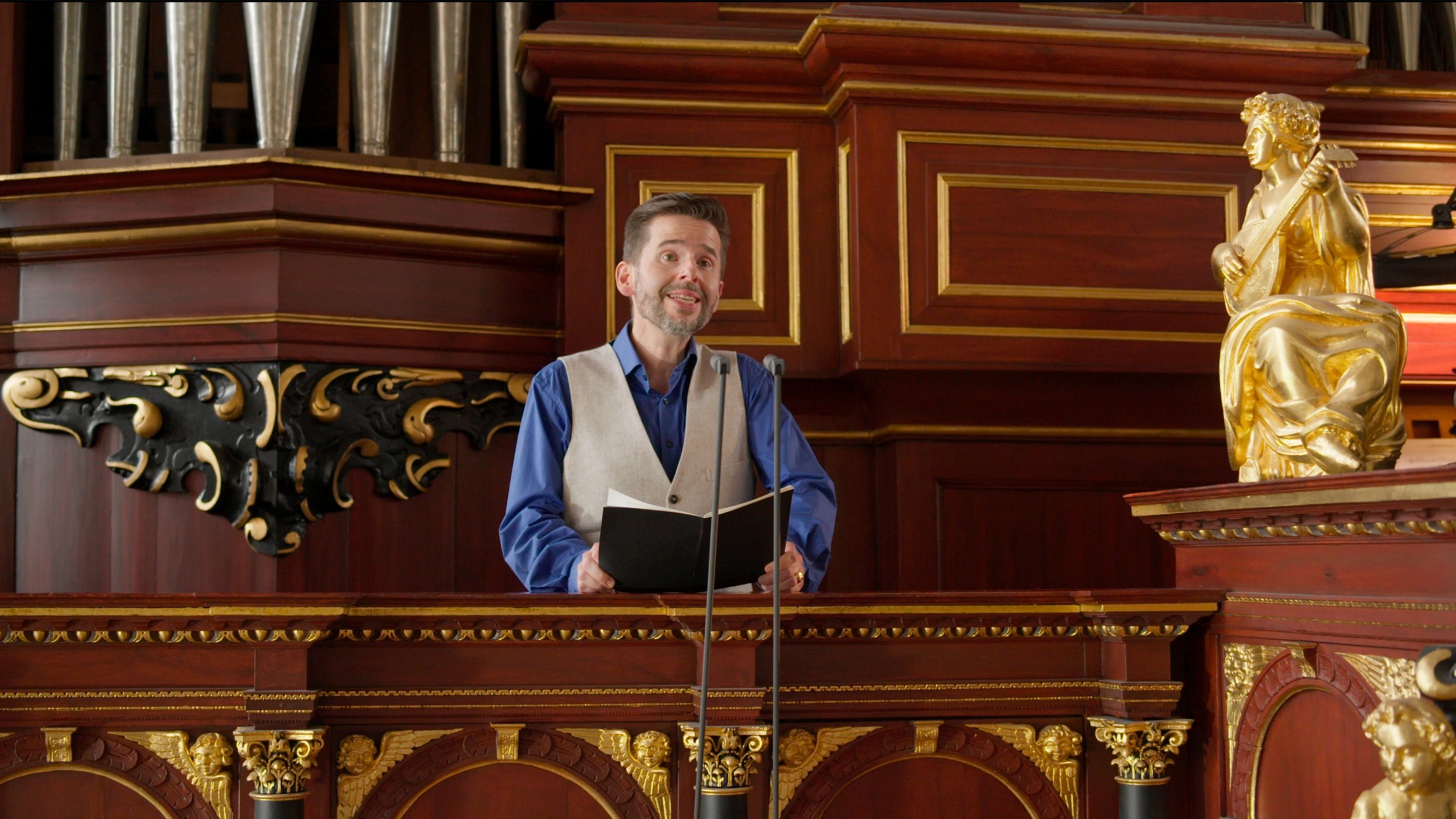
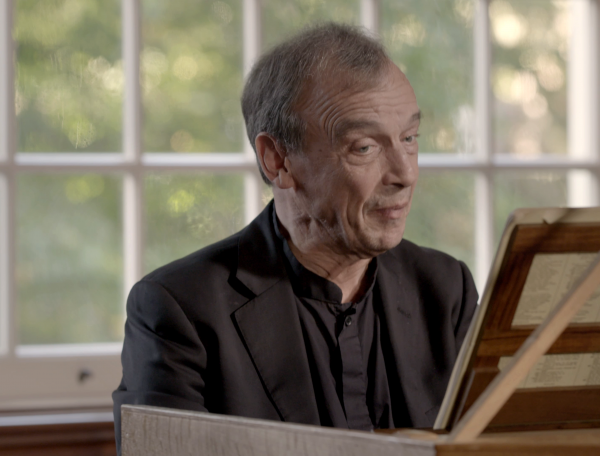
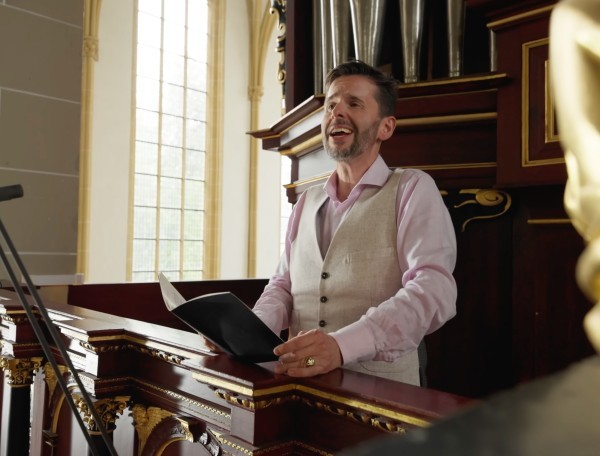
BWV 462 performed by Daniel Johannsen and Matthias Havinga
Walburgiskerk, Zutphen
Behind the music
Story
Story
Extra videos
Extra videos
Texts
Texts
Credits
Credits
Bach x Schemelli
A calm and serene hymn about faith in God
In 1736 pietist Schemelli launched a songbook for domestic devotion, containing no fewer than 954 songs, 69 of which included melody, text incipit and figured bass. It is assumed that some of the 69 printed melodies were written by Bach – this would have been part of his duties as a church musician. Bach furthermore was the music teacher of Schemelli’s son.
Striking is the clearly attested fact that Schemelli himself wrote the four stanzas of this song, Gott, wie groß ist deine Güte. The text is finely crafted, though not on the level of Paul Gerhardt or Georg Neumark, famous lyricists of his time. But it offers a revealing glimpse into the mind of the man who spared neither expense nor effort to have a hymnal of 954 songs printed. It likely moved Bach to include this poem among the settings of Schemelli's songbook he carefully arranged.
Perhaps this was also a gesture of respect by Bach towards Mr. Schemmel, as he was originally called. The melody – otherwise unattested – could even be Schemelli’s own. It is certainly noble and refined enough: flowing eighth-note motion in both the vocal line and the bass, beautifully balanced, with splendid modulations. Yet even without an explicit authorial note, suspicion quickly turns toward J. S. Bach.
Gratitude for God’s goodness and praise of his mercy were themes close to Bach. Gratitude despite illness and the loss of ten children, may seem almost beyond comprehension today. Yet in this song from the 1730s we encounter a calm, confident, even serene faith.
Musicalisches Gesang-Buch G.C. Schemelli
In the eighteenth century, sacred songbooks for private use were an important aid in simple, domestic devotion. For example, no fewer than 17 editions of Johann Freylinghausen’s Geistreiches Gesangbuch were published between 1704 and 1734. Two years later, pietist Georg Christian Schemmel, alias Schemelli, launched his own songbook, containing no fewer than 954 songs, 69 of which included melody, text incipit and figured bass. In order to outdo the competition, he involved probably the most famous music consultant of all time, who happened to be his son’s music teacher: Bach. Following intensive research, only three of the 21 original melodies in the collection (BWV 439-509) can be attributed with certainty to the cantor at the Thomasschule: BWV 452, 478 and 505. The others are accompaniments, revisions and improvements. Bach’s precise role in Schemelli’s Gesangbuch will probably always remain a mystery.
Extra videos
Daniel Johannsen about freedom in baroque
"In this baroque music, you can take your freedom, especially in the recits"
Vocal texts
Original
Gott, wie groß ist deine Güte!
die mein Herz auf Erden schmeckt.
Ach! wie labt sich mein Gemüte,
wenn mich Not und Tod erschreckt.
Wenn mich etwas will betrüben,
wenn mich meine Sünde presst,
zeiget sie von deinem Lieben,
das mich nicht verzagen lässt.
Drauf ich mich zufrieden stelle
und Trotz bieten kann der Hölle.
Deine Güte ist mein Leben
und mein allerbestes Teil,
das niemand, als du, kann geben,
du mein auserwähltes Heil.
Alles, was die Welt besitzet,
womit sie zu prangen pflegt,
hat noch keinen nie genützet,
ja wenn mans genau erwägt,
senkt es manchen ins Verderben,
dass er hier und dort muss sterben.
Besser macht es deine Güte,
die bewahret Leib und Seel,
denn die erste Lebensblüte
wird bewahret durch dies Öl.
Niemand kann sein Leben fristen,
auch nicht einen Augenblick,
weil wir gleich vergehen müssten,
wo du diese zögst zurück;
niemand kann sich von dem Bösen
sonder deiner Güt erlösen.
Darum bitt ich deine Güte,
deine Gnade und Wundertreu,
o mein Vater! mich behüte,
dass ich nicht verlassen sei.
Stärke mich mit deinem Geiste,
wenn ich werde hingerafft,
und vor allen, was das meiste,
gib mir stets des Glaubens Kraft;
lass mich deine Liebe schmecken,
wenn du mich wirst auferwecken.
Translation
God, how great is your grand goodness
that my heart on earth is blessed.
How my soul, refreshed in fullness,
when I fear death and distress.
When my heart and mind are troubled,
under my sin’s load of care,
it bears witness to your loving
that will not let me despair.
Thus content, I place reliance
And to Hell can bid defiance.
Your great goodness is my living
and of that, the greatest part.
None compares with you for giving,
chosen Savior of my heart.
Everything the world possesses,
which it boasts of constantly,
always turns out to be worthless
when one weighs it carefully.
Ruin sinks all their endeavor
so they die, now and forever.
For far better is your goodness,
which preserves us, life and soul,
from the first bloom of existence
guarded by this holy oil.
Our life’s span we cannot cherish,
not one moment or one day;
in an instant we would perish
if you took our breath away.
And from evil’s profanation
only you provide salvation.
So I pray for your great goodness,
wondrous faithfulness and grace
o my Father, please protect me,
not forsaken, keep me safe.
Strengthen me then with your Spirit
when I’m called away by death,
and above all else in merit,
give me always strength of faith;
may I taste your love’s delight
when you raise me back to life.
translation © Ruth van Baak Griffioen, June 2026
Credits
-
- Release date
- 4 June 2026
-
- Recording date
- 28 May 2024
-
- Location
- Walburgiskerk, Zutphen
-
- Tenor
- Daniel Johannsen
-
- Organ
- Matthias Havinga
-
- Instrument
- Henrick Bader, 1639/1643
-
- Director and editor
- Gijs Besseling
-
- Music recording
- Guido Tichelman, Pim van der Lee
-
- Music edit and mix
- Guido Tichelman
-
- Camera
- Danny Noordanus, Manon Hoskens, Remco van Leest
-
- Grip
- Wouter Visser
-
- Assistant music recording
- Marloes Biermans
-
- Producer
- Lisanne Marlou de Kok
Help us to complete All of Bach
There are still many recordings to be made before the whole of Bach’s oeuvre is online. And we can’t complete the task without the financial support of our patrons. Please help us to complete the musical heritage of Bach, by supporting us with a donation!