Ach Gott, wie manches Herzeleid
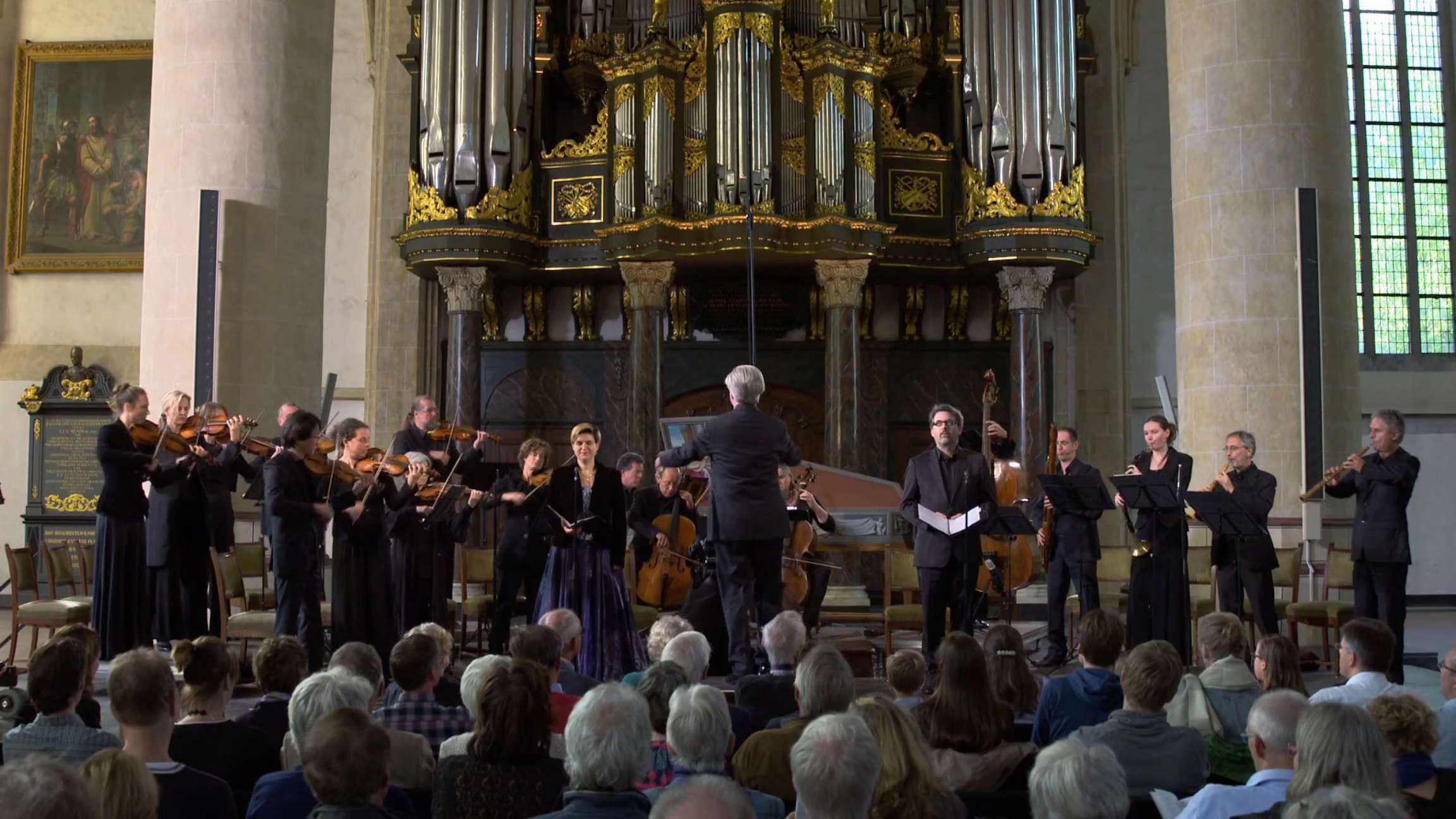
BWV 58 performed by the Netherlands Bach Society
conducted by Jos van Veldhoven
St. Martin's Church, Groningen
Behind the music
Story
Story
Extra videos
Extra videos
Texts
Texts
Credits
Credits
Efficient frugality
Bach illustrates loneliness extremely effectively with an austere instrumentation
Right at the outset of this piece, Bach makes an abrupt ending to the festive spirit of Christmas with a heartrending aria. It is the first Sunday after New Year’s Day and the sermon is about the story of the Massacre of the Innocents. Herod, afraid that he would lose his throne to Jesus, ordered the massacre of all the children of Bethlehem. Joseph, however, had received a warning, and escaped with Mary and Jesus to Egypt. All the other children were killed.
This great suffering is expressed in the opening aria: a drawn-out sarabande with austere instrumentation. The suffering soul, a soprano, sings the cheerless words of the first verse of the chorale ‘Ach Gott, wie manches Herzeleid’, accompanied by a descending plaintive bass line. The bass, Jesus, interrupts rather more cheerfully, advising patience, as the path to salvation is not strewn with roses.
The turning point of this laboured cantata comes in the extraordinarily beautiful soprano aria, in which the tormented soul – supported by a radiant violin part and in the knowledge that Jesus has been saved – comes to terms with her suffering. At the end of this completely symmetrical cantata, when the duo once again enter into dialogue, we hear the second verse of another chorale: ‘O Jesu Christ, meins Lebens Licht’. A festive fanfare erupts, as the soprano has accepted her devotion and looks forward to the eternal comfort of Jesus.
The exceptional beauty of this gem from 1727 lies in the combination of the limited means and the loneliness caused by the suffering. Even when Bach added a trio of two oboes and an alto oboe to the outer movements, for a later performance around 1733, he still did not put in any solo wind passages. Only right at the end are the trio allowed to give a festive hint of the hope of paradise. And it was, of course, considerate of Bach to think of his musicians, who could certainly have done with a breather after the busy Christmas period and just before the Epiphany festivities on 6 January.
Extra videos
Vocal texts
Original
1. Arie und Choral (Sopran, Bass)
Ach Gott, wie manches Herzeleid
Nur Geduld, Geduld, mein Herze,
begegnet mir zu dieser Zeit!
es ist eine böse Zeit!
Der schmale Weg ist Trübsals voll,
Doch der Gang zur Seligkeit
den ich zum Himmel wandern soll.
führt zur Freude nach dem Schmerze.
Nur Geduld, Geduld, mein Herze,
Es ist eine böse Zeit!
2. Rezitativ (Bass)
Verfolgt dich gleich die arge Welt,
so hast du dennoch Gott zum Freunde,
der wider deine Feinde
dir stets den Rücken hält.
Und wenn der wütende Herodes
das Urteil eines schmähen Todes
gleich über unsern Heiland fällt,
so kommt ein Engel in der Nacht,
der lässet Joseph träumen,
dass er dem Würger soll entfliehen
und nach Ägypten ziehen.
Gott hat ein Wort, das dich vertrauend macht.
Er spricht: ‘Wenn Berg und Hügel niedersinken,
wenn dich die Flut des Wassers will ertrinken,
so will ich dich doch nicht verlassen
noch versäumen.
3. Arie (Sopran)
Ich bin vergnügt in meinem Leiden,
denn Gott ist meine Zuversicht.
Ich habe sichern Brief und Siegel,
und dieses ist der feste Riegel,
den bricht auch selbst die Hölle nicht.
4. Rezitativ (Sopran)
Kann es die Welt nicht lassen,
mich zu verfolgen und zu hassen,
so weist mir Gottes Hand
ein andres Land.
Ach! könnt es heute noch geschehen,
dass ich mein Eden möchte sehen!
5. Arie und Choral (Sopran, Bass)
Ich hab für mir ein schwere Reis
Nur getrost, getrost, ihr Herzen,
zu dir ins Himmels Paradeis,
hier ist Angst, dort Herrlichkeit!
Da ist mein rechtes Vaterland,
Und die Freude jener Zeit
daran du dein Blut hast gewandt.
Überwieget alle Schmerzen.
Nur getrost, getrost, ihr Herzen,
hier ist Angst, dort Herrlichkeit!
Translation
1. Chorale and Aria (Soprano, Bass)
Ah, God, how much heartache
Patience, only patience, my heart,
do I encounter at this time!
it is an evil time!
The narrow path is full of trouble
Yet the way to blessedness
that I shall follow to heaven.
leads to joy after pain.
Patience, only patience, my heart,
it is an evil time!
2. Recitative (Bass)
Though the angry world might persecute you,
yet you still have God as a friend,
Who guards your back constantly
against your enemies.
And when the raging Herod
decrees a shameful death
even against our Savior,
then an angel comes by night
and has Joseph dream
that he should flee the strangler
and go into Egypt.
God has a word, that makes you confident.
He says: though hill and mountain sink down,
though the water's flood seeks to drown you,
even then I will not abandon
or forsake you.
3. Aria (Soprano)
I am content in my sorrow,
for God is my confidence.
I have the certain letter and seal,
and this is the secure bolt,
that even Hell itself cannot break.
4. Recitative (Soprano)
If the world cannot cease
to persecute and hate me,
God's hand shows me
a different land.
Ah! Could it only happen today,
that I might see my Eden!
5. Chorale and Aria (Soprano, Bass)
I have a difficult journey before me
Be comforted, comforted now, you hearts,
to You in heaven's paradise,
here is fear, there blessedness!
there is my true fatherland,
and the happiness of that time
for which You have shed Your blood.
outweighs all suffering.
Be comforted, comforted now, you hearts,
here is fear, there blessedness!
Translation © Pamela Dellal
Credits
-
- Release date
- 20 January 2017
-
- Recording date
- 26 September 2015
-
- Location
- St. Martin's Church, Groningen
-
- Conductor
- Jos van Veldhoven
-
- Soprano
- Monika Mauch
-
- Bass
- Stephan MacLeod
-
- Violin 1
- Shunske Sato, Annabelle Ferdinand, Anneke van Haaften, Annelies van der Vegt
-
- Violin 2
- Sayuri Yamagata, Pieter Affourtit, Paulien Kostense
-
- Viola
- Staas Swierstra, Deirdre Dowling
-
- Cello
- Lucia Swarts, Richte van der Meer
-
- Double bass
- Robert Franenberg
-
- Oboe
- Martin Stadler
-
- Oboe 2
- Peter Frankenberg
-
- Taille
- Hanna Lindeijer
-
- Bassoon
- Benny Aghassi
-
- Organ
- Leo van Doeselaar
-
- Harpsichord
- Siebe Henstra
-
- Director
- Simon Aarden
-
- Editor
- Pjotr 's Gravesande
-
- Assistant director
- Niek Wijns
-
- Music recording
- Guido Tichelman, Bastiaan Kuijt, Micha de Kanter
-
- Music edit and mix
- Guido Tichelman
-
- Camera
- Jorrit Garretsen, Bart Ten Harkel, Chris Reichgelt, Jochem Timmerman
-
- Lights
- Daan de Boer
-
- Lighting assistant
- Gijs 't Hoen
-
- Video engeneer
- Niels Cnossen
-
- Set technique
- Marco Korzelius
-
- Project manager nep
- Peter Ribbens
-
- Interview
- Onno van Ameijde
-
- Producer concert
- Marco Meijdam, Imke Deters
-
- Producer film
- Jessie Verbrugh
-
- Acknowledgements
- Jan Haak


Help us to complete All of Bach
There are still many recordings to be made before the whole of Bach’s oeuvre is online. And we can’t complete the task without the financial support of our patrons. Please help us to complete the musical heritage of Bach, by supporting us with a donation!