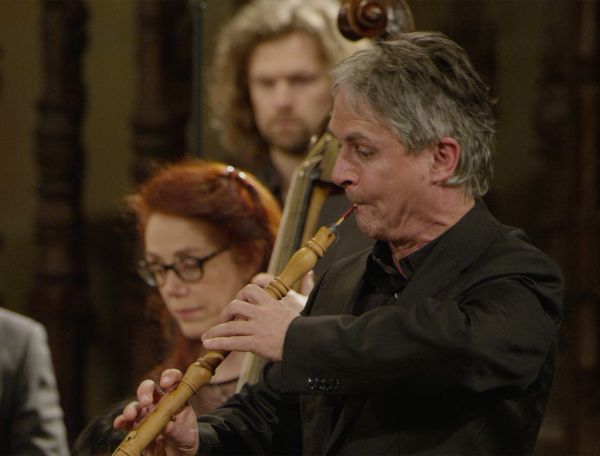
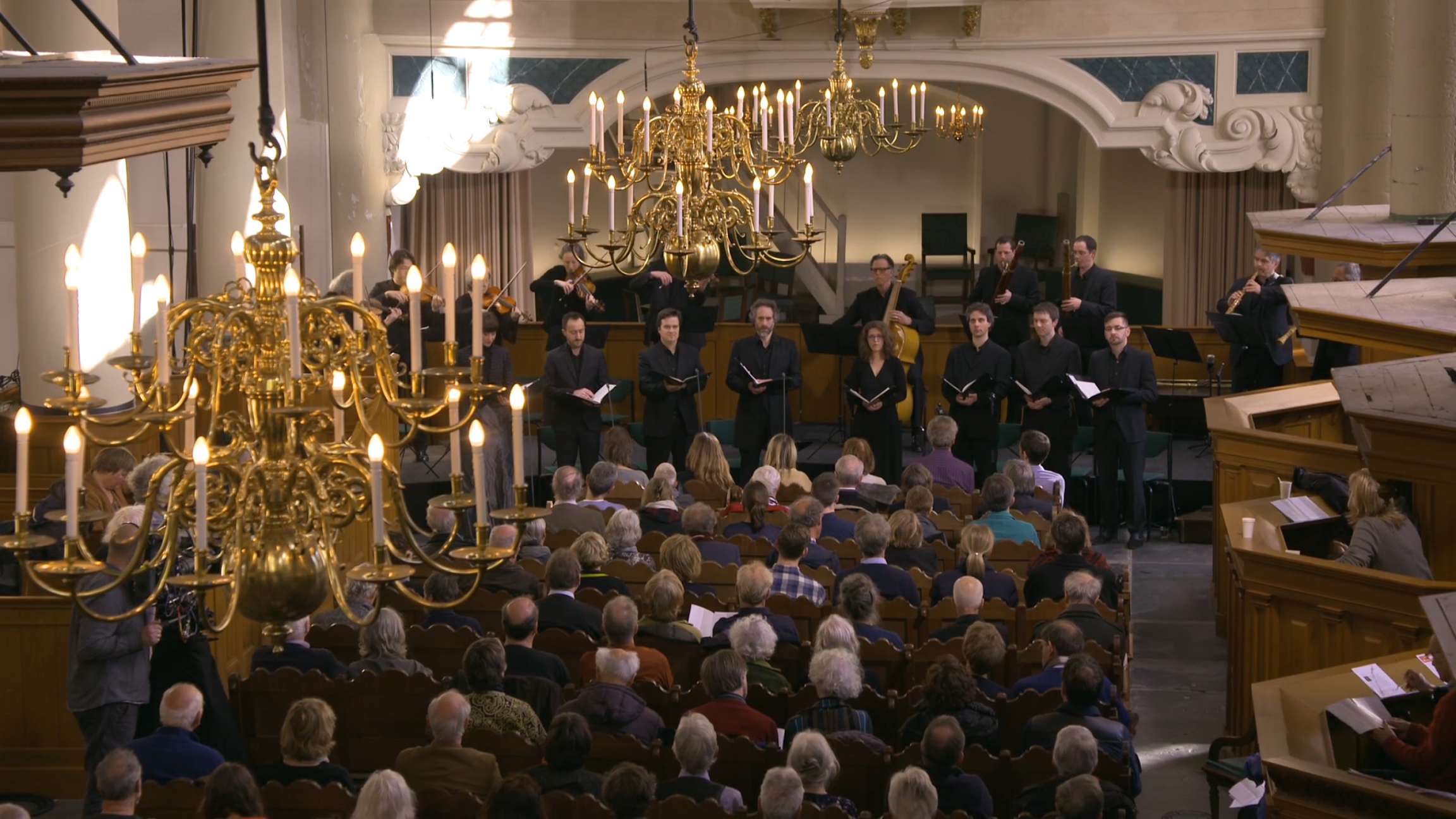
Die Elenden sollen essen
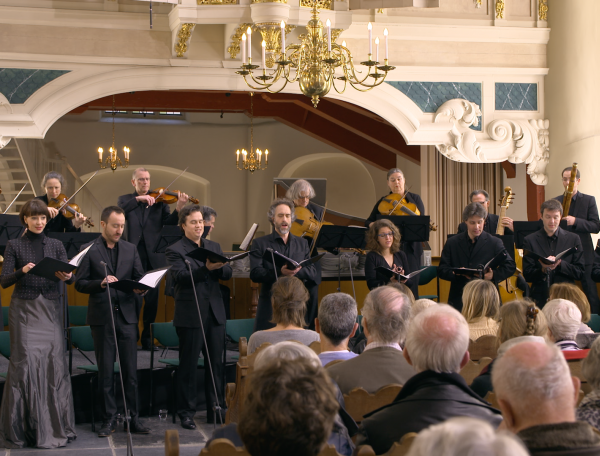
BWV 75 performed by the Netherlands Bach Society
conducted by Sigiswald Kuijken
Waloon Church, Amsterdam
Behind the music
Story
Story
Extra videos
Extra videos
Texts
Texts
Credits
Credits
Maiden speech
Bach broke the ice on the first Sunday in his new post
Bach’s cantata Die Elenden sollen essen broke the ice in his new post. At last his appointment as cantor in Leipzig had been finalised and he had moved with his family from Köthen to Leipzig on 22 May 1723. And his first actual duties as cantor were carried out at the service on Sunday 30 May 1723.
The cantata he composed especially for this service comprised two parts, which were performed before and after the sermon. The two parts are divided in turn into 14 sections – the Bach number. If you number all the letters of the alphabet from 1 to 26 and then add up the values of the b, a, c and h, you get 14. Bach often used this number as a sort of signature.
The piece revolves around the contrast between the poverty of earthly life and the true riches of heaven. Bach thus linked up nicely to the reading that preceded the cantata: the parable of Lazarus and the rich man. Earthly riches turn out to be of no value in heaven.
The opening section resembles a French ouverture; music that was used to announce the entrance of a king. Maybe Bach was writing his own tongue-in-cheek ceremonious entrance. Violone player Robert Franenberg can well imagine this to be the case.
Three of the four arias take their rhythm from a dance: a polonaise, a minuet and a passepied respectively. A major role is also played by the chorale ‘Was Gott tut, das ist wohlgetan’, which recurs as a sort of motto in both identical closing sections, as well as in the instrumental opening of the second part. Bach thus presents himself to his new audience as a ‘contemporary’ composer who is not afraid of using elements considered modern at the time and putting his own mark on them.
Extra videos
Vocal texts
Original
Erster Teil
1. Chor
Die Elenden sollen essen,
dass sie satt werden,
und die nach dem Herrn fragen,
werden ihn preisen.
Euer Herz soll ewiglich leben.
2. Rezitativ (Bass)
Was hilft des Purpurs Majestät,
da sie vergeht?
Was hilft der größte Überfluss,
weil alles, so wir sehen,
verschwinden muss?
Was hilft der Kitzel eitler Sinnen,
denn unser Leib muss selbst von hinnen?
Ach, wie geschwind ist es geschehen,
dass Reichtum, Wollust, Pracht
den Geist zur Hölle macht!
3. Arie (Tenor)
Mein Jesus soll mein Alles sein!
Mein Purpur ist sein teures Blut,
er selbst mein allerhöchstes Gut,
und seines Geistes Liebesglut
mein allersüß’ster Freudenwein.
4. Rezitativ (Tenor)
Gott stürzet und erhöhet
in Zeit und Ewigkeit.
Wer in der Welt den Himmel sucht,
wird dort verflucht.
Wer aber hier die Hölle überstehet,
wird dort erfreut.
5. Arie (Sopran)
Ich nehme mein Leiden mit Freuden auf mich.
Wer Lazarus’ Plagen geduldig ertragen,
den nehmen die Engel zu sich.
6. Rezitativ (Sopran)
Indes schenkt Gott ein gut’ Gewissen,
dabei ein Christe kann
ein kleines Gut mit großer Lust genießen.
Ja, führt er auch
durch lange Not zum Tod,
so ist es doch am Ende wohlgetan.
7. Choral
Was Gott tut, das ist wohlgetan;
muss ich den Kelch gleich schmecken,
der bitter ist nach meinem Wahn,
lass ich mich doch nicht schrecken,
weil doch zuletzt
ich werd’ ergötzt
mit süßem Trost im Herzen;
da weichen alle Schmerzen.
Zweiter Teil
8. Sinfonia
9. Rezitativ (Alt)
Nur eines kränkt
ein christliches Gemüte:
Wenn es an seines Geistes Armut denkt.
Es gläubt zwar Gottes Güte,
die alles neu erschafft;
doch mangelt ihm die Kraft,
dem überirds’chen Leben
das Wachstum und die Frucht zu geben.
10. Arie (Alt)
Jesus macht mich geistlich reich.
Kann ich seinen Geist empfangen,
will ich weiter nichts verlangen;
denn mein Leben wächst zugleich.
Jesus macht mich geistlich reich.
11. Rezitativ (Bass)
Wer nur in Jesu bleibt,
die Selbstverleugnung treibt,
dass er in Gottes Liebe
sich gläubig übe,
hat, wenn das Irdische verschwunden,
sich selbst und Gott gefunden.
12. Arie (Bass)
Mein Herze glaubt und liebt.
Denn Jesu süße Flammen,
aus den’ die meinen stammen,
gehn über mich zusammen,
weil er sich mir ergibt.
13. Rezitativ (Tenor)
O Armut, der kein Reichtum gleicht!
Wenn aus dem Herzen
die ganze Welt entweicht
und Jesus nur allein regiert,
so wird ein Christ zu Gott geführt!
Gib, Gott, dass wir es nicht verscherzen!
14. Choral
Was Gott tut, das ist wohlgetan,
dabei will ich verbleiben.
Es mag mich auf die raue Bahn
Not, Tod und Elend treiben;
so wird Gott mich
ganz väterlich
in seinen Armen halten;
drum lass ich ihn nur walten.
Translation
Part One
1. Chorus
The meek shall eat
and be satisfied:
they shall praise the Lord
that seek Him.
Your heart shalllive for ever.
2. Recitative (Bass)
What does purple majesty avail,
since it perishes?
What avails the greatest abundance,
since all things that we see
must vanish?
What does the arousal of vain senses avail,
since our body itself must die?
Ah, how swiftly has it come to pass
that riches, pleasure, pomp
condemn the soul to hell!
3. Aria (Tenor)
My Jesus shall be my all!
My purple is His precious blood,
Himself my most exalted wealth,
and the glowing love of His spirit
my sweetest wine of joy.
4. Recitative (Tenor)
God casts down and raises up
both now and in eternity.
Who in the world would seek heaven,
is cursed there.
But he who overcomes hell on earth,
shall find joy in heaven.
5. Aria (Soprano)
I joyfully accept my suffering.
Who bears with patience the torments of Lazarus,
is taken by angels to heaven.
6. Recitative (Soprano)
God meanwhile provides a clear conscience,
so that a Christian can
enjoy simple things with great joy.
Yea, though he pass
through prolonged anguish to death,
all in the end shall be well.
7. Chorale
What God doth, is well done;
though I must drink of the cup
that tastes bitter according to my misconception,
I shall feel no terror,
for at the last
I shall find joy
with sweet comfort in my heart;
all pain shall then yield.
Part Two
8. Sinfonia
9. Recitative (Alto)
But one thing grieves
a Christian soul:
when he thinks on his spirit’s privation.
Though he believe in God’s goodness,
which makes all things new,
yet he lacks the strength
to renew the life of heaven
with increase and fruit.
10. Aria (Alto)
Jesus makes me rich in spirit.
If I can receive His spirit,
I shall desire nothing else;
for my life will grow thereby.
Jesus makes me rich in spirit.
11. Recitative (Bass)
He who dwells in Jesus,
cultivating self-denial,
that he in God’s love
may practise his faith,
has, when earthly things have vanished,
found himself and God.
12. Aria (Bass)
My heart believes and loves.
For Jesus’ sweet flames,
from which my own originate,
engulf me altogether,
because He devotes Himself to me.
13. Recitative (Tenor)
O poverty which no wealth can match!
When from my heart
all the world withdraws
and Jesus alone reigns.
Thus is a Christian led to God!
Grant, O God, that we do not forfeit this!
14. Chorale
What God doth, is well done,
To this I shall be constant.
Though I be cast onto the rough road
by affliction, death and misery,
God shall hold me
just like a father
in His arms;
that is why I let Him prevail.
Credits
-
- Release date
- 10 February 2017
-
- Recording date
- 23 April 2016
-
- Location
- Waalse Kerk, Amsterdam
-
- Violin and leader
- Sigiswald Kuijken
-
- Soprano
- Miriam Feuersinger
-
- Alto
- Damien Guillon
-
- Tenor
- Wolfram Lattke
-
- Bass
- Christian Immler
-
- Ripieno soprano
- Griet de Geyter
-
- Ripieno alto
- Barnabás Hegyi
-
- Ripieno tenor
- Kevin Skelton
-
- Ripieno bass
- Sebastian Myrus
-
- Violin 1
- Sigiswald Kuijken, Shunske Sato
-
- Violin 2
- Sayuri Yamagata, Anneke van Haaften
-
- Viola
- Staas Swierstra
-
- Violone
- Robert Franenberg
-
- Oboe
- Martin Stadler, Peter Frankenberg
-
- Bassoon
- Benny Aghassi, Eyal Streett
-
- Tromba da tirarsi
- Robert Vanryne
-
- Organ
- Leo van Doeselaar
-
- Harpsichord
- Siebe Henstra
-
- Director
- Bas Wielenga
-
- Music recording
- Guido Tichelman, Bastiaan Kuijt, Micha de Kanter
-
- Music edit and mix
- Guido Tichelman
-
- Camera
- Jochem Timmermans, Merijn Vrieling, Chris Reichgelt
-
- Lights
- Zen Bloot, Gijs 't Hoen
-
- Assistant director
- Ferenc Soetman
-
- Video engineer
- Vincent Nugteren
-
- Set technique
- Martin Struijf
-
- Project manager nep
- Peter Ribbens
-
- Trainee nep
- Leon Mignon
-
- Data handling
- Jesper Blok
-
- Interview
- Onno van Ameijde
-
- Producer
- Marco Meijdam, Imke Deters, Jessie Verbrugh
-
- Acknowledgements
- Nienke Meuleman
Help us to complete All of Bach
There are still many recordings to be made before the whole of Bach’s oeuvre is online. And we can’t complete the task without the financial support of our patrons. Please help us to complete the musical heritage of Bach, by supporting us with a donation!