
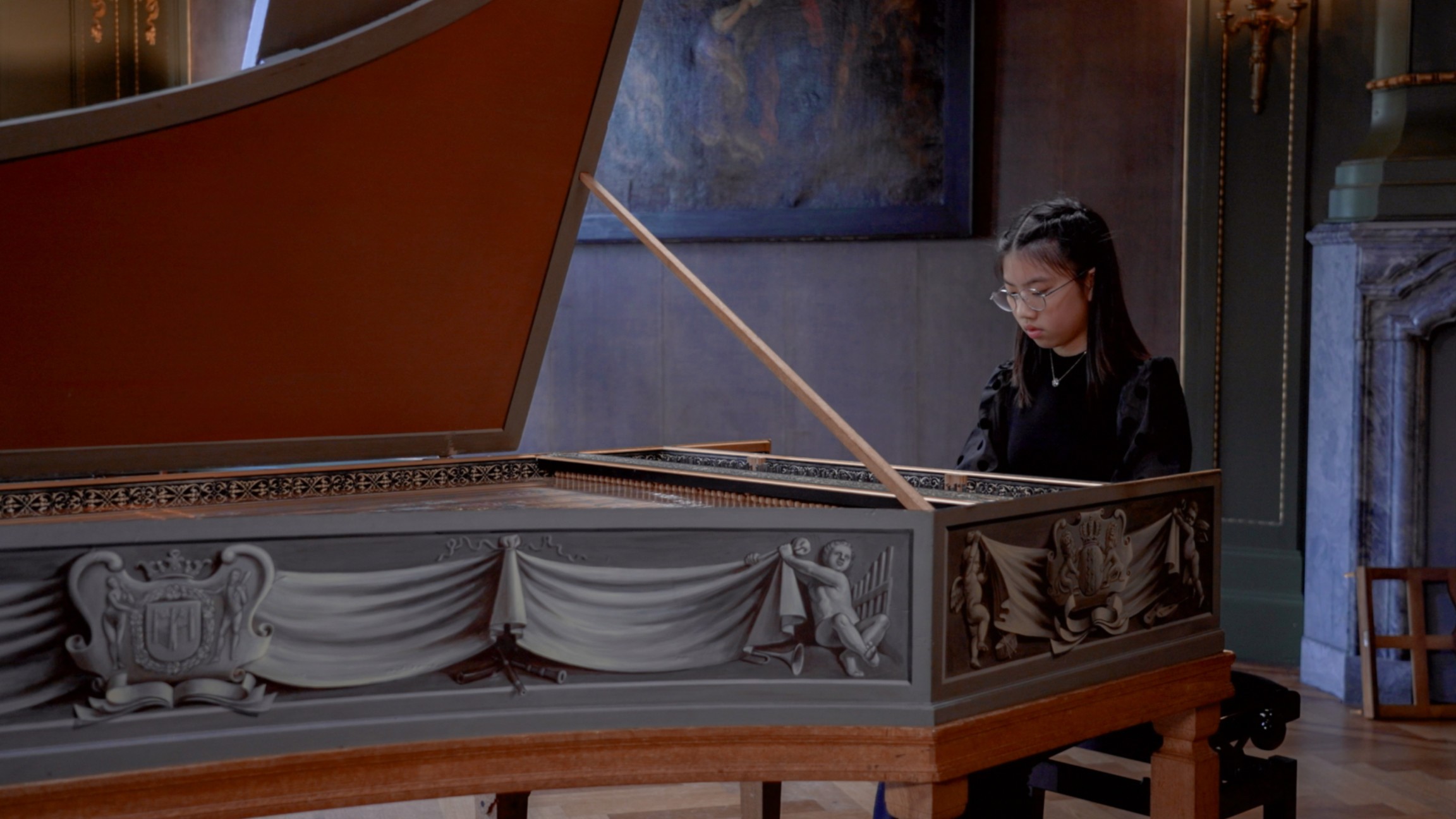
Allemande in G minor
BWV 836 performed by Hanna Zhang
Maltezerhuis, Utrecht
Behind the music
Story
Story
Extra videos
Extra videos
Credits
Credits
Neatly in time, but not rigid
Learning through play with Bach and his young son
You might picture Bach on a kind of cloud between heaven and earth, serenely turning his divine inspiration into one amazing cantata after another. But that picture is in urgent need of correction. Although we can only guess at the nature of Bach’s inspiration, we know for certain that his composition process was far from serene. This was particularly so in Leipzig – where Bach had a busy performance schedule and actually ran a music academy as well – but it was also the case in his previous positions with the church and at court. Bach’s fame as a musician attracted so many pupils that in Weimar, for instance, where his performance and composition schedule was not quite as full, he almost earned more from teaching than from his permanent position as an organist.
We know what those lessons were like, thanks to a very special student: Bach’s young son Wilhelm Friedemann. At the age of ten, he already received a ‘Klavierbüchlein’, in which both father and son notated music that was intended to gradually prepare fingers and brain for the bigger works. For example, we see early versions of the Inventions and the Sinfonias, some preludes that were later to be included in the Wohltemperirte Clavier, and music by other composers, including Friedemann himself.
There are also some very simple finger exercises, like this Allemande in G minor, played here by the young Hanna Zhang. You hear the influence of the keyboard music of French composers like Couperin, Royer and Rameau, for example; stately and with panache. Here, the young keyboard player has to play neatly in time without the music becoming rigid. No easy task on the harpsichord, where every note always sounds equally loud. The whole piece must also be ornamented tastefully, without detracting from the beautifully balanced melody.
Young talent
Once every two or three years, the Netherlands Bach Society organises a talent development project for gifted young musicians under the age of 18. The projects, which focus on the performance practice of Bach’s music, allows us to bring talented youngsters into contact with historical performance practice and give them deeper insight into Bach’s music. In this talent development project, we worked with keyboardists of the future. Seven very talented international youngsters between twelve and eighteen years old were selected from auditions to take two masterclasses about Bach, the harpsichord and baroque playing techniques and styles, given by Siebe Henstra. Each keyboardist rehearsed movements from the Klavierbüchlein für Wilhelm Friedemann Bach, including the Nine Little Preludes, BWV 924-932, which Bach wrote to use in lessons with his son Wilhelm Friedemann. The rehearsed works were recorded for All of Bach in October 2024, at the Maltezerhuis in Utrecht.
Extra videos
Vocal texts
Original
Translation
Credits
-
- Release date
- 19 November 2026
-
- Recording date
- 16 October 2024
-
- Location
- Maltezerhuis, Utrecht
-
- Harpsichord
- Hanna Zhang
-
- Instrument
- Titus Crijnen, 1992 after Johannes Ruckers, 1638
-
- Director and camera
- Robin van Erven-Dorens
-
- Music recording
- Guido Tichelman, Pim van der Lee
-
- Music recording, edit and mix
- Guido Tichelman
-
- Camera
- Martijn van Beenen
-
- Lights
- Ernst-Jan Thieme
-
- Data handling
- Brechtje van Riel
-
- Assistant music recording
- Marloes Biermans
-
- Producer
- Lisanne Marlou de Kok

Help us to complete All of Bach
There are still many recordings to be made before the whole of Bach’s oeuvre is online. And we can’t complete the task without the financial support of our patrons. Please help us to complete the musical heritage of Bach, by supporting us with a donation!