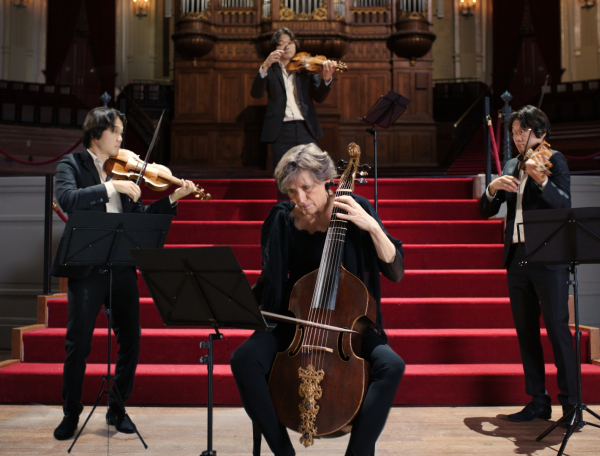

Ach bleib bei uns, Herr Jesu Christ
BWV 253 performed by the Netherlands Bach Society
Sint-Gertrudiskerk, Bergen op Zoom
Behind the music
Story
Story
Texts
Texts
Credits
Credits
Ode to the chorale
Bach’s works bring traditional hymns to life
Chorales play a key role in Bach’s music. They are simple hymns that were sung by the congregation in church every Sunday.
In the time before the Reformation, the congregation was silent. It was only the clergy who sang, and then in Latin as well. Luther thought this should change. So the reformer wrote his own hymns in German, which the congregation could sing themselves, allowing the people to actively participate in the service. As Luther’s Protestantism gained ground, the Protestant church was established, and with it a flourishing composition culture. Composers wrote hundreds of chorales, some of which were set to new melodies, although they also made good use of old Latin hymns that they translated and arranged, or even of folk songs that everyone knew already.
In principle, chorales were monophonic, i.e. there was a single melody that was seldom accompanied, even by an organ. This soon changed, however, and it was most common to have chorale harmonisations, in which the melody was accompanied by other parts. But composers increasingly started running away with the melody, which often formed a foundation around which all sorts of other virtuoso parts were composed.
As a true Lutheran, Bach was passionate about chorales. Besides virtuoso arrangements – the opening chorus of the St Matthew Passion being the highlight – he also handed down hundreds of chorale harmonisations: more than any other composer. As Bach wrote only a handful of new melodies himself, his oeuvre is an ode to the rich chorale tradition that preceded him.
This chorale, BWV 253, is an excellent example of a chorale harmonisation. The original chorale melody is supported by an accompaniment of three lower voices, as always in Bach’s harmonisations. At first sight it appears simple, but the more carefully you listen, the more you hear Bach’s mastery. The accompaniment is at least as interesting as the melody. He brings the old melody to life with radiant harmonies, while beneath the surface the alto, tenor and bass propel the melody onwards.
Extra videos
Vocal texts
Original
1.
Ach bleib bei uns, Herr Jesu Christ,
Weil es nun Abend worden ist;
Dein göttlich Wort, das helle Licht,
Lass ja bei uns auslöschen nicht!
4.
Erhalt uns nur bei deinem Wort
und wehr' des Teufels Trug und Mord!
Gib deiner Kirchen Gnad' und Huld,
Fried', Einigkeit, Mut und Geduld!
Translation
1.
Lord Jesus Christ, stay with us now
As we approach this evening hour;
Your holy Word, that brilliant light
May we not let out of our sight.
4.
Sustain us only with your Word,
ward off the Devil’s murd’rous fraud!
Grant favor to your Church, and grace,
with courage, patience, union, peace!
translation © Ruth van Baak Griffioen, May 2026
Credits
-
- Release date
- 21 May 2026
-
- Recording date
- 5 May 2024
-
- Location
- Sint-Gertrudiskerk, Bergen op Zoom
-
- Soprano
- Mónica Monteiro
-
- Alto
- Bernadett Nagy
-
- Tenor
- Immo Schröder
-
- Bass
- Bram Trouwborst
-
- Director and editor
- Onno van Ameijde
-
- Music recording
- Guido Tichelman, Pim van der Lee
-
- Music edit and mix
- Guido Tichelman
-
- Camera
- Jesper Blok, Jorne Tielemans
-
- Focus pull
- Glenn van Neerden
-
- Lights
- Jorne Tielemans, Patrick Galvin
-
- Project manager nep
- Ron Vermeulen
-
- Assistant music recording
- Marloes Biermans
-
- Producer
- Lisanne Marlou de Kok, Stephan Esmeijer


Help us to complete All of Bach
There are still many recordings to be made before the whole of Bach’s oeuvre is online. And we can’t complete the task without the financial support of our patrons. Please help us to complete the musical heritage of Bach, by supporting us with a donation!