
Der Himmel lacht! Die Erde jubilieret
BWV 31 performed by the Netherlands Bach Society
conducted by René Jacobs
Grote Kerk, Naarden
Behind the music
Story
Story
Texts
Texts
Credits
Credits
Longing for transformation
In this festive Easter cantata, Bach looks ahead to the divine world that awaits us
Bach always pulls out all the stops for Easter. In this festive cantata, he presents an
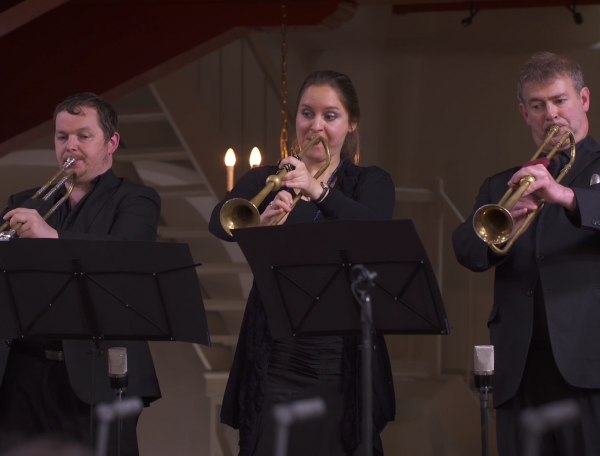
orchestra that is gigantic by his standards, comprising three trumpets and timpani, as well as five parts for the choir instead of four. In the forty days before Easter, trumpets and timpani were forbidden in the church. So Bach
turns up the instrumental sound to the full in his works for this high feast day, the best
known of which is probably the Easter Oratorio.
As always in the case of Bach, there is also a theological reason for doing so, as Easter is
probably the most important feast day in the church. It is the day when Christians
celebrate Jesus rising from the dead, three days after his crucifixion. Through this
miraculous resurrection, Jesus reveals his divine nature. It is also a prefiguration of the
resurrection that awaits mankind, when Jesus will return at the end of days and conquer
death for eternity. Then, according to the Bible, all the faithful will be granted eternal life,
just like Jesus.
The transformation from mortality to immortality lies at the heart of this cantata, BWV 31.
Bach’s lyricist Salomon Franck seizes on Jesus’s resurrection to look ahead to the coming
world. The fanfare-like ‘Sinfonia’ that ushers in the cantata heralds Jesus as a sort of
sovereign general doing battle with Death. The subsequent exuberant choral fugue whirls
with joy. Then it is the turn of the soloists, whose first three solo sections are supported
only by a bass line of chords, known as a basso continuo. In a dramatic recitative, the
bass prophesies that when Jesus lives, then his followers will also come to life again.
Then a powerful aria underlines Jesus’s kingship again. In the tenor’s aria, where all the
strings play again for the first time, the message is brought back to the people: our mortal
forefather Adam must perish, to make way for a new immortal person ‘created in God’s
image’. An impassioned recitative is followed by an exceptionally dulcet aria for soprano,
in which the longing for transformation reaches a climax: ‘let me be like the angels’, the
singer prays fervently.
The final chorale of the cantata is magnificent. In an ordinary cantata, the final chorale is
often quite plain: four voices reinforced by the orchestra. But for high feast days, Bach
often adds a counterpart to the upper part. Here, he does so to great effect, with a
rarefied, high violin line spanning the chorale and glittering like a starry sky. As Paul the
Apostle once wrote: “The glory of a celestial body is different to that of a terrestrial body.”
Extra videos
Vocal texts
Original
1. Sonata
2. Chor
Der Himmel lacht! Die Erde jubilieret
und was sie trägt in ihrem Schoß.
Der Schöpfer lebt! Der Höchste triumphieret
und ist von Todesbanden los.
Der sich das Grab zur Ruh erlesen,
der Heiligste kann nicht verwesen.
3. Rezitativ (B)
Erwünschter Tag! Sei, Seele, wieder froh!
Das A und O,
der erst und auch der letzte,
den unsre schwere Schuld
in Todeskerker setzte,
ist nun gerissen aus der Not!
Der Herr war tot,
und sieh, er lebet wieder!
Lebt unser Haupt, so leben auch die Glieder!
Der Herr hat in der Hand
des Todes und der Höllen Schlüssel!
Der sein Gewand
blutrot bespritzt in seinen bittern Leiden,
will heute sich mit Schmuck und Ehren kleiden.
4. Aria (B)
Fürst des Lebens, starker Streiter,
hochgelobter Gottessohn!
hebet dich des Kreuzes Leiter
auf den höchsten Ehrenthron?
Wird, was dich zuvor gebunden,
nun dein Schmuck und Edelstein?
Müssen deine Purpurwunden
deiner Klarheit Strahlen sein?
5. Rezitativ (T)
So stehe dann, du gottergebne Seele,
mit Christo geistlich auf!
Tritt an den neuen Lebenslauf!
Auf! von den toten Werken!
Laß, daß dein Heiland in dir lebt,
an deinem Leben merken!
Der Weinstock, der jetzt blüht,
trägt keine tote Reben!
Der Lebensbaum läßt seine Zweige leben!
Ein Christe flieht
ganz eilend von dem Grabe!
Er läßt den Stein,
er läßt das Tuch der Sünden dahinten
und will mit Christo lebend sein!
6. Aria (T)
Adam muß in uns verwesen,
soll der neue Mensch genesen,
der nach Gott geschaffen ist!
Du mußt geistlich auferstehen
und aus Sündengräbern gehen,
wenn du Christi Gliedmaß bist.
7. Rezitativ (S)
Weil dann das Haupt sein Glied
natürlich nach sich zieht,
so kann mich nichts von Jesu scheiden.
Muß ich mit Christo leiden,
so werd ich auch nach dieser Zeit
mit Christo wieder auferstehen
zur Ehr und Herrlichkeit
und Gott in meinem Fleische sehen.
8. Aria (S)
Letzte Stunde, brich herein,
mir die Augen zuzudrükken!
Laß mich Jesu Freudenschein
und sein helles Licht erblikken!
Laß mich Engeln ähnlich sein!
Letzte Stunde, brich herein!
9. Choral
So fahr ich hin zu Jesu Christ,
mein Arm tu ich ausstrecken;
so schlaf ich ein und ruhe fein;
kein Mensch kann mich aufwecken,
denn Jesus Christus, Gottes Sohn,
der wird die Himmelstür auftun,
mich führn zum ewgen Leben.
Translation
1. Sonata
2. Chorus
Heaven laughs! Earth exults
and all she bears in her lap;
the Creator lives! The Highest triumphs
and is freed from the bonds of death.
He who has selected the grave for rest,
the Holy One, can not be corrupted.
3. Recitative (B)
Longed-for day! O soul, be happy again!
The A and O,
the first and also the last,
who placed our heavy guilt
in the prison of death,
is now wrested from danger!
The Lord was dead,
and behold, he lives again;
if our Head lives, so also the limbs live.
The Lord has in his hand
the key to death and hell!
He whose garment
was sprinkled blood red in his bitter suffering,
will robe himself today with adornment and honor.
4. Aria (B)
Prince of life, strong fighter,
highly-praised Son of God!
Does the ladder of the Cross raise you
up to the highest throne of honor?
Does that which previously bound you
now become your adornment and jewel?
Shall your purple wounds
be now the rays of your brilliance?
5. Recitative (T)
So rise up then, you God-given soul,
with Christ in spirit!
Step onto the new course of life!
Up! Away from the works of death!
Let your Savior take notice
of your life in the world!
The vine, that now blooms,
bears no dead fruit!
The tree of life lets its branches live!
A Christian flees
with great haste from the grave!
He leaves the stone,
he leaves the cloth of sin behind
and wishes to be living with Christ.
6. Aria (T)
Adam must decay in us,
so the new person can be born,
who is created in God's image.
You must be resurrected spiritually
and go forth from the tombs of sin,
if you are one of Christ's members.
7. Recitative (S)
Because the head naturally
draws the limbs after it,
so I cannot part myself from Jesus.
If I must suffer with Christ,
so also hereafter I will
be resurrected again with Christ
to honor and glory
and see God in my own flesh.
8. Aria (S)
Last hour, break forth,
to press closed my eyes!
Let me gaze upon Jesus' joyous glow
and his bright light,
let me be like the angels!
Last hour, break forth!
9. Chorale
Thus I go away to Jesus Christ,
stretching out my arm;
thus I fall asleep and rest sweetly,
no one can awaken me,
for Jesus Christ, the Son of God,
will open the gate of heaven,
leading me to eternal life.
translation © Pamela Dellal
Credits
-
- Release date
- 9 April 2026
-
- Recording date
- 5 November 2023
-
- Location
- Grote Kerk Naarden
-
- Conductor
- René Jacobs
-
- Soprano
- Isabel Schicketanz
-
- Tenor
- Thomas Hobbs
-
- Bass
- Edward Grint
-
- Ripieno soprano
- Lauren Armishaw, Amelia Berridge, Marta Paklar, Anna Bachleitner
-
- Ripieno alto
- Alexander Chance, Sofia Gvirts, Michaela Riener, Emilie Wijers
-
- Ripieno tenor
- Adriaan De Koster, João Moreira, Immo Schröder
-
- Ripieno bass
- Hidde Kleikamp, Mitchell Sandler, Jaap van der Wel
-
- Violin 1
- Evgeny Sviridov, Sayuri Yamagata, Annelies van der Vegt
-
- Violin 2
- Lidewij van der Voort, Lucia Giraudo, Anneke van Haaften
-
- Viola 1
- Femke Huizinga, Ivan Jorge Saez Schwartz
-
- Viola 2
- Deirdre Dowling, Marta Jiménez
-
- Cello
- Lucia Swarts, Matyas Virag
-
- Double bass
- Robert Franenberg
-
- Oboe
- Rodrigo López Paz
-
- Bassoon
- Josep Casadellà
-
- Trumpet
- Robert Vanryne, Mark Geelen, Christopher Price
-
- Cornetto
- Christopher Price
-
- Timpani
- Marianna Soroka
-
- Organ
- Siebe Henstra
-
- Archiliuto
- Shizuko Noiri
-
- Director and editor
- Bas Wielenga
-
- Music recording
- Guido Tichelman, Lilita Dunska, Pim van der Lee
-
- Music edit and mix
- Guido Tichelman
-
- Camera
- Martin Struijf, Jesper Blok, Tijmen Veerman, Bjorn Tiebout
-
- Lights
- Ernst-Jan Thieme, Patrick Galvin, Robert Groendijk, Jason Mulder
-
- Assistant director
- Ferenc Soeteman
-
- Set technique
- Justin Mutsaers
-
- Data handling
- Ruben Kuyl
-
- Project manager nep
- Ron Vermeulen
-
- Assistant music recording
- Marloes Biermans
-
- Producer concert
- Imke Deters
-
- Producer film
- Wietske Hovingh

Help us to complete All of Bach
There are still many recordings to be made before the whole of Bach’s oeuvre is online. And we can’t complete the task without the financial support of our patrons. Please help us to complete the musical heritage of Bach, by supporting us with a donation!