
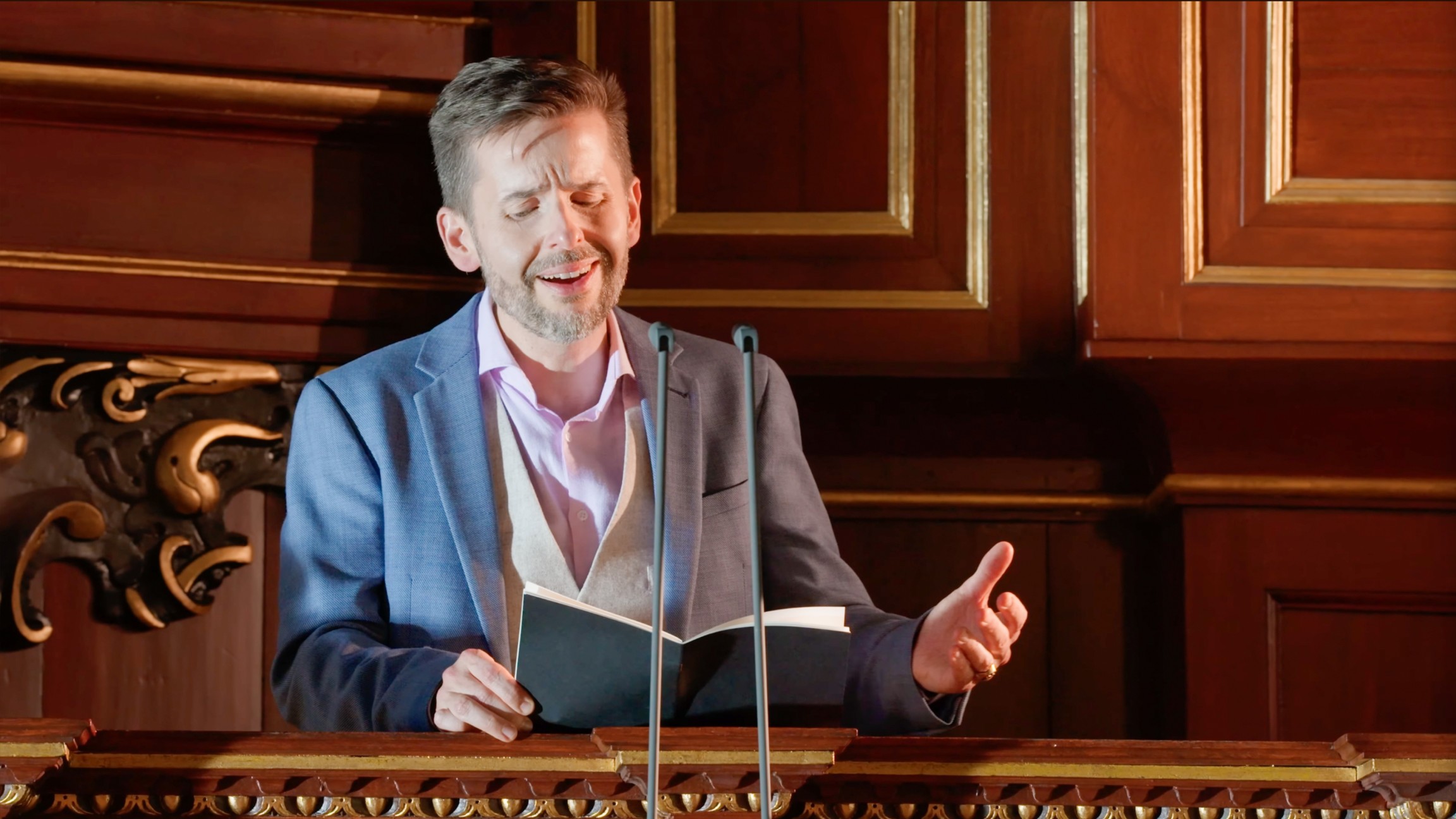
Lasset uns mit Jesu ziehen
BWV 481 performed by Daniel Johannsen and Leo van Doeselaar
Walburgiskerk, Zutphen
Behind the music
Story
Story
Extra videos
Extra videos
Texts
Texts
Credits
Credits
A cover for Lent
Bach kept to Schop’s harmonic world
As regards chorales, Lent is an exceptionally productive period in the church calendar. In Bach’s day, it was not permitted to perform complex music for choir and orchestra in church, so people sang motets by sixteenth-century composers and many contemplative hymns, like those familiar to us from Bach’s Passions. One such hymn for Lent is Lasset uns mit Jesu ziehen, from Schemelli’s Songbook.
The melody of Lasset uns mit Jesu ziehen is by Johan Schop, although he originally wrote it for another song; the poem Sollt ich meinem Gott nicht singen by the well-known religious poet Paul Gerhardt. So Lasset uns mit Jesu ziehen is actually what we now call a cover. Quite soon after the hymn by Gerhardt/Schop was published, lyricist Sigmund von Birken wrote a new text: a poem of four verses, which is still in hymn books today, with the same fitting melody in a minor key.
Johann Sebastian Bach treated this hymn with great respect and also kept to the harmonic basis by his Early Baroque colleague Schop, making only a couple of melodic changes. This is exceptional, as Bach frequently arranged Renaissance melodies with unparalleled versatility. But in the case of this hymn, he retained Schop’s almost closed harmonic world. And Bach must have thought the hymn important enough, contextually and musically speaking, to include as an arrangement in Schemelli’s Songbook.
Incidentally, Sigmund von Birken also appears in Bach’s oeuvre with his other well-known chorale, Jesu, deine Passion will ich jetzt bedenken. The theme of this chorale corresponds to that of BWV 481, being a contemplation of the suffering of Jesus Christ.
Musicalisches Gesang-Buch G.C. Schemelli
In the eighteenth century, sacred songbooks for private use were an important aid in simple, domestic devotion. For example, no fewer than 17 editions of Johann Freylinghausen’s Geistreiches Gesangbuch were published between 1704 and 1734. Two years later, pietist Georg Christian Schemmel, alias Schemelli, launched his own songbook, containing no fewer than 954 songs, 69 of which included melody, text incipit and figured bass. In order to outdo the competition, he involved probably the most famous music consultant of all time, who happened to be his son’s music teacher: Bach. Following intensive research, only three of the 21 original melodies in the collection (BWV 439-509) can be attributed with certainty to the cantor at the Thomasschule: BWV 452, 478 and 505. The others are accompaniments, revisions and improvements. Bach’s precise role in Schemelli’s Gesangbuch will probably always remain a mystery.
Extra videos
Daniel Johannsen about freedom in baroque
"In this baroque music, you can take your freedom, especially in the recits"
Vocal texts
Original
1.
Lasset uns mit Jesu ziehen,
seinem Fürbild folgen nach,
in der Welt der Welt entfliehen,
auf der Bahn, die er uns brach,
immer fort zum Himmel reisen,
irdisch, doch schon himmlisch sein,
glauben recht und leben fein,
in der Lieb den Glauben weisen.
Treuer Jesu! bleib bei mir,
gehe für, ich folge dir.
2.
Lasset uns mit Jesu leiden,
seinem Fürbild werden gleich.
Nach den Leide folgen Freuden,
Armut hier macht dorten reich.
Tränensaat, die erntet Lachen,
Hoffnung tröstet mit Geduld,
es kann leichtlich Gottes Huld
aus dem Regen Sonne machen.
Jesu! hier leid ich mit dir,
dort teil deine Freud mit mir.
4.
Lasset uns mit Jesu leben,
weil er auferstanden ist,
muß das Grab uns wiedergeben.
Jesu! unser Haupt du bist,
wir sind deine Leibesglieder,
wo du lebst, da leben wir,
ach! erkenn uns für und für,
treues Herz, für deine Brüder.
Jesu, dir ich lebe hier,
laß mich ewig sein bei dir!
Translation
1.
Let us journey on with Jesus,
following where he leads the way,
in the world, but living freely,
on the path he first surveyed,
ever onward bound toward heaven,
living here, but hearts above,
true in faith and life in love,
demonstrating faith by loving.
Faithful Jesus! stay with me,
I will follow where you lead.
2.
Let us suffer here with Jesus,
so that we become like him.
Suffering turns to rejoicing,
Poor on earth, but rich in heaven.
Sowing tears, but reaping laughter,
Hope consoles with patient pace,
Rain at first, but sun thereafter.
Jesus! here with you we fight,
But in heaven share delight.
4.
Let us all now live with Jesus,
he has risen from the dead,
therefore our graves will release us,
Jesus! for you are our Head,
we are members of your body,
where you live, there also we,
name us yours, eternally,
faithful heart, as your own family.
Jesus, here I live for you,
Let me live forever too!
translation © Ruth van Baak Griffioen, 2026
Credits
-
- Release date
- 12 November 2026
-
- Recording date
- 28 May 2024
-
- Location
- Walburgiskerk, Zutphen
-
- Tenor
- Daniel Johannsen
-
- Organ
- Leo van Doeselaar
-
- Instrument
- Henrick Bader, 1639/1643
-
- Director and editor
- Gijs Besseling
-
- Music recording
- Guido Tichelman, Pim van der Lee
-
- Music edit and mix
- Guido Tichelman
-
- Camera
- Danny Noordanus, Manon Hoskens, Remco van Leest
-
- Grip
- Wouter Visser
-
- Assistant music recording
- Marloes Biermans
-
- Producer
- Lisanne Marlou de Kok
Help us to complete All of Bach
There are still many recordings to be made before the whole of Bach’s oeuvre is online. And we can’t complete the task without the financial support of our patrons. Please help us to complete the musical heritage of Bach, by supporting us with a donation!