Liebster Herr Jesu
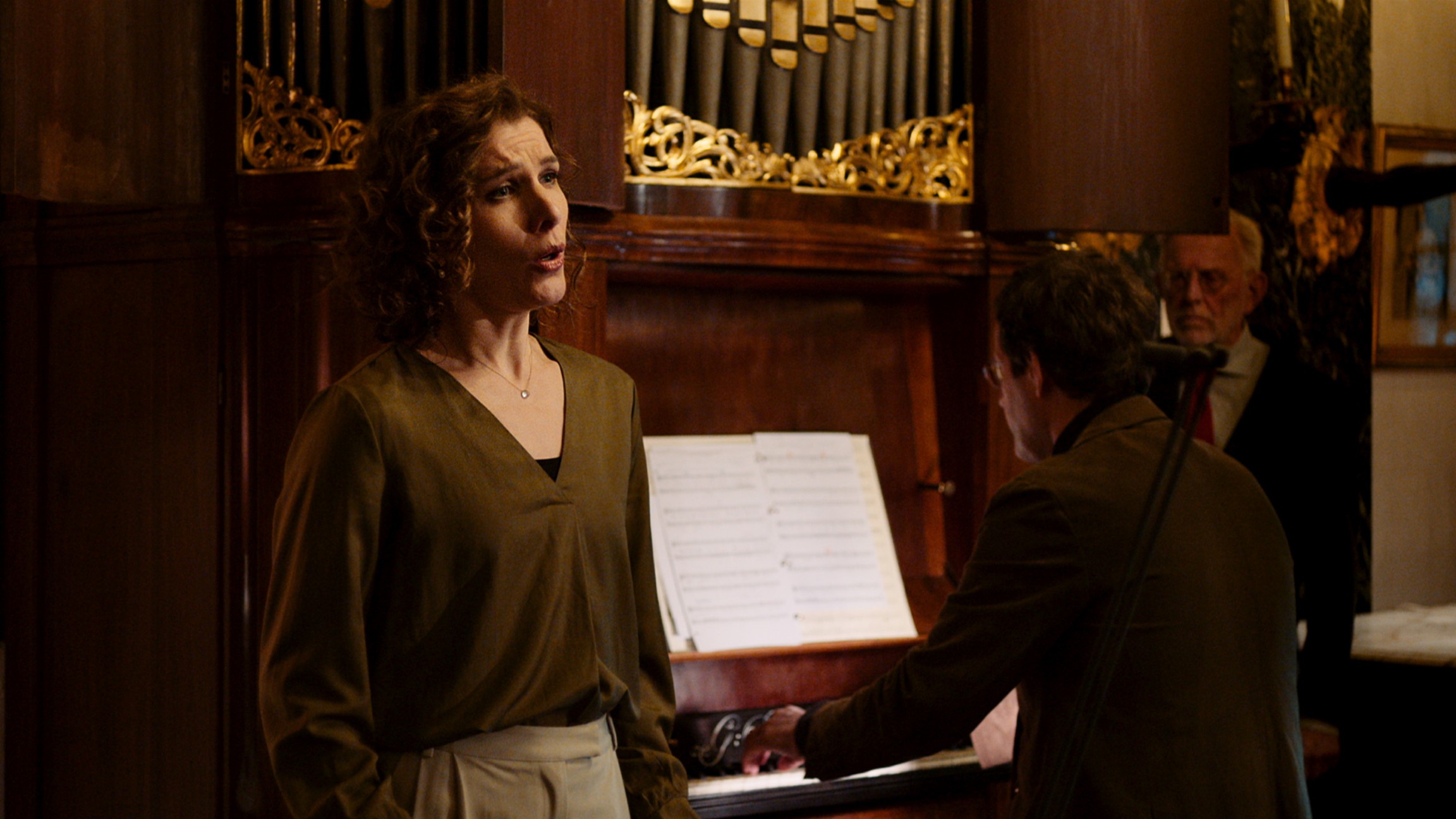
BWV 484 performed by Michaela Riener and Menno van Delft
Kasteel Amerongen, Amerongen
Behind the music
Story
Story
Extra videos
Extra videos
Texts
Texts
Credits
Credits
Even art must be silenced in the end
In this sacred song, Bach points to eternity
Liebster Herr Jesu is a song that gives you goosebumps. The text is pervaded by an awareness of finiteness. Everything on earth will eventually turn to dust, and even art will be silenced in the end. The speaker longs for Eternity, as every day on earth is a battle. Only when Jesus returns to earth, as foretold in the Bible, will the inconstancy of the world come to an end. So where is Jesus then?
With all its repetitions, the text is certainly effective. You could easily imagine it as a richly orchestrated aria. Bach takes a different approach, however, and the voice is supported only by a bass part. He does the same for all the songs he wrote for Schemelli’s Songbook. The songs were intended for domestic devotion.
Musicalisches Gesang-Buch G.C. Schemelli
In the eighteenth century, sacred songbooks for private use were an important aid in simple, domestic devotion. For example, no fewer than 17 editions of Johann Freylinghausen’s Geistreiches Gesangbuch were published between 1704 and 1734. Two years later, pietist Georg Christian Schemmel, alias Schemelli, launched his own songbook, containing no fewer than 954 songs, 69 of which included melody, text incipit and figured bass. In order to outdo the competition, he involved probably the most famous music consultant of all time, who happened to be his son’s music teacher: Bach. Following intensive research, only three of the 21 original melodies in the collection (BWV 439-509) can be attributed with certainty to the cantor at the Thomasschule: BWV 452, 478 and 505. The others are accompaniments, revisions and improvements. Bach’s precise role in Schemelli’s Gesangbuch will probably always remain a mystery.
Extra videos
Vocal texts
Original
1.
Liebster Herr Jesu, wo bleibst du so lange?
Komm doch, mir wird hier auf Erden so bange,
komm doch und nimm mich, wenn dir es gefällt,
von der beschwerlichen Bürde der Welt.
Komm doch, Herr Jesu! Wo bleibst du so lange?
Komm doch, mir wird hier auf Erden so bange.
4.
Denn mit der Welt hat man immer zur Rechten
und mit dem Teufel zur Linken zu fechten,
draußen ist Angst, und von innen ist Streit,
komm doch, mein Bruder, und gehe nicht weit.
Komm doch, Herr Jesu! Wo bleibst du so lange?
Komm doch, mir wird hier auf Erden so bange.
6.
Alles ist eitel, was unter der Sonne,
flüchtig die Freude, vergänglich die Wonne,
Herrlichkeit, Wollüste, Reichtum und Kunst,
alles ist schattiger Nebel und Dunst.
Komm doch, Herr Jesu! Wo bleibst du so lange?
Komm doch, mir wird hier auf Erden so bange.
Translation
1.
Dearest Lord Jesus, why are you not near me?
Come to me, here on earth I am so fearful,
come to me, take me, when the time is right,
take me away from the burdens of life.
Dearest Lord Jesus, why are you not near me?
Come to me; here on earth I am so fearful.
4.
Here in the world we must always be fighting
right hand to left, with the Devil inciting,
outside is fear, while inside there is strife,
come now, my Brother, stay close to my life.
Dearest Lord Jesus, why are you not near me?
Come to me; here on earth I am so fearful.
6.
Everything under the sun is defeating;
happiness fading, while rapture is fleeting;
splendor and pleasure, or riches and art,
all of it shadowy mist that will part.
Dearest Lord Jesus, why are you not near me?
Come to me; here on earth I am so fearful.
translation © Ruth van Baak Griffioen, August 2026
Credits
-
- Release date
- 27 August 2026
-
- Recording date
- 2 April 2025
-
- Location
- Kasteel Amerongen, Amerongen
-
- Mezzo-soprano
- Michaela Riener
-
- Organ
- Menno van Delft
-
- Calcant
- Joop Muller
-
- Director and editor
- Onno van Ameijde
-
- Music recording
- Guido Tichelman, Pim van der Lee
-
- Music edit and mix
- Guido Tichelman
-
- Camera
- Onno van Ameijde, Rieks Soepenberg, Joost Kuiper
-
- Lights
- Patrick Galvin
-
- Datahandling
- Stefan Ebels
-
- Assistant music recording
- Marloes Biermans
-
- Producer film
- Lisanne Marlou de Kok
Help us to complete All of Bach
There are still many recordings to be made before the whole of Bach’s oeuvre is online. And we can’t complete the task without the financial support of our patrons. Please help us to complete the musical heritage of Bach, by supporting us with a donation!