Schaffs mit mir, Gott, nach deinem Willen
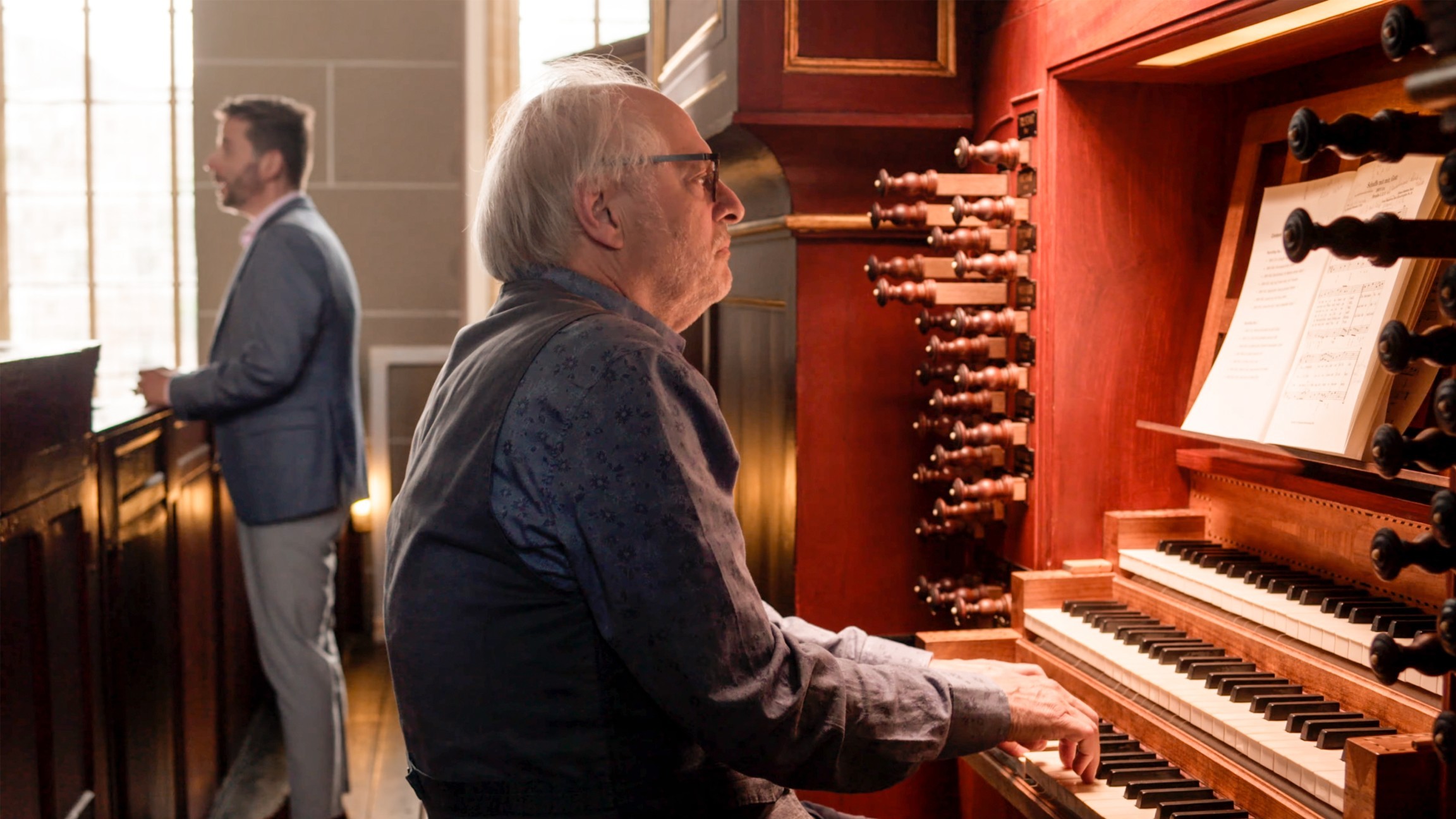
BWV 514 performed by Daniel Johannsen and Leo van Doeselaar
Walburgiskerk, Zutphen
Behind the music
Story
Story
Extra videos
Extra videos
Texts
Texts
Credits
Credits
Private worship
A positive poem about faith, set to one of Bach's brightest melodies
Lyricist Benjamin Schmolck – the author of the lyrics of this song by Bach – must have been a kind character: all possible aspects of a Christian life were put into his 1183 poems. He wrote texts of worship and strengthening, prayers and exhortations. Most of his texts were set to music or connected with already established tunes, and many of these are still in use today (e.g. Tut mir auf die schöne Pforte or Schmückt das Fest mit Maien).
Schmolck, born in 1672 and son of a Silesian vicar, studied theology in Leipzig where he was awarded the title poeta laureatus already in early years. He returned to his home town, assisting his father, before he was called to the main church of Schweidnitz which should be the centre of his entire life.
Benjamin Schmolck was nearly of Bach’s generation, and he knew about the powers and blessings of church music. Thus, he contributed a whole set of cantata texts (Das Saiten-Spiel des Hertzens) which were used by such renowned composers as Telemann, Fasch and Stöltzel.
Bach chose this positive poem for one of his brightest melodies – coming remarkably close to Handel's festive sound world. The lines proceed solemnly, in clear, simple harmonies, towards a wonderfully exalted resumé. Like most of the other hymns Bach put to the Notenbüchlein für Anna Magdalena Bach, the composer didn’t use this song in his big church music works, seemingly designating it to be a piece for private worship and religious house music.
The Notenbüchlein für Anna Magdalena Bach
Shortly after their arrival in Leipzig in 1723, Johann Sebastian and Anna Magdalena Bach revealed themselves as a cultural power couple. Although Anna Magdalena gave up her successful public singing career, she joined her husband in running a thriving music business, alongside looking after a large and growing family. We have at least two tangible traces of their married life in the form of two Notenbüchlein from 1722 and 1725.
Whereas the first Notenbüchlein was still a sort of notebook, containing things like early versions of five ‘French Suites’ (and who knows what else, as two-thirds of the pages are missing), the second one was definitely intended as a gift from Johann Sebastian to his wife. In fair copy, he notated two Partitas and all sorts of other music of Anna Magdalena’s own choosing, such as the aria from the Goldberg Variations and the song Dir, dir Jehova, as well as music by composers like Couperin and Anna Magdalena’s stepson Carl Philipp Emanuel. Together, the Notenbüchlein form a colourful mix of arias, chorales and suites.
Extra videos
Vocal texts
Original
Schaff's mit mir, Gott, nach deinem Willen,
dir sei es alles heimgestellt.
Du wirst mein Wünschen so erfüllen,
wie's deiner Weisheit wohlgefällt.
Du bist mein Vater, du wirst mich
versorgen, darauf hoffe ich.
Richt nur mein Herz zu dir in Himmel
und zieh es ab von dieser Welt,
gib dass mir in dem Weltgtümel
das Ewige sei fürgestellt
und meine Seele sei befreit
von aller schnöden Eitelkeit.
Zu dir mein Gott steht all’ Vertrauen,
du bist mein Gott, mein Schatz, und Schutz,
auf dich will ich beständig bauen,
mit dir biet’ ich dem Teufel Trutz.
Ist Gott für mich und bleibet mein,
wer mag mir denn zuwieder sein.
Translation
Make of me, God, according to your will,
let all my life be home in you;
I know that my desires you will fulfill
as your great wisdom sees fit to do.
You are my Father, you’ll provide
that is my sure hope that abides.
Direct my heart to you in heaven
pull it away far from this world.
Grant in this world, by tumult driven,
I see eternity unfurled,
and that my soul should thus be freed
from every worthless thought and deed.
In you, my God, is all my trusting
you are my God, my prince and prize,
you are the rock on which I’m resting,
with you the devil I defy.
If God is with me and abides,
then who can stand against my side?
translation © Ruth van Baak Griffioen, 2025
Credits
-
- Release date
- 26 February 2026
-
- Recording date
- 28 May 2024
-
- Location
- Walburgiskerk, Zutphen
-
- Tenor
- Daniel Johannsen
-
- Organ
- Leo van Doeselaar
-
- Instrument
- Henrick Bader, 1639/1643
-
- Director and editor
- Gijs Besseling
-
- Music recording
- Guido Tichelman, Pim van der Lee
-
- Music edit and mix
- Guido Tichelman
-
- Camera
- Danny Noordanus, Manon Hoskens, Remco van Leest
-
- Grip
- Wouter Visser
-
- Assistant music recording
- Marloes Biermans
-
- Producer
- Lisanne Marlou de Kok


Help us to complete All of Bach
There are still many recordings to be made before the whole of Bach’s oeuvre is online. And we can’t complete the task without the financial support of our patrons. Please help us to complete the musical heritage of Bach, by supporting us with a donation!