Ich bin vergnügt mit meinem Glücke
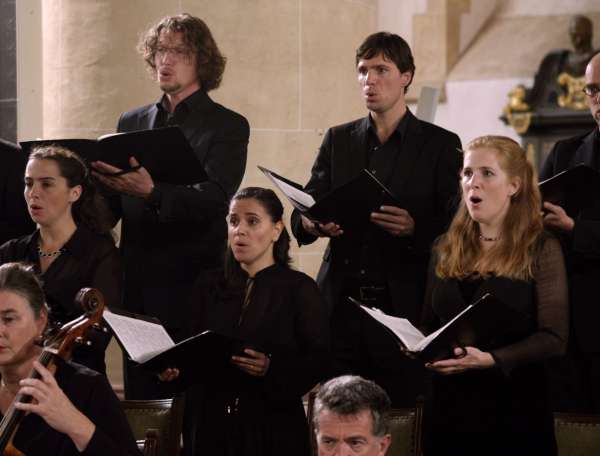
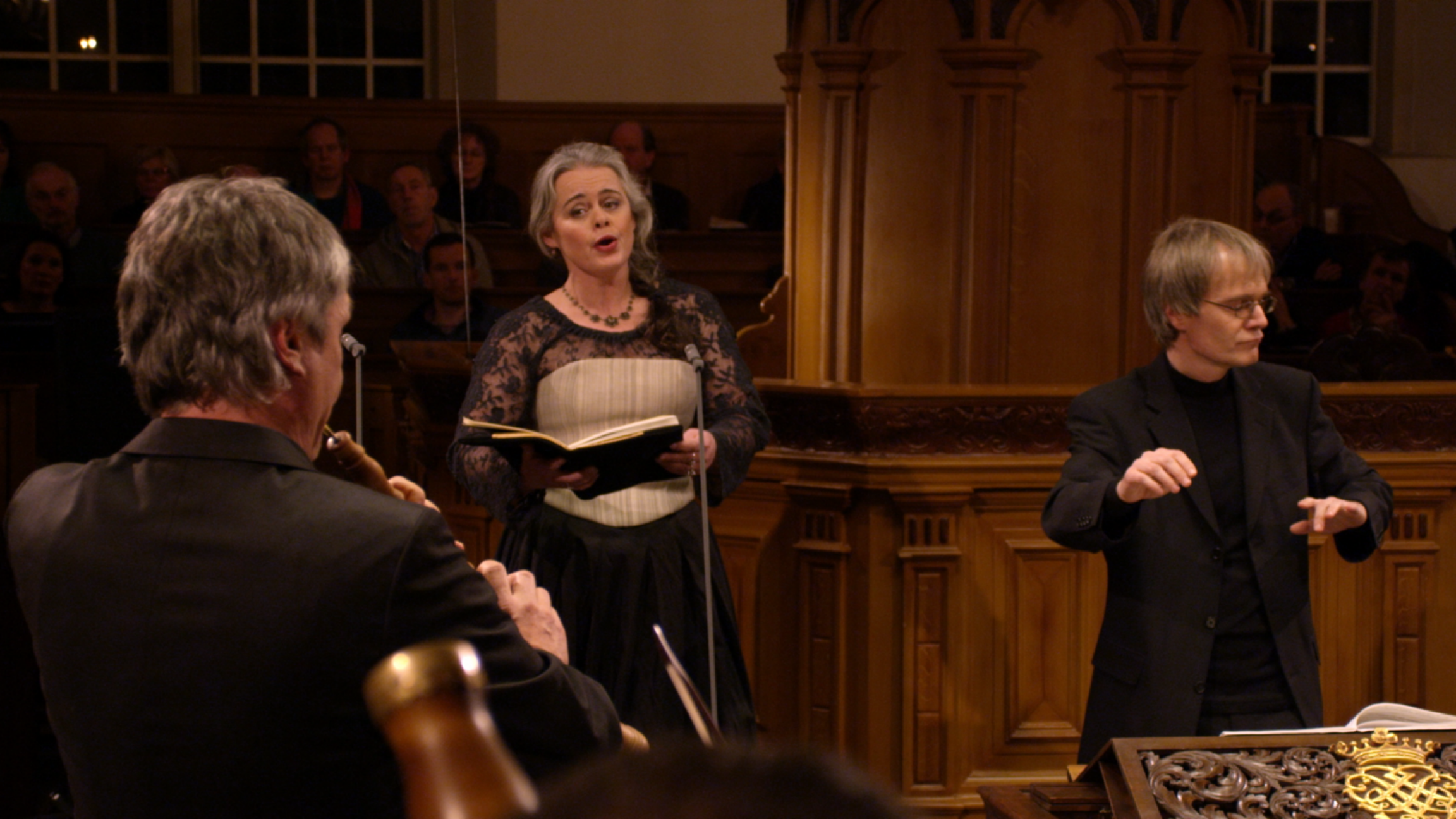
BWV 84 performed by the Netherlands Bach Society
conducted by Fabio Bonizzoni
Walloon Church, Amsterdam
Behind the music
Story
Story
Extra videos
Extra videos
Texts
Texts
Credits
Credits
A mysterious change
Why did Bach replace the word 'Stand' with 'Glücke'?
In this solo cantata, the oboe and soprano express their joy. It is one of the few pieces referred to by Bach himself as a ‘cantata’. The text originates from one of the collections by Bach’s regular lyricist, Christian Friedrich Henrici, who wrote under the pseudonym of Picander. However, Bach changed his first line. Picander wrote ‘Ich bin vergnügt mit meinem Stand’, which Bach changed to 'Glücke'. This change prompted conductor John Eliot Gardiner to speculate. In his book on Bach, Music in the Castle of Heaven, he describes how Bach was obsessed by status and is supposed to have often felt misunderstood. Could this be a reason for Bach finding it hard to set words to music about how satisfied he was with his ‘position’ and thus changing the text to ‘Glücke’? Possibly. Another theory is that reconciling oneself to social position (not getting ideas above your station) was probably too anti-revolutionary for Bach, and ‘Glücke’ was therefore more suitable.
Whatever the case, the words and the music are undeniably in the service of God. ‘Ich esse mit Freude mein wenige Brot’, sings the soprano contentedly, in the knowledge that she has nothing to demand of God.
Extra videos
Vocal texts
Original
1. Arie (Sopran)
Ich bin vergnügt mit meinem Glücke,
das mir der liebe Gott beschert.
Soll ich nicht reiche Fülle haben,
so dank ich ihm vor kleine Gaben
und bin auch nicht derselben wert.
2. Rezitativ (Sopran)
Gott ist mir ja nichts schuldig,
und wenn er mir was gibt,
so zeigt er mir, dass er mich liebt;
ich kann mir nichts bei ihm verdienen,
denn was ich tu,
ist meine Pflicht.
Ja! wenn mein Tun
gleich noch so gut geschienen,
so hab ich doch nichts Rechtes ausgericht'.
Doch ist der Mensch so ungeduldig,
dass er sich oft betrübt,
wenn ihm der liebe Gott
nicht überflüssig gibt.
Hat er uns nicht so lange Zeit
umsonst ernähret und gekleidt
und will uns einsten seliglich
in seine Herrlichkeit erhöhn?
Es ist genug vor mich,
Dass ich nicht hungrig darf zu Bette gehn.
3. Arie (Sopran)
Ich esse mit Freuden mein weniges Brot
und gönne dem Nächsten von Herzen das Seine.
Ein ruhig Gewissen, ein fröhlicher Geist,
ein dankbares Herze, das lobet und preist,
vermehret den Segen, verzuckert die Not.
4. Rezitativ (Sopran)
Im Schweisse meines Angesichts
will ich indes mein Brot geniessen,
und wenn mein Lebenslauf,
mein Lebensabend
wird beschliessen,
so teilt mir Gott
den Groschen aus,
da steht der Himmel drauf.
O! wenn ich diese Gabe
zu meinem Gnadenlohne habe,
so brauch ich
weiter nichts.
5. Choral
Ich leb indes in dir vergnüget
und sterb ohn alle Kümmernis,
mir genüget, wie es
mein Gott füget,
ich glaub und bin es ganz gewiss:
durch deine Gnad und Christi Blut
machst du's mit meinem Ende gut.
Translation
1. Aria (Soprano)
I am content with my [good and bad] fortune
That dear God ordains unto me.
If I am not to have rich abundance,
Then I thank him for small gifts;
And [I] am not worthy even of those.
2. Recitative (Soprano)
God indeed owes me nothing,
And when he gives me anything [at all],
Then he is showing me that he loves me;
[By my works] I am able to merit nothing with him,
For what [good] I [can] do
is [only] my obligation [to him].
Yes, even if my doings have appeared ever so good,
I have, to the contrary,
brought to pass nothing righteous.
Yet humankind is so impatient
That it often finds itself aggrieved
When dear God does not give
[good things] to it overflowingly.
Has he not, for such a long time,
Fed and clothed us, without merit [on our part],
And will [he not] someday blessedly
Lift us up into his glory [in heaven]?
It is enough for me
That I do not have to go to bed hungry.
3. Aria (Soprano)
With joy I will eat my scant bread,
And from my heart will not begrudge my neighbor his.
A quiet conscience, a cheerful spirit,
A thankful heart that lauds and praises,
Increases blessing, sweetens privation.
4. Recitative (Soprano)
[Only] by the sweat of my brow
Will I meanwhile [be able to] savor my bread,
And when the course of my life
[as a “vineyard laborer”],
The evening of [this “day” that is] my life,
will come to a close,
Then God will pay me the [day’s-wage] coin
[Where] there is [an image of]
heaven [stamped] upon it.
Oh, if I have this gift
As my [unmerited] wage of [God’s] grace,
Then I will need nothing more.
5. Chorale
Meanwhile I will live content in you
And die without any grief;
It suffices for me how ever
my God sets [things] in order;
I believe and am entirely certain of it:
By your grace and Christ’s blood
You will make it [go] well at my [life’s] end.
transl. © Daniel R. Melamed and Michael Marissen
For the annotated version of the text and translation, see here.
Credits
-
- Release date
- 14 August 2015
-
- Recording date
- 17 January 2015
-
- Location
- Walloon Church, Amsterdam
-
- Conductor and organ
- Fabio Bonizzoni
-
- Soprano
- Maria Keohane
-
- Alto
- Barnabás Hegyi
-
- Tenor
- Robert Buckland
-
- Bass
- Matthias Winckhler
-
- Violin 1
- Shunske Sato, Pieter Affourtit, Anneke van Haaften
-
- Violin 2
- Sayuri Yamagata, Paulien Kostense, Annelies van der Vegt
-
- Viola
- Staas Swierstra, Jan Willem Vis
-
- Cello
- Lucia Swarts, Richte van der Meer
-
- Double bass
- Robert Franenberg
-
- Oboe
- Martin Stadler, Peter Frankenberg, Yongcheon Shin
-
- Bassoon
- Benny Aghassi
-
- Church organ
- Leo van Doeselaar
-
- Concert production
- Erik van Lith, Marco Meijdam
-
- Producer
- Frank van der Weij
-
- Film director
- Joost Honselaar
-
- Director of photography
- Simon Aarden
-
- Camera
- Simon Aarden, Ruben van den Broeke, Jorrit Garretsen, Benjamin Sparschuh, Indy Hamid
-
- Film editor
- Joost Honselaar
-
- Music recording producer
- Leo de Klerk
-
- Gaffer
- Zen Bloot
-
- Production assistant
- Zoë de Wilde
-
- Score reader
- Niek Wijns
-
- Make up
- Marloes Bovenlander, Jamila el Bouch
-
- Camera assistant
- Izak de Dreu
-
- Best boy
- Jur Oster
-
- Music recording assistants
- Jaap Firet, Jaap van Stenis, Bobby Verbakel
-
- Music edit and mix
- Leo de Klerk, Frank van der Weij
-
- Music edit and mix assistant
- Nina Kraszewska
-
- Colorist
- Jef Grosfeld
-
- Interview
- Gijs Besseling, Kasper Koudenburg
-
- Acknowledgements
- Nienke Meuleman
Help us to complete All of Bach
There are still many recordings to be made before the whole of Bach’s oeuvre is online. And we can’t complete the task without the financial support of our patrons. Please help us to complete the musical heritage of Bach, by supporting us with a donation!