
Liebster Jesu, wir sind hier
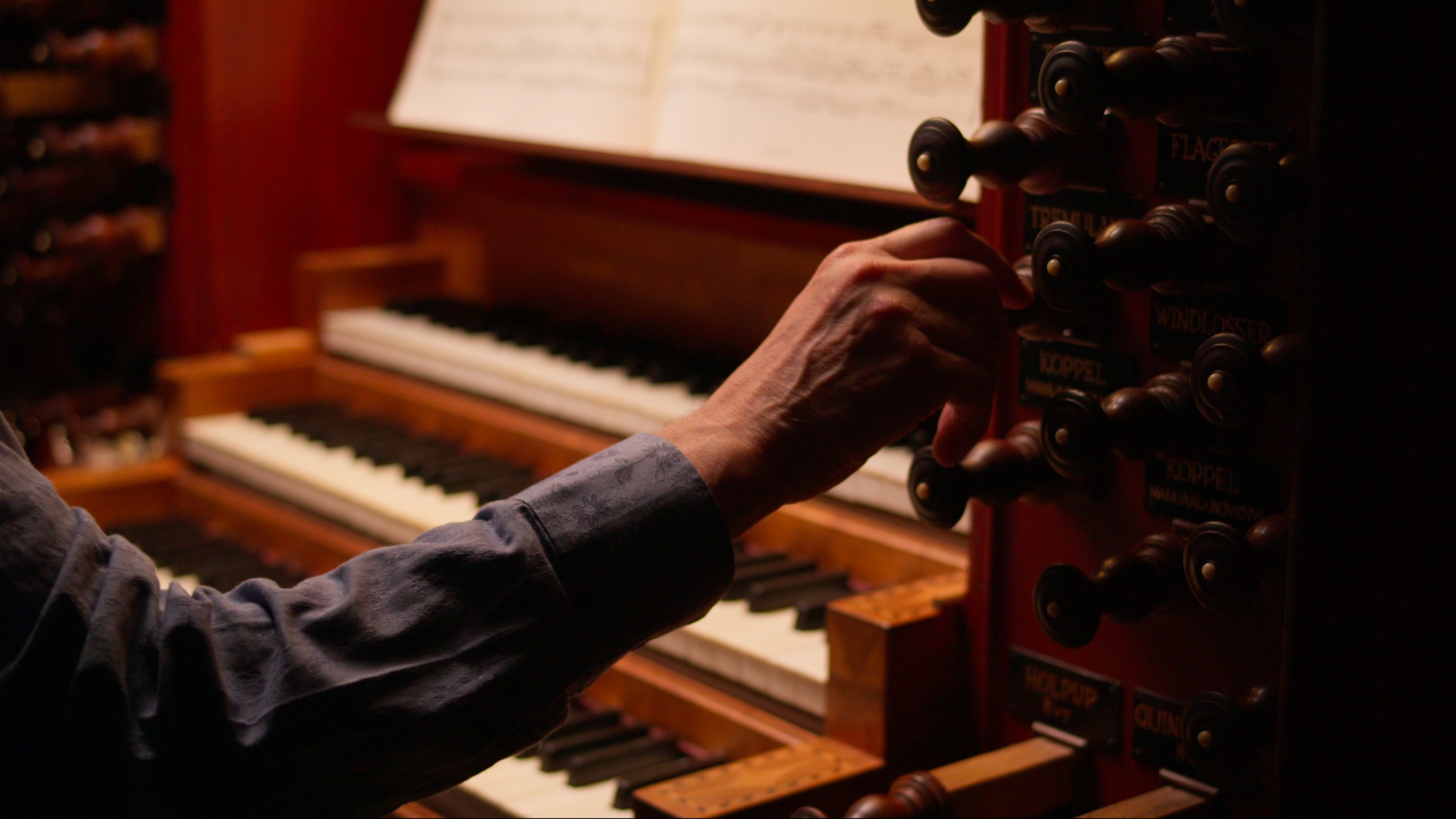
BWV 634 performed by Leo van Doeselaar
Walburgiskerk, Zutphen
Behind the music
Story
Story
Extra videos
Extra videos
Credits
Credits
Children’s song in canon
Bach saw the potential of an angelic chorale
The chorale melody chosen here by Bach feels almost like a children’s song. The lyrics by Tobias Clausnitzer are simple yet effective, as is the melody by Johann Rudolph Ahle. Bach and his congregation must have liked this chorale, as he made no fewer than four arrangements of it for organ and one for choir. As always in Bach’s case, they vary widely in character, yet you can hear an angelic purity in each version.
In BWV 634, a chorale arrangement for organ, Bach brings the melody to the fore. Although the piece sounds simple, it is cleverly constructed. Bach wrote a canon, in which the voices imitate one another. If you listen carefully, you can hear it straight away: the upper voice introduces the melody, and soon after a second voice enters with the melody four tones lower. Not every melody lends itself to this, but as a master of counterpoint Bach must have sensed the suitability of this theme. He was second to none at spotting the potential of this type of simple melody.
Orgelbüchlein, BWV 599-644
During his time as court organist at Weimar (1708-1714), Bach already started compiling his first collection of chorale arrangements and chorale preludes (compositions based on Lutheran hymns). They were intended to be used in church services, and the preludes were an introduction to congregational singing. According to the list of contents in Bach’s manuscript, it was supposed to have been a collection of 164 compositions, but in the end it did not exceed 46 (BWV 599-644). The order, combined with the limited length of the pieces, indicates that Bach was planning to compile a complete cycle of chorale arrangements. Later, in his period at Köthen, he gave the collection a title page, which reads: ‘Orgel-Büchlein, Worinne einem anfahenden Organisten Anleitung gegeben wird, auff allerhand Arth einen Choral durchzuführen…’ (‘Little organ book, in which a beginner organist is taught to arrange a chorale in all sorts of ways...’). So at the time, he intended the collection just as a teaching manual, maybe to present on his application in 1722 for the post of cantor at the Thomasschule in Leipzig, which was an important teaching position. The pupils must have had a hard time of it, as the preludes contain the complete range of baroque keyboard techniques in a nutshell.
Extra videos
Vocal texts
Original
Translation
Credits
-
- Release date
- 16 July 2026
-
- Recording date
- 27 May 2024
-
- Location
- Walburgiskerk, Zutphen
-
- Organ
- Leo van Doeselaar
-
- Instrument
- Henrick Bader, 1639/1643
-
- Director and editor
- Gijs Besseling
-
- Music recording
- Guido Tichelman, Pim van der Lee
-
- Music edit and mix
- Guido Tichelman
-
- Camera
- Danny Noordanus, Manon Hoskens, Remco van Leest
-
- Grip
- Wouter Visser
-
- Assistant music recording
- Marloes Biermans
-
- Producer
- Lisanne Marlou de Kok
Help us to complete All of Bach
There are still many recordings to be made before the whole of Bach’s oeuvre is online. And we can’t complete the task without the financial support of our patrons. Please help us to complete the musical heritage of Bach, by supporting us with a donation!